

Free visual inspection and a written scope of work before any mitigation begins - photos, moisture readings, and drying logs go in your claim file
The scope we write is the scope we bill. Anything new gets shown to you, in writing, before we touch it.






 Before
 After
After Before
 After
After Before
 After
AfterFast, Reliable Mold Remediation Across Franklin Park
Mold remediation in Franklin Park usually costs between $1,200 and $4,500 for a typical finished basement containment job, and we can have a Threshold Verified technician at your door within hours, not days. That matters here because Franklin Park sits directly alongside the Millstone River, and many homes carry mold problems that started years ago behind drywall that was cosmetically patched after Irene or Floyd. You call about a musty smell or a new water heater leak, and the real issue turns out to be a decade-old colony feeding on damp framing.
We’ve worked enough basements off Route 27 and through the subdivisions south of Bennetts Lane to know what Franklin Park homes hide. If you’re seeing black staining, smelling earthiness that won’t air out, or dealing with a finished basement that got wet and stayed wet, call (910) 613-6568. A live person answers, not a recording.
Why Marsh Water Damage Restoration Is Franklin Park’s Preferred Mold Remediation Company
Franklin Park homeowners keep calling us because we show up with a written scope before any work starts and a technician whose name and photo you already have. Our founder, Tobias Reyner, built the Threshold Verified standard so no one opens the door to a stranger. That resonates here, where people are often home alone with kids or aging parents and want to know exactly who’s coming through the front door.
Every Marsh technician in Franklin Park is background-checked, identity-verified, uniformed, and wearing a photo ID badge when they ring your bell. We’re credentialed through IICRC, RIA, and IFA, and we run commercial-grade equipment from Phoenix and Injectidry. The 365-Day Done Right Promise is printed on every work order: if the remediation isn’t right within a full year, we come back and make it right, at no charge. No arguments, no fine print.
We answer calls live around the clock. Mold doesn’t wait for business hours, and neighbors in Franklin Park shouldn’t have to leave a voicemail while spores move through their HVAC system.
Mold Removal Service in Franklin Park
Mold Removal Service in Franklin Park is for the visible stuff: the black staining on drywall, the fuzzy growth along baseboards, the colonies spreading across a rim joist. This is where we isolate the affected area with containment barriers, run HEPA-filtered air scrubbers, remove contaminated material, and apply antimicrobial treatment to the remaining structure. Most Franklin Park mold removal jobs run $800 to $2,500 depending on square footage and accessibility.
Containment and Source Removal
We set up negative air pressure, so spores don’t travel through the rest of your house while we work. Then we remove the contaminated drywall, insulation, or carpet and bag it for disposal. In Franklin Park’s finished basements, that usually means cutting out lower wall sections where moisture wicked up from the slab or from river flooding.
Surface Treatment and Air Scrubbing
After the source is gone, we treat the framing and surrounding materials with antimicrobial agents and keep HEPA air scrubbers running until airborne spore counts drop to normal background levels. This step keeps spores from re-colonizing any damp surface we didn’t remove.
Mold Remediation Services in Franklin Park
Mold Remediation Services in Franklin Park go deeper than removal because this township has a specific problem: homes flooded during Irene and Floyd often got cosmetic patches over framing that never fully dried. Full remediation means investigating behind walls, measuring moisture in studs and sill plates, and fixing the water source, not just wiping off the surface. A typical Franklin Park remediation with moisture mapping and structural drying runs $1,200 to $4,500, and complex behind-drywall cases near the Millstone River can reach $7,000+ when framing repairs are needed.
Moisture Mapping and Legacy Mold Detection
Before we touch a wall, we find out how far the water went. Thermal imaging and moisture meters tell us whether a basement wall that looks dry is actually holding 40% moisture behind the paint. In Franklin Park, that answer is often yes, because previous cosmetic repairs sealed damp framing inside.
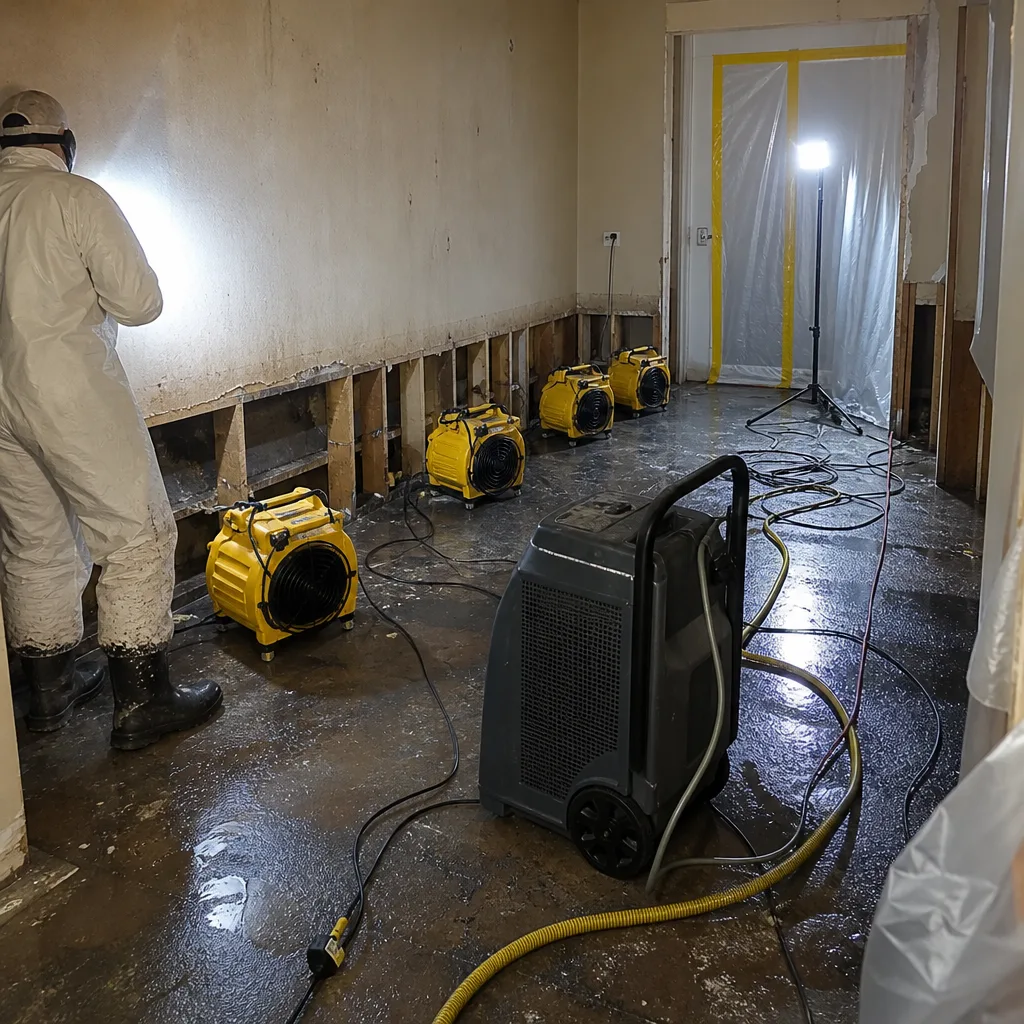
Structural Drying with Injectidry Wall Cavity Mats
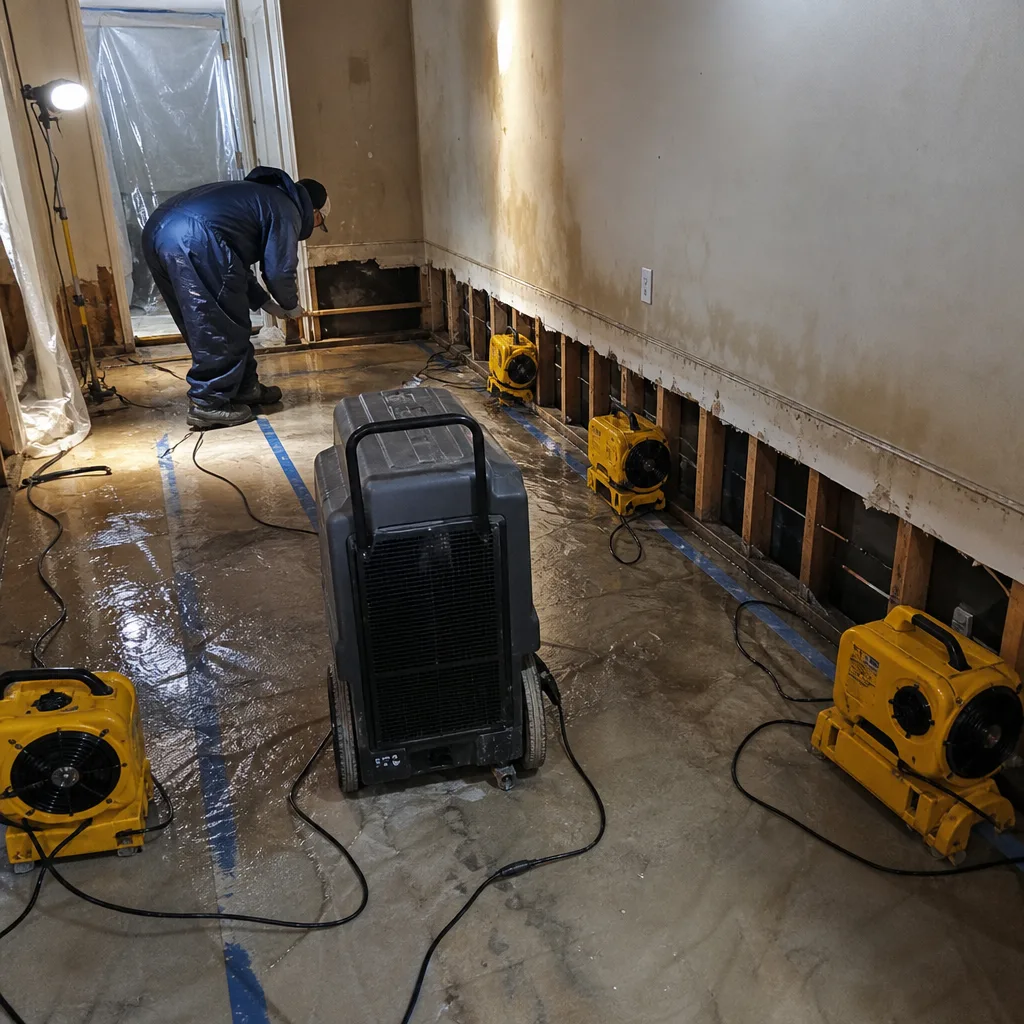
Once we open the wall, we dry the cavity properly. Injectidry mats push dry air through the void between studs, paired with Phoenix dehumidifiers pulling water out of the air. We log moisture readings daily until the structure hits dry standard, not just until the surface feels dry.
What happens when you call
- 1
A real person answersNo phone trees - you reach a local pro.
- 2
You get an upfront price rangeHonest numbers before anyone is dispatched.
- 3
A background-checked tech heads outLicensed & insured, dispatched right away.
- 4
You approve before work beginsNothing starts until you say go.
Trusted Brands We Service in Franklin Park
We stock and service equipment from the brands restoration pros actually run: Phoenix dehumidifiers for high-capacity drying, Injectidry systems for wall cavities that won’t dry on their own, and XPOWER air movers for fast evaporation. Because we maintain our own equipment and keep common parts on our trucks, we don’t lose days waiting on a rental house when a Franklin Park basement is sitting wet. That speed keeps mold from getting a second foothold.
Common Mold Remediation Problems We See in Franklin Park Homes
- Cosmetic repairs over flood-damaged framing: Homes along the Millstone River that flooded during Irene or Floyd often got re-finished drywall over wood that never fully dried, which means mold has been growing behind those walls for years and a “new” leak just exposes it.
- Finished basements hiding water heater failures: Franklin Park’s housing stock is largely 25 to 45 years old, and original water heaters and supply lines are failing in clusters. A Category 2 water loss in a finished basement soaks drywall, carpet pad, and insulation fast, creating ideal mold conditions within 48 hours.
- Foundation seepage after storm season: Even outside FEMA-designated flood zones, heavy nor’easter rain against a 30-year-old foundation finds cracks and cove joints. Slow seepage behind finished walls goes unnoticed until mold begins to smell.
- HVAC duct contamination: When mold colonizes a basement, spores get pulled into the return air system. Franklin Park homes with central air then spread spores through every bedroom before the homeowner realizes the basement is the source.
Pricing for Mold Remediation in Franklin Park, NJ
A small, contained mold removal job in Franklin Park, like a bathroom ceiling or a single basement wall section, typically runs $800 to $1,800. A full finished basement remediation with containment, source removal, HEPA air scrubbing, and structural drying generally lands between $2,500 and $4,500. Where legacy flood damage is involved and we’re opening walls to dry framing that’s been damp for over a decade, scope can reach $7,000 or more because structural repairs become necessary. You’ll get a written price before any work begins, not after demolition opens up the wall. Call (910) 613-6568 for a free estimate and a straight answer about what your specific Franklin Park basement needs.
We Also Serve Cities Near Franklin Park
Our Mold Remediation crews work throughout central Somerset and Middlesex counties, including Kendall Park, Dayton, Somerset, and Milltown. If you’re in a neighboring community and dealing with mold, water damage, or a flood, call us at (910) 613-6568. Dispatch and scheduling are coordinated from our New York City office, and crews serve Franklin Park locally.
Serving Franklin Park, NJ - Our Local Coverage Area
We’re based in the Franklin Park area and know this community well. Use the map below to see our service coverage - if you’re nearby, we can almost certainly help.
FAQs About Mold Remediation in Franklin Park
You don’t know without opening a wall or running moisture and thermal scans behind the finished surface. In Franklin Park specifically, homes that flooded during Irene often had drywall re-finished over framing that never dried, leaving mold that’s been active since 2011. Watch for musty odor that returns after cleaning, staining bleeding through paint, or baseboards that feel soft at the bottom edge. Call (910) 613-6568 and we’ll map the moisture before cutting anything open.
Mold colonization typically begins within 24 to 48 hours of a water heater leak in a finished basement, especially with Category 2 or 3 water that carries organic material. Franklin Park’s 25-to-45-year-old homes are at the age where original water heaters fail often, and by the time you notice the leak, the drywall and pad have usually been wet for days. Fast extraction and drying within that first 48-hour window is the difference between a cleanup and a remediation project.
Yes, FEMA flood zone maps along the Millstone River can affect what your insurer will approve for remediation, and in some cases the approved scope covers visible damage only. That leaves hidden mold behind walls, which is exactly the pattern we see on Franklin Park streets closest to the river. We document everything with photos and moisture readings so you have what an adjuster needs, and we coordinate directly with your insurance carrier.
Mold removal addresses the visible colonies you can see, while mold remediation addresses why the mold is there, how far the moisture went, and what has to change so it doesn’t return. In Franklin Park, that distinction matters more than most places because cosmetic post-flood repairs often hid the root cause. Remediation includes moisture mapping, source removal, structural drying, and verification that the structure is genuinely dry.
Because the Millstone River keeps flooding the same low-lying neighborhoods, and previous rounds of cosmetic repair left damp framing inside walls that becomes a mold reservoir. When a new storm pushes water back into those basements, the existing mold gets reactivated and spreads into the newly wet drywall. Full remediation requires addressing both the new water and the old, hidden colony. Call (910) 613-6568 and we’ll explain what that scope looks like for your street and your house.
What Full Mold Remediation Actually Looks Like in a Franklin Park Basement
Here’s the Franklin Park-specific reality most homeowners don’t discover until we start opening walls. On Hillcrest Avenue, our technician pulled baseboards after a homeowner reported a musty odor that wouldn’t go away. Behind the drywall, he found active mold colonies feeding on framing that had been left damp since Hurricane Irene and simply covered over. The prior “fix” had hidden the problem. We set containment, ran HEPA air scrubbers, applied antimicrobial treatment, and completed structural drying with Injectidry wall cavity mats paired with Phoenix dehumidifiers. Moisture readings were logged daily in our drying logs until the framing hit dry standard. The scope addressed both the new water intrusion and the legacy mold from 2011. That’s what full mold remediation in Franklin Park often requires, and it’s why we don’t quote a job until we’ve looked behind the surface. Our Mold Remediation in Franklin Park approach is built around this reality, not around pretending a wipe-down is a fix.
If you’re smelling mold, seeing staining, or dealing with a basement that got wet and won’t dry, don’t wait. The longer spores move through your HVAC system, the more areas of your Franklin Park home are affected. Call (910) 613-6568 for a free estimate. A live person answers. We’ll tell you what we think, what it will cost, and exactly who will be at your door. In writing, before any work starts.
Written by Tobias Reyner, Owner at Marsh Water Damage Restoration, serving Franklin Park through the Threshold Verified standard.