

Free visual inspection and a written scope of work before any mitigation begins - photos, moisture readings, and drying logs go in your claim file
The scope we write is the scope we bill. Anything new gets shown to you, in writing, before we touch it.






 Before
 After
After Before
 After
After Before
 After
AfterFast, Reliable Mold Remediation Across Pleasantville
Mold remediation in Pleasantville typically costs between $1,800 and $6,400 for a contained removal, with most village-center jobs landing around $2,900 to $4,200 depending on how far moisture has wicked through original masonry and plaster. That’s the honest range we quote before any work starts, because Pleasantville’s housing stock does not dry the way newer Westchester construction does. We serve the village, the neighborhoods off Bedford Road and Washington Avenue, and the streets around the Saw Mill River valley, and a live person answers when you call (910) 613-6568, 24 hours a day.
What matters most in Pleasantville is not just removing the mold you can see. It’s finding the moisture path that keeps feeding it, which in these older homes is usually lateral movement through fieldstone or poured-concrete foundations that standard thermal imaging never catches. Our crews probe the masonry itself. That’s the difference between a job that holds and a job that comes back in six months.
Why Marsh Water Damage Restoration Is Pleasantville’s Preferred Mold Remediation Company
Homeowners in Pleasantville call us because we treat the village’s older housing stock as its own category of work, not as a generic zip code. A 1920s fieldstone basement on Manville Road behaves nothing like a 1990s finished basement in a development off Route 141. We know what we’re walking into before the first moisture reading, because our technicians are trained on plaster-over-lath, old-growth framing, and masonry that wicks water sideways for days after the visible leak is gone.
Every technician who arrives at your door in Pleasantville has been background-checked and identity-verified under the Threshold Verified standard. We send their name and photo before they knock, and they show a photo ID badge at the door, every time. That matters if you’re home alone with kids, or if you’re an older homeowner who’s already been through enough with a flooded basement. You’ll know exactly who’s coming.
Our team holds credentials from IICRC, RIA, and IFA, and we run Dri-Eaz and Injectidry drying systems, Phoenix dehumidifiers, and B-Air air movers. Since 2005, the Marsh name has meant a written price before any work begins and a written guarantee on every repair, stamped on the work order. In Pleasantville, that guarantee is not a slogan. It’s the 365-Day Done Right Promise, and it comes with a free second visit if the repair fails within a full year.
Mold Removal Service in Pleasantville
Mold Removal Service in Pleasantville means physically removing contaminated material from homes where mold has colonized plaster, old timber, or foundation masonry, and where surface cleaning alone won’t resolve the problem. We see this most often in village-center basements after a Nor’easter or a January ice-dam melt, when water from a steep slate or cedar roof tracks behind exterior walls and saturates plaster-and-lath cavities. Removal involves containment, HEPA air scrubbing, cutting out or soda-blasting affected plaster, treating framing with antimicrobials, and hauling contaminated material off-site. Most village-center mold removal jobs involving a basement wall and one adjoining room run $2,900 to $4,400.
What Removal Actually Involves Here
In Pleasantville’s pre-war homes, mold removal almost always starts with cavity inspection, because water travels through plaster and lath in ways drywall never does. We open small inspection ports behind baseboards and along foundation sills to see how far growth has spread before we quote the cut line. That prevents a surprise mid-job scope change, and it means our written price reflects actual conditions in your home, not a guess from the driveway.
When Surface Cleaning Is Not Enough
If mold is growing into plaster, settled between lath strips, or rooted in old timber, cleaning the surface leaves the colony alive underneath. In Pleasantville, where original plaster keys into lath over 100-year-old studs, this is exactly the failure that causes repeat growth in the same basement corner. We remove the material to solid substrate, treat the cavity, and document moisture readings each day until the structure is genuinely dry.
Mold Remediation Services in Pleasantville
Mold Remediation Services in Pleasantville go a step beyond removal: we identify and stop the moisture pathway that let mold establish in the first place, then restore the home to a condition where mold cannot immediately re-colonize. That means tracing how water entered, probing fieldstone foundations for lateral wicking, installing drying systems sized for plaster and masonry, and rebuilding with materials that dry properly. A full remediation project on a Pleasantville basement with lateral foundation moisture typically runs $4,200 to $6,400. A smaller contained job, like a bathroom ceiling from an ice dam, usually lands around $1,800 to $2,600.
The Foundation Piece Most Companies Skip
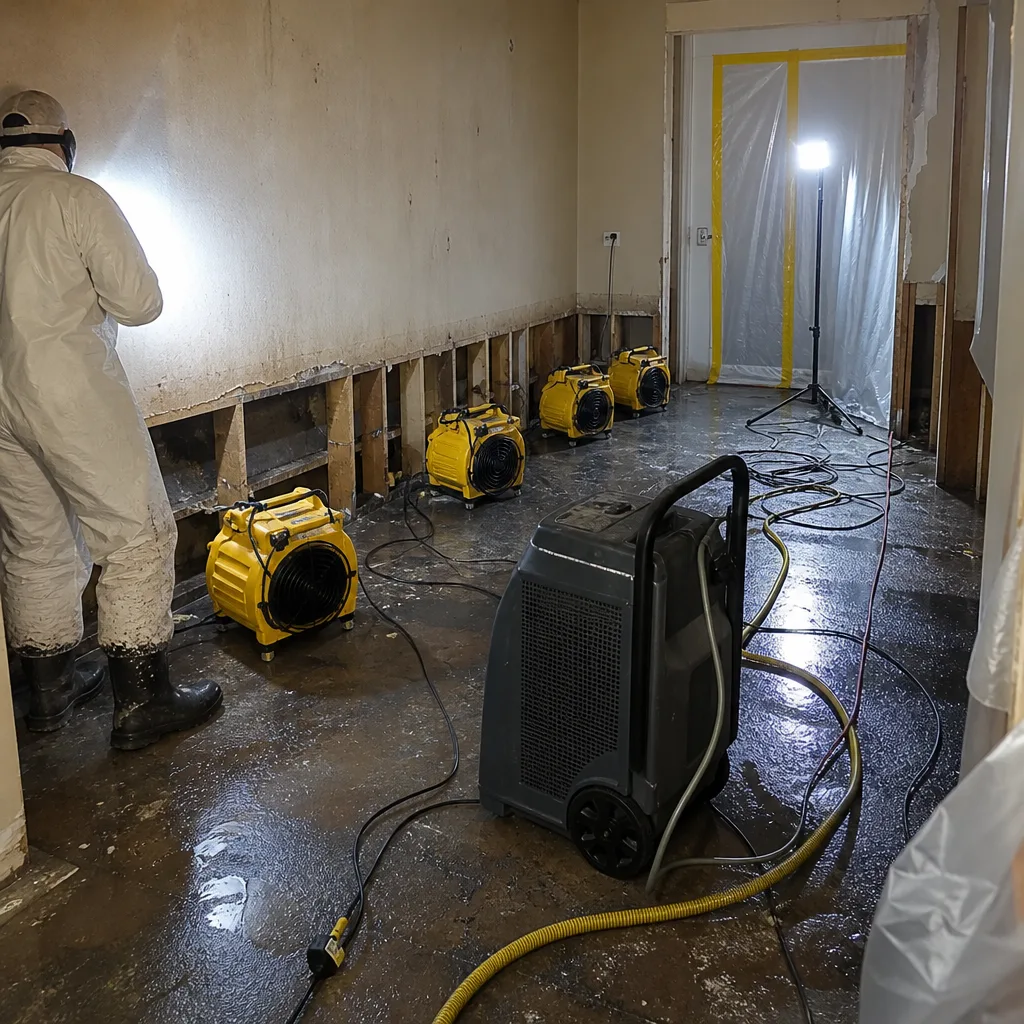
Here’s what we find in Pleasantville that we rarely see in newer Westchester developments: water moving sideways through fieldstone and poured-concrete foundations, sometimes four or five feet beyond the visible stain. A thermal camera reads that masonry as dry because the surface has not warmed or cooled enough to register. Our techs carry moisture probes designed for masonry and we take readings directly in the stone at multiple depths. If we do not do that, the remediation fails and the mold returns, which is exactly what local building inspectors are starting to flag during post-restoration permits.
What Happens Before Rebuild
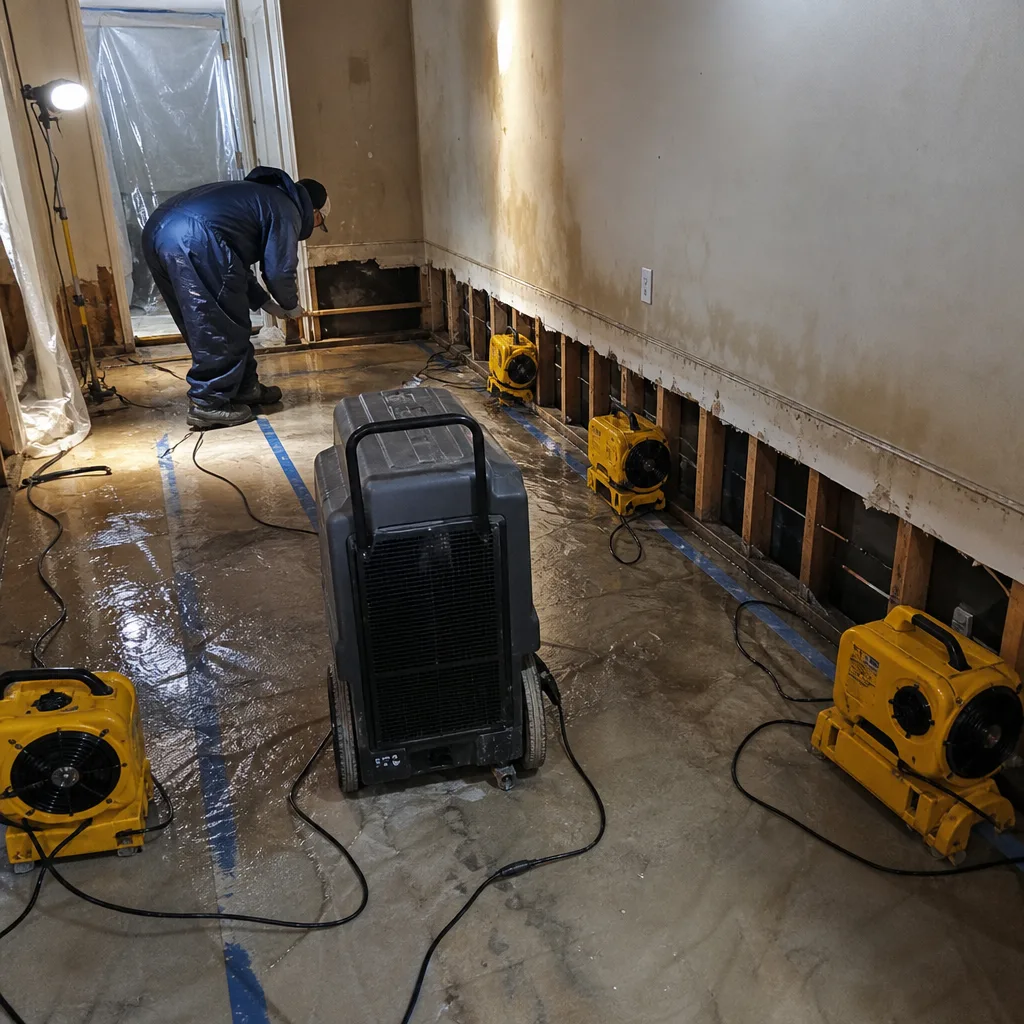
We do not close a Pleasantville remediation job until the moisture data says it’s dry. On these older homes that can mean running Injectidry systems and Dri-Eaz dehumidifiers for several days longer than a typical modern-home timeline. The plaster holds moisture stubbornly, and the framing behind it holds even more. We log readings daily, show you the trend, and only then sign off on rebuild.
What happens when you call
- 1
A real person answersNo phone trees - you reach a local pro.
- 2
You get an upfront price rangeHonest numbers before anyone is dispatched.
- 3
A background-checked tech heads outLicensed & insured, dispatched right away.
- 4
You approve before work beginsNothing starts until you say go.
Trusted Brands We Service in Pleasantville
We run the same drying and air-movement equipment in Pleasantville basements that large commercial restoration projects use, because these old homes need it. Our crews operate Phoenix dehumidifiers, XPOWER air movers, and Injectidry drying systems, calibrated for the dense plaster and masonry we encounter throughout the village. We keep spare parts and consumables on hand for fast turnaround on Pleasantville jobs, which means less waiting when your basement is already open and the clock is running.
Common Mold Remediation Problems We See in Pleasantville Homes
- Lateral wicking through fieldstone foundations. Water from storm runoff or snowmelt enters the stone and travels sideways, far from the original leak. We probe the masonry directly because thermal imaging alone misses this, which is why mold returns in homes where a previous contractor only treated the visible wall.
- Ice-dam meltwater behind plaster walls. Pleasantville’s steep older roofs with original cedar or slate sheathing generate ice dams from January through March. Meltwater runs behind exterior walls, soaks plaster-and-lath, and creates mold inside wall cavities without leaving a visible ceiling stain for weeks.
- Applying modern drying timelines to pre-war construction. Contractors who treat a 1920s plaster wall like a 1995 drywall wall close the job too early. Old-growth timber and thick plaster release moisture over days, not hours, and a moisture reading taken too soon makes the entire remediation unreliable.
- Underclassifying storm water that has crossed old framing. Water from a roof leak or foundation seepage that has run through 100-year-old framing and masonry is not clean Category 1 water. Treating it that way leaves contaminated material in the wall, and the odor and mold growth come back within months.
Pricing for Mold Remediation in Pleasantville, NY
Mold remediation in Pleasantville breaks down into a few honest ranges. A single-room mold removal, like a bathroom ceiling or a closet from a roof leak, runs $1,800 to $2,600. A basement remediation involving containment, removal of affected plaster, antimicrobial treatment, and drying runs $2,900 to $4,400. A full foundation-focused job with lateral wicking, multiple days of Injectidry drying, and rebuild starts at $4,200 and can reach $6,400 when the moisture has traveled far and affected multiple rooms. The variables are square footage, how deep the water moved into masonry, and whether we need to remove plaster or can treat it in place. We’ll give you a written price before any work starts, and that price will not balloon once demo begins. Call (910) 613-6568 for a free estimate on your Pleasantville home.
We Also Serve Cities Near Pleasantville
Our Mold Remediation team also works throughout the surrounding Westchester communities. We regularly handle jobs in Thornwood, Chappaqua, Briarcliff Manor, and Valhalla, where similar foundation and older-home conditions show up. If you’re in Pleasantville or just outside the village, the same written-price, written-guarantee standard applies.
Serving Pleasantville, NY - Our Local Coverage Area
We’re based in the Pleasantville area and know this community well. Use the map below to see our service coverage - if you’re nearby, we can almost certainly help.
FAQs About Mold Remediation in Pleasantville
Because the original plaster-and-lath walls and fieldstone foundations hold moisture far longer than modern drywall and poured-concrete with dampproofing. When a storm drives water into a Pleasantville foundation or behind an exterior wall, the material itself acts like a sponge, and mold can establish within 48 to 72 hours in the dark, cool cavities. Call (910) 613-6568 the day you see water, not the day you see mold.
No. Water that has run across a roof, through a gutter, down an exterior wall, or through a fieldstone foundation has picked up soil, animal waste, and organic matter along the way. Once it crosses old framing and masonry, it must be treated as contaminated, which means affected porous materials need removal, not just drying. We classify water correctly before we build a remediation plan.
We probe the masonry directly with moisture meters designed for stone and concrete, not just a thermal camera pointed at the wall. Thermal imaging reads surface temperature, and old stone often hides moisture that the camera cannot see. We take readings at multiple depths and log them daily until the numbers stabilize, and we show you those readings before we close the job.
Because the water source was never fully dried. In Pleasantville, that usually means lateral wicking through a fieldstone or old poured-concrete foundation, which carries moisture several feet beyond the visible stain. If a previous contractor treated only the stained area and relied on thermal imaging, the hidden moisture remained, and the mold re-colonized. We find and dry the source before we treat the growth.
Sometimes. If the mold is surface-level on painted plaster and the underlying masonry readings are stable, we can HEPA-vac, sand, and apply antimicrobial treatment without removing the plaster. But if growth has penetrated behind the lath or into the framing, partial removal is usually necessary. We’ll show you what’s behind the inspection port before we cut anything, so you’ll know exactly why and where.
If you have water or mold in your Pleasantville home, call (910) 613-6568. A live person answers, we’ll give you a written price before any work starts, and the technician who shows up will be someone whose name and photo you already have.
Written by Tobias Reyner, Owner at Marsh Water Damage Restoration, serving Pleasantville since 2005.