
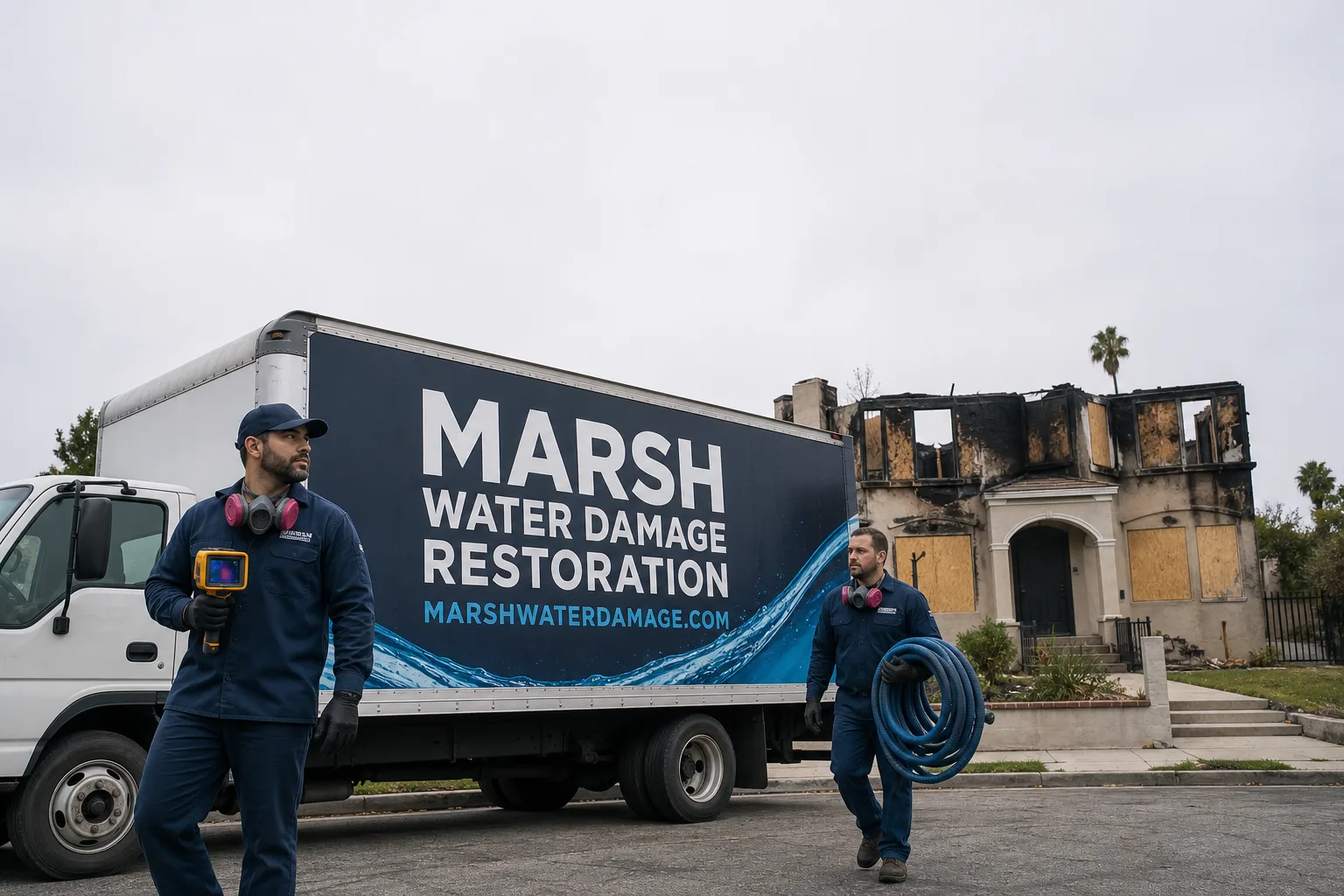
Free visual inspection and a written scope of work before any mitigation begins - photos, moisture readings, and drying logs go in your claim file
The scope we write is the scope we bill. Anything new gets shown to you, in writing, before we touch it.






 Before
 After
After Before
 After
After Before
 After
AfterFast, Reliable Storm Damage Restoration Across Coronado
Storm damage in Coronado hits differently than it does across the bay. Wind-driven rain off the Pacific, salt-saturated air, and only two ways on or off the island mean a flooded house here needs a crew that understands the geography, not just the water. We respond to Coronado homes quickly, with drying equipment and technicians who know what a 1900s wood-frame near Orange Avenue holds onto after a storm. If water is inside your home right now, call (910) 613-6568 and a live person answers, 24 hours a day.
Why Marsh Water Damage Restoration Is Coronado’s Preferred Storm Damage Restoration Company
Coronado homeowners call us because we treat the island’s older housing stock as the defining factor in every storm loss. A home in Coronado Village built before 1920 does not dry like a stucco track house in National City. We know that before we unload equipment. Our Storm Damage Restoration team has worked through wind-driven rain events in the historic core, mid-century homes along the Glorietta Bay side, and newer construction near the Silver Strand. Every call to Coronado starts with the same question: what kind of framing and sheathing are we dealing with, and how long has salt air been working on it.
We run every Coronado job under the Threshold Verified standard. That means the technician who shows up at your door in Coronado was background-checked, identity-verified, and sent to you by name and photo before they ever crossed the bridge. They show a photo ID badge at the door. Tobias Reyner, our owner, built this protocol because a flooded house is already stressful without a stranger standing in the doorway. That is the risk we remove first.
Flooded House in Coronado
Flooded House in Coronado usually means water has already moved through the first floor and into wall cavities, and with the island’s year-round marine humidity, mold can establish faster than on the mainland. When a coastal storm pushes surge water or wind-driven rain into a Coronado home, we move on two fronts at once: extraction and moisture mapping. Extraction pulls the standing water. Moisture mapping uses meters and probes to find where water has wicked into framing, under flooring, and behind baseboards. In Coronado’s legacy homes, that hidden moisture is the real problem.
Extraction and Stabilization
We start with truck-mounted extraction and commercial air movers from XPOWER and Phoenix. The goal in the first hours is to stop water from moving deeper into porous materials. In Coronado, this matters more because the existing indoor humidity is already higher than mainland San Diego. Leave wall cavities wet for 48 hours on this island and you are often past the point of simple drying.
Drying the Structure, Not Just the Surface
Once the standing water is out, we set drying chambers and take psychrometric readings, which means we measure the moisture in the air and in the materials themselves, every day until the numbers say the structure is dry. A flooded Coronado house typically runs $3,500 to $8,000 for full extraction, drying, and monitoring depending on square footage and how far water traveled.
Flood Restoration in Coronado
Flood Restoration in Coronado picks up where emergency extraction ends. This is the phase where materials get repaired, replaced, or restored to their pre-loss condition, and on this island, that usually means working with lath-and-plaster, original wood flooring, and hardware that is no longer manufactured. In a Victorian-era home near the Hotel del Coronado, restoration is not a drywall replacement job. It is matching plaster thickness, preserving original trim, and sometimes sourcing salvaged materials.
Repairing What Can Be Saved
Our crews are trained to restore before they replace. Hardwood floors in mid-century Coronado homes can often be dried and refinished rather than torn out. Plaster walls that have not crumbled can be stabilized, patched, and repainted. The call on what can be saved comes from moisture readings and material integrity, not convenience.
Replacement When Drying Is Not Enough
Some materials cannot be dried. Pressed-wood cabinetry, saturated insulation, and drywall that has wicked water more than a few inches typically come out. Flood restoration in Coronado commonly runs $6,000 to $15,000 depending on how many rooms were affected and what finishes need to match. We give a written price before any demolition starts, and we never expand scope without your written approval.
Trusted Brands We Service in Coronado
We run drying equipment from brands Coronado homeowners can verify: Dri-Eaz dehumidifiers, Phoenix and XPOWER air movers, and B-Air and Injectidry systems for floor and cavity drying. These are the same tools used on commercial losses, applied to residential jobs in Coronado. Because our San Diego office stocks parts and replacement units, we do not lose a drying day waiting on equipment when a unit fails mid-job. That matters on an island where every hour of drying before mold colonizes counts.
Common Storm Damage Restoration Problems We See in Coronado Homes
- Salt-air amplified moisture retention. The island’s marine layer keeps indoor relative humidity elevated year-round. After a storm, that means materials dry slower, and mold windows open sooner, even when the weather outside looks clear.
- Legacy lath-and-plaster confusion. Technicians trained on modern drywall miss water trapped inside plaster assemblies. In Coronado Village’s older homes, we probe wall cavities because the surface can read dry while the framing behind it is still soaked.
- Access delays during peak storm events. When the Coronado Bridge or the Silver Strand is restricted, equipment mobilization stalls. A generic restoration crew might arrive late and lose the mold-prevention window entirely.
- Older electrical and HVAC corrosion. Salt-air humidity accelerates corrosion on panels, coils, and fasteners. Storm water intrusion often reveals electrical systems that were already compromised by years of marine exposure.
Pricing for Storm Damage Restoration in Coronado, CA
We Also Serve Cities Near Coronado
Our storm damage restoration coverage extends across the bay and down the Silver Strand. We work routinely in Coronado and neighboring San Diego, National City, Chula Vista, and Imperial Beach. When access to Coronado is blocked, our crews can stage from multiple sides of the bay and move in as soon as routes reopen.
Serving Coronado, CA - Our Local Coverage Area
We’re based in the Coronado area and know this community well. Use the map below to see our service coverage - if you’re nearby, we can almost certainly help.
FAQs About Storm Damage Restoration in Coronado
Coronado’s marine humidity keeps indoor moisture levels higher than mainland San Diego even when it has not rained, which means materials dry slower and mold can establish within 24 to 48 hours. Drying logs in Coronado must account for ongoing marine moisture, so we typically run dehumidifiers longer and take more frequent psychrometric readings than we would on an inland job. The salt in the air also accelerates corrosion on exposed metal during the drying window, so we protect and inspect HVAC components and fasteners during restoration. Call (910) 613-6568 and we will walk you through what your specific home needs.
We monitor access conditions and stage equipment accordingly. Because we serve Coronado through our San Diego-based dispatch, we can position crews and drying units on the appropriate side of the bay when a storm is forecast. If both routes are restricted, our priority is getting containment set up as soon as access opens, and we will tell you honestly what that timeline looks like rather than promising a truck that cannot physically reach you. That is the reality of an island city, and we plan for it.
Yes. Lath-and-plaster holds moisture differently than drywall, and the original wood framing in Coronado’s Victorian-era and early 20th-century homes has absorbed decades of salt-air humidity. We use moisture mapping inside wall cavities to find hidden water, and we often extend structural drying by 48 hours or more on these homes. Plaster that is still intact can usually be stabilized and patched rather than removed, but the decision depends on moisture readings, not appearance.
We base the call on moisture content readings, material type, and how long the material has been wet. Solid hardwood, framing lumber, and intact plaster can often be dried successfully. Particleboard, saturated insulation, and drywall that has wicked water more than a few inches usually cannot be saved. In Coronado, where mold develops faster due to year-round humidity, we lean toward removal when material has been wet beyond 48 hours. We show you the readings and explain the recommendation before anything is torn out.
We run equipment from Dri-Eaz, Phoenix, XPOWER, B-Air, and Injectidry, and our technicians hold credentials through the IICRC, RIA, and IFA. That equipment and training standard is the same applied to large commercial losses, and we bring it to every residential job in Coronado. Every technician is also Threshold Verified: background-checked, identity-verified, and sent to you by name and photo before the visit. Call (910) 613-6568 for a free estimate.
If storm water has gotten into your Coronado home, call (910) 613-6568 now. A live person answers, we tell you exactly who is coming, and we give you a written price before any work starts.
Written by Tobias Reyner, Owner at Marsh Water Damage Restoration, serving Coronado residents through the Threshold Group family of restoration companies since 2005.