
RIA Water Damage Restoration in Los Angeles: A Homeowner’s Guide
When a Los Angeles water damage contractor says they “follow industry standards,” they’re almost certainly referring to the RIA S500 standard, a 200-page technical document that governs exactly how wet materials should be dried, in what sequence, and verified by what measurements. Most homeowners have never heard of it. Here’s the short version, and why it matters for your specific job.
If you’ve got water where it shouldn’t be right now, skip the reading and call (910) 613-6568. A live person answers 24/7, and we’ll walk you through the first steps before help arrives.
Key Takeaways
- The RIA S500 standard classifies water damage by contamination level: clean, grey, or black water.
- Drying goals are measured in precise moisture content percentages, not by whether the surface “feels dry.”
- A drying log is your proof that the job was done right, and any contractor following the standard should provide one.
- Los Angeles warm temperatures shorten the drying window before mold becomes a real risk, making standard-compliant speed a necessity, not a luxury.
What the RIA S500 Standard Actually Governs
The Restoration Industry Association publishes the S500 Standard and Reference Guide for Professional Water Damage Restoration. It’s the document that defines what a competent water damage job looks like, from the moment water is discovered to the final moisture reading. Think of it as the playbook every serious restoration company works from.
In plain English, the S500 covers three things that matter to you as a homeowner in Los Angeles.
First, it classifies water by contamination level. Category 1 is clean water from a supply line or faucet. Category 2 is grey water, meaning it carries some contaminants, like washing machine discharge. Category 3 is black water, which contains sewage, flood water from outside, or anything that carries pathogens. The category dictates what gets removed, what gets cleaned, and what gets replaced. A contractor who treats a Category 3 sewage backup like a Category 1 pipe leak is putting your family’s health at risk.
Second, the standard sets drying goals based on moisture content percentages, not appearances. A wall can feel dry to the touch and still hold enough moisture to feed mold growth behind the baseboard. The S500 specifies target moisture content readings for different materials, like drywall, hardwood, and concrete, and requires that those targets be verified with moisture meters before the job is closed out.
Third, it requires documentation. A proper drying log records the initial moisture readings, the equipment placed, the daily readings taken during drying, and the final readings proving the structure met the drying goals. That log is your receipt for a job done correctly.
The Classification System: Why Miscounting Your Job Costs You
The S500 standard also assigns a class to each water loss, based on how much water was absorbed and how fast it will evaporate. This classification drives the entire drying plan, and getting it wrong is one of the most common ways homeowners end up with a moisture problem that never really goes away.
Class 1 is the smallest loss: a small area, low absorption, maybe a corner of a room where water sat briefly. Class 2 is a larger area with porous materials like carpet and drywall soaked. Class 3 involves water coming from overhead, soaking walls, ceilings, insulation, and flooring throughout the space. Class 4 is specialty drying: deep water saturation in materials that hold water tightly, like concrete, hardwood, or plaster. Class 4 jobs require low-humidity dehumidification and often specialty drying systems to pull moisture from materials that don’t give it up easily.
Here’s where it gets real for Los Angeles homeowners. Misclassifying a job saves the contractor time and equipment costs. A Class 4 hardwood floor in a Hancock Park dining room, for example, might get treated like a Class 2 carpet loss, with a few air movers and a dehumidifier pointed at the general area. The surface dries. The subfloor doesn’t. Six months later, the boards cup, the floor buckles, and the smell of stale water rises from the crawl space. By then the drying contractor is long gone, and you’re paying for a full replacement out of pocket because the moisture problem was never properly resolved.
We pulled a garage in Atwater Village last month where exactly this happened. A previous company had “dried” a Class 4 concrete slab with a single fan and an open door. The slab read 22% moisture when we arrived. It should have been below 14% before anyone signed off. The homeowner thought the job was finished because the floor felt dry. The moisture meter told a different story.
Psychrometric Drying in One Plain Sentence
Psychrometric drying uses the relationship between temperature, humidity, and airflow to pull moisture out of building materials faster than air movers alone ever could.
That’s the plain version. The technical version involves vapor pressure, grain depression, and evaporation rate calculations. What it means for you is simpler: a contractor who understands psychrometrics will dry your home faster and more completely than one who just points fans at wet walls and hopes for the best.
Why does this matter in Los Angeles specifically? Because warm ambient temperatures accelerate mold growth. Mold needs moisture, organic material, and the right temperature to establish itself. In a city where interior temperatures routinely sit in the 70s and 80s year-round, mold can begin colonizing wet drywall within 24 to 48 hours of the water event. In cooler climates, the window is longer. Here, standard-compliant drying speed isn’t a premium feature. It’s the difference between a water damage job and a mold remediation job.
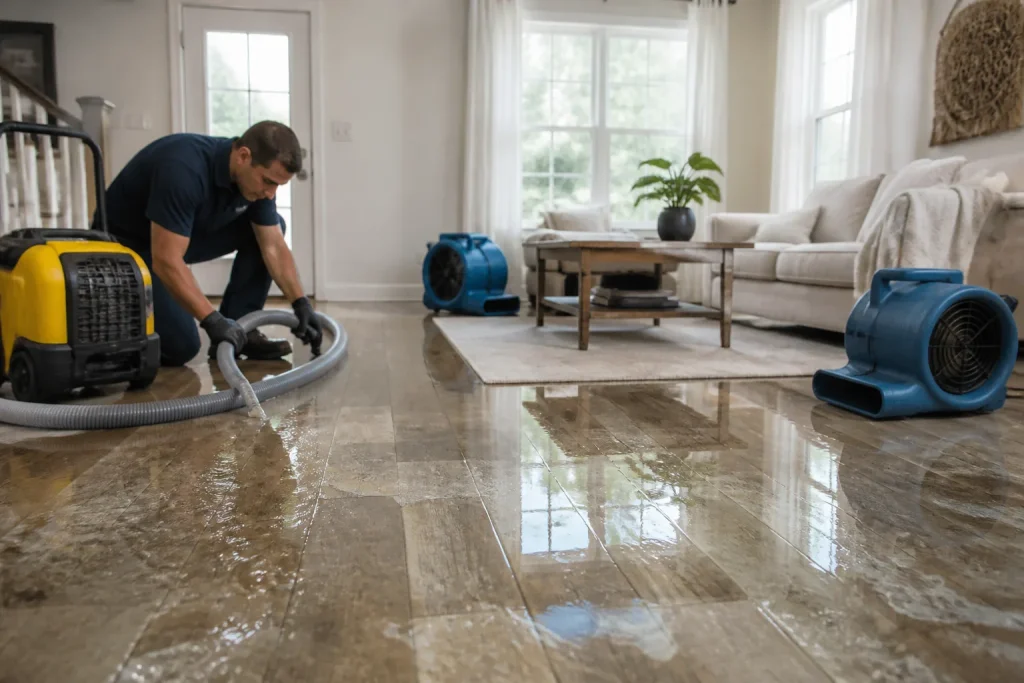
We run Phoenix and Dri-Eaz dehumidifiers and air movers on residential jobs in Los Angeles because they’re engineered for precisely this kind of controlled drying. The equipment measures and responds to the air conditions in real time, which gets materials to their target moisture content faster and keeps them there until the job is verified dry.
Three Questions Every Los Angeles Homeowner Should Ask
Before you sign anything with a water damage company in Los Angeles, ask these three questions. They come straight from the RIA S500 standard, and the answers will tell you whether you’re hiring a restoration professional or a guy with a wet vac who watched a few YouTube videos.
- What moisture class is this job? A good answer names the class and explains why. “This is a Class 2 loss: water soaked the carpet and affected the drywall up to 14 inches in three rooms, so we’ll need extraction, carpet pad replacement, and structural drying in the adjacent walls.” A bad answer is “We’ll just dry it out, don’t worry.”
- What are your target moisture content readings for this material? A competent contractor will cite specific numbers, like 12% for hardwood or below 15% for structural lumber. If they can’t tell you what number they’re drying toward, they don’t have a drying goal, which means they don’t have a drying plan.
- Will I receive a drying log? The right answer is yes, with daily readings, equipment placement, and final verification numbers, delivered in writing. The wrong answer is “We’ll keep an eye on it.”
If the contractor answers all three cleanly, you’re likely in good hands. If they wave off any of them, keep looking.
How Marsh Water Damage Restoration Applies These Standards in Los Angeles
We built our process around the RIA S500 standard because it removes exactly the kind of uncertainty that makes water damage stressful. Every job starts with a written classification and scope, a drying plan with target moisture readings for the materials involved, and a commitment to hand you the documentation showing the work was done right.
Our technicians are credentialed through IICRC, RIA, and IFA, the organizations that define and teach these standards. The equipment we run, from Dri-Eaz and Phoenix dehumidifiers to XPOWER air movers, is the same gear used on large commercial losses, applied to your living room.
And because we know that opening your door to a restoration crew is its own kind of stress, every Marsh technician is background-checked, identity-verified, and sent to you by name and photo before the visit. When they arrive, they show a photo ID badge. Every time. It’s called the Threshold Verified standard, and it’s non-negotiable on every job we do in Los Angeles.
We’ve been doing this since 2005, and the two things we hear most from Los Angeles homeowners are “I didn’t know who else to call” and “I wasn’t sure who I was letting in.” The S500 standard answers the first. The Threshold Verified standard answers the second.
When to Call a Pro
Water damage is not a weekend project. If water has touched drywall, flooring, or any enclosed cavity, you need professional-grade extraction and controlled drying, not box fans from the garage. If the water came from a sewage line, a toilet overflow, or storm flooding, you need professional-grade contaminant handling for your own safety. If you can see water staining spreading or smell must and it’s been more than 48 hours, mold is already a real possibility and you should have the area assessed immediately.
The safest call is the one you make early. We answer the phone at (910) 613-6568 at any hour, and we’ll tell you over the phone what you can do in the next 30 minutes to slow the damage while help is on the way.
Related services in Los Angeles: Water Damage Restoration in Los Angeles, Mold Remediation in Los Angeles, and Storm Damage Restoration in Los Angeles. For an overview of all our work, visit the Marsh Water Damage Restoration home page.
The Bottom Line
The RIA S500 standard exists so that water damage restoration is a verifiable science, not a guess. It classifies the water, sets the drying goals, and requires the documentation to prove those goals were met. Any Los Angeles contractor who follows it will be able to tell you what class your job is, what moisture readings they’re targeting, and when you’ll receive your drying log. If they can’t answer those three questions, you haven’t found the right contractor.
Most residential water extractions in Los Angeles run between $1,200 and $4,500 before drying equipment costs, depending on the class of the loss, the affected square footage, and whether contaminated water is involved. Your insurance may cover much of it, and we work directly with adjusters and provide photo-documented assessments to support your claim. Every job we do receives a written price before any work begins, and every repair carries our 365-Day Done Right Promise: if it’s not right within a full year, we make it right, with a free second visit included automatically.
If you’re in Los Angeles and need water damage help, Marsh Water Damage Restoration offers free estimates. Call (910) 613-6568 and a live person will answer, day or night.
Frequently Asked Questions
The RIA S500 is the Restoration Industry Association’s Standard and Reference Guide for Professional Water Damage Restoration. It defines how water damage should be classified by contamination level, how drying goals should be measured in moisture content percentages, and what documentation is required to prove the structure is genuinely dry. It’s the benchmark professional restoration companies in Los Angeles use to plan and verify their work.
In Los Angeles, where ambient temperatures are consistently warm, mold can begin colonizing wet organic materials within 24 to 48 hours of a water event. That’s a shorter window than in cooler climates, which is why standard-compliant drying speed matters so much here. The faster the structure is dried to its target moisture content, the less chance mold has to establish itself.
It depends on your policy and the source of the water. Sudden and accidental events, like a burst pipe or storm damage, are often covered, while gradual issues like a slow leak you didn’t address may fall under maintenance exclusions. We provide photo-documented assessments and work directly with your adjuster to support your claim. Call (910) 613-6568 and we’ll walk you through what to expect from your specific situation.
The only way to know is with moisture meter readings, not the feel of the surface. A professional drying job ends when materials reach their target moisture content specified for that material type, as defined by the RIA S500 standard. Ask your contractor for the final moisture readings and a drying log that documents the daily progress and final verification. If they can’t provide that, be skeptical of the job.
Written by Tobias Reyner, Owner at Marsh Water Damage Restoration, serving Los Angeles since 2005.
Need Damage Restoration Help?
Call Marsh Water Damage Restoration - licensed & insured, here with fast after-hours help in Los Angeles.
(910) 613-6568