
Emergency Water Damage Restoration Near Me: What Los Angeles Homeowners Should Do First
If water is spreading through your Los Angeles home right now, here’s the short version: cut the power to affected rooms at the breaker, stop the water at its source, photograph everything before you move anything, and call a restoration company that can tell you who is showing up before they knock. Most water damage calls we receive come in 6 to 18 hours after the actual event, not because homeowners panicked, but because they froze in place unsure what was safe to touch. That hesitation window is exactly when mold colonies begin forming on drywall and padding in LA’s warm climate. If you’d rather not handle the first steps yourself, call us at (910) 613-6568 and a live person will walk you through what to do until our team arrives.
Key Takeaways
- Your first 20 minutes determine whether you’re looking at a $3,000 extraction job or a $15,000 rebuild.
- Photograph everything before moving anything. Timestamped pre-mitigation photos protect your insurance claim.
- Know your water category. Category 1 is safe to touch. Category 3 is not.
- Los Angeles slab foundations and stucco exteriors change the drying timeline compared to wood-frame homes.
- Ask any restoration company who is actually coming to your door before you open it.
The First 20 Minutes: A Room-by-Room Sequence
We’ve handled thousands of extractions across Los Angeles, from Echo Park bungalows to Northridge ranch houses, and the pattern is always the same: the homeowners who act in the first 20 minutes save themselves thousands. Here’s the sequence we recommend, written for real LA homes with real LA construction.
Step one: Stop the water source. If a supply line burst under a sink, turn the angle stop clockwise. If it’s a water heater, cut the cold-water inlet valve on top of the tank. If you can’t find the shutoff for a specific fixture, turn off the main at the street meter. In Los Angeles, most homes have a main shutoff near the sidewalk in a concrete box with a meter. A crescent wrench will turn it. This single action stops the meter from running and the damage from compounding.
Step two: Cut power to the affected rooms only. This is where bad advice circulates. You want to cut breakers feeding outlets in the wet area, not the whole panel. Why? If you have a moisture-sensing alarm or a sump pump on a dedicated circuit, cutting the wrong breaker disables the one thing still working to keep water out. In LA homes with slab foundations, groundwater intrusion is a separate threat from pipe bursts. Keep the sump running if you have one. Labeled panels in most LA homes built after 1980 will say which circuits feed what. If you’re unsure, leave the panel alone and keep yourself out of standing water.
Step three: Photograph everything before you touch it. This is a financial act, not an insurance formality. Adjusters routinely discount water damage claims that lack timestamped pre-mitigation photos. Use your phone. Shoot wide shots of the room, then close-ups of baseboards, flooring edges, drywall seams, and any visible standing water. Do this before you move furniture, lift carpet, or place towels. Those photos are your baseline evidence. We take our own photo documentation when we arrive, but your timestamped sequence is what anchors the claim to a specific moment in time.
Water Categories: What You Can Touch and What You Cannot
Not all water damage in Los Angeles homes is equal. The restoration industry classifies water into three categories, and the category determines what you can safely handle yourself in those first minutes.
Category 1: Clean water. This comes from a fresh supply line, a water heater that hasn’t been sitting, or a sink overflow with no contaminants. You can touch this water. You can move furniture out of it. You can place towels to slow spread. Most burst supply lines in Los Angeles kitchens and bathrooms start as Category 1.
Category 2: Gray water. This has significant biological or chemical contamination. Think washing machine discharge, dishwasher overflow, toilet overflow with urine but no feces. You can still touch this with proper gloves and handwashing afterward, but you should not let children or pets near it, and you should call a professional quickly because bacteria multiplies fast in LA’s warm indoor temperatures.
Category 3: Black water. This is sewage, floodwater from the LA River or street runoff, or any water that has sat long enough to grow pathogens. Do not touch this water with bare skin. Do not attempt to extract it yourself. Evacuate the room, close the door if possible, and call us immediately. Category 3 requires full personal protective equipment, containment, and antimicrobial treatment, not just drying.
Here’s what matters for the DIY window: if you’re not sure what category you’re dealing with, treat it as Category 3. The downside of being overly cautious is a slightly slower cleanup. The downside of being under-cautious is a hospital visit or a mold problem that spreads through the wall cavities.
Why Los Angeles Building Materials Change the Timeline
Most restoration guides are written generically, but Los Angeles homes have specific construction characteristics that change how water behaves and how fast damage spreads.
Stucco exteriors trap moisture behind them. When water wicks into an exterior wall of an LA home, the stucco exterior doesn’t allow for the same evaporation you’d get with wood siding or vinyl. Moisture gets trapped between the stucco and the framing, which means mold growth can begin faster and drywall on interior walls may need to be removed even when the exterior looks fine from outside. We use psychrometric readings (measuring the moisture in the air and in materials) to determine when a wall is genuinely dry, not just dry on the surface.
Concrete slab foundations have no crawl space for airflow. In a pier-and-beam home, water that saturates flooring can dry from below through the crawl space. In a Los Angeles slab foundation, water that penetrates the flooring and padding sits directly on concrete. The concrete holds moisture against the bottom of the flooring, and without commercial drying equipment, that sandwich stays wet for weeks. This is why a water event that looks minor on top can still require significant drying underneath. Our team runs Dri-Eaz and Phoenix drying systems that move air through the material rather than just across its surface.
LA’s climate accelerates mold growth. Mold needs three things: moisture, organic material (drywall paper, wood, carpet backing), and temperatures between 40°F and 100°F. Los Angeles indoor temperatures sit in that range for most of the year. We consistently see visible mold starting within 48 to 72 hours in LA homes where water was left unaddressed, faster than in colder climates where the same damage might take 5 to 7 days to show visible growth.
What “Threshold Verified” Means When You’re Letting a Stranger In at 2 a.m.
Here’s the uncomfortable truth about emergency water damage: the worst events happen at the worst hours. A water heater lets go at 11 p.m. A supply line bursts on a Sunday afternoon. The person who shows up at your door is a stranger, and in the urgency of the moment, most homeowners skip the “who are you” question entirely.
That’s a real vulnerability, and it’s the one we built our company around. Every Marsh Water Damage Restoration technician carries the Threshold Verified standard: background-checked, identity-verified, uniformed, and photo-badged. Before the visit, you receive the technician’s name and photo. At the door, they show a photo ID badge that matches the person you were told to expect. It’s not a one-time courtesy. It’s applied to every visit, on every job, every time.
If you’re calling another company, ask them the same question we’d want you to ask us: “Who exactly is coming, and can you send me their name and photo before they arrive?” A legitimate company can answer that in under a minute. If they can’t, that’s information worth having at 2 a.m.
This matters because the second fear most LA homeowners carry in a water emergency isn’t the water. It’s the uncertainty of who they’re letting into their home. Parents with young children. People who live alone. Older homeowners. The damage is bad enough without adding a stranger at the door to the list of things to worry about. That’s why we print a written price before any work begins and a written guarantee on every repair. Both are on the work order, not in a verbal promise.
What Actually Happens When a Restoration Crew Arrives
Here’s the sequence you should expect from a professional water damage restoration team in Los Angeles. Every step maps to something specific, and knowing this in advance helps you spot whether a company is cutting corners.
- Scope and photo documentation. The technician walks every affected room, takes moisture readings with a meter, and photographs everything before any equipment is set or any material is removed. This mirrors your own pre-mitigation photos and anchors the claim.
- Water category confirmation. The tech identifies the source and confirms the category of water. If Category 3, containment is set up before anything else moves.
- Written scope and price. Before any demo starts, you get a written price. Not an estimate with wiggle room. A written number for extraction, drying, and any necessary removal. If the scope changes mid-job because new damage is found, we stop and get your signature on the change before proceeding. No surprises.
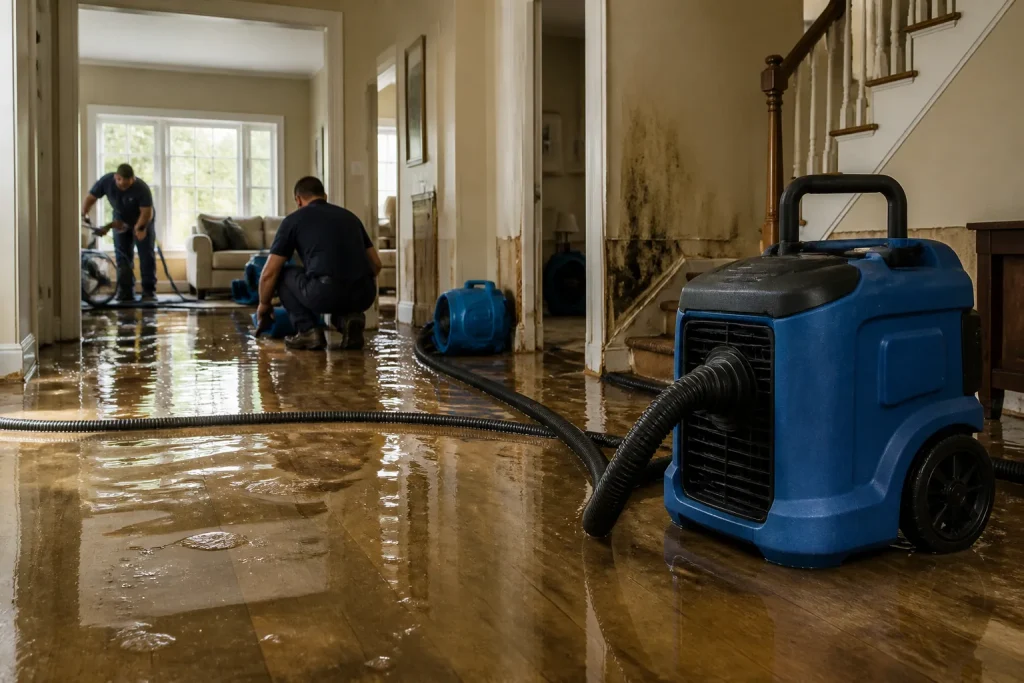
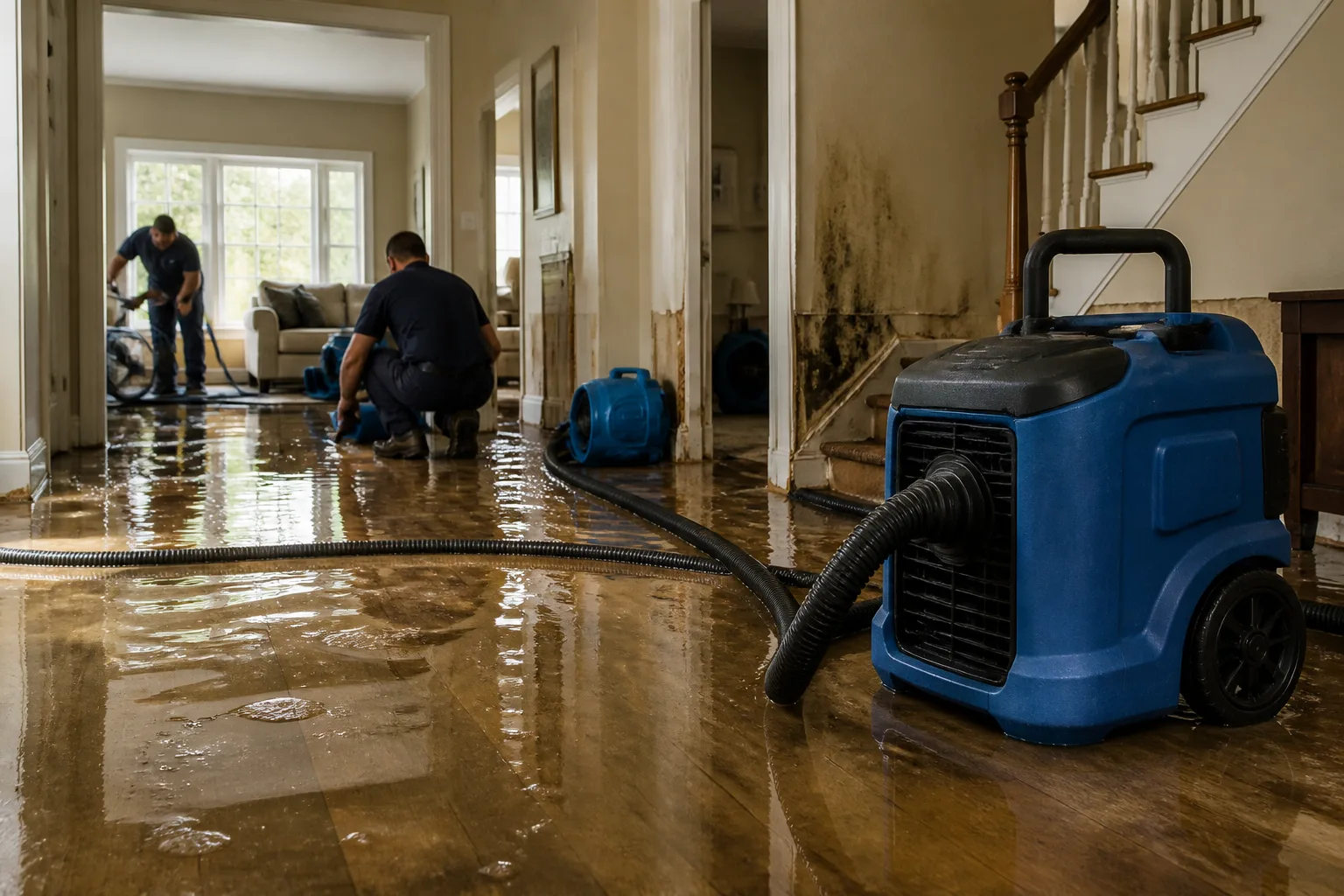
- Extraction and drying. Commercial extractors pull standing water, then high-velocity air movers and dehumidifiers are placed in a calculated layout. We run Dri-Eaz and Phoenix units with sealed system dehumidification for most residential jobs.
- Daily monitoring. The technician returns daily to take psychrometric readings, adjust equipment placement, and log drying progress. You get a written record of every reading, not a shrug and a “looks dry to me.”
We pulled one out of a garage in Woodland Hills a few months back where a water heater had failed and the homeowner had been out of town for four days. The water had sat long enough that the garage drywall wicked moisture up three feet into the wall cavities. The homeowner’s insurance adjuster initially questioned whether it needed full drying or just surface treatment. Our daily moisture logs, timestamped and written, changed that conversation. The claim was approved for full drying and targeted drywall removal, and the homeowner didn’t pay a deductible dollar beyond what their policy required.
When to call a pro: if the water has touched drywall, baseboards, cabinetry, or any flooring other than tile, call a professional. Surface drying with towels and fans won’t reach the water inside wall cavities or under flooring. The cost of professional extraction and drying is almost always less than the cost of mold remediation and rebuild if that hidden moisture sits. If you’re in Los Angeles and reading this with water actively spreading, call (910) 613-6568 now and we’ll tell you exactly what to do while you wait.
Related services in Los Angeles: Water Damage Restoration in Los Angeles covers full extraction, drying, and rebuild. If the water had microbial contamination, see Mold Remediation in Los Angeles for containment and removal. For wind-driven rain, roof leaks, and storm runoff, Storm Damage Restoration in Los Angeles covers what to do when the damage came from outside.
What This Should Cost in Los Angeles
You should know the numbers before you call anyone. Los Angeles pricing for water damage restoration varies by square footage affected, water category, and how long the water sat before extraction, but here are realistic ranges based on what we see in LA homes.
- Emergency extraction only (Category 1, small area, same-day response): $1,200 to $2,800
- Extraction plus drying equipment (3 to 5 days of commercial drying, typical burst pipe in a bathroom or kitchen): $3,000 to $6,500
- Extraction, drying, plus drywall and baseboard removal (water that sat overnight or spread to multiple rooms): $6,500 to $12,000
- Full containment, antimicrobial treatment, and rebuild (Category 3 or long-standing water): $12,000 and up, depending on scope
Most residential water extractions in Los Angeles run between $3,000 and $6,500 before drying equipment is set. That said, every job has a written price before any work begins at Marsh Water Damage Restoration home, so you’ll know the exact number on your specific job before you commit to anything. Estimates are free. Call (910) 613-6568 and we’ll give you a straight answer.
The Bottom Line
Water damage in Los Angeles homes is a fight against two clocks: the one that measures how fast mold grows in warm air, and the one that measures how long moisture sits against concrete and stucco with no escape route. Your first 20 minutes are yours to control. Cut the water. Cut the right breakers. Photograph everything. Know your water category and act accordingly. Then get a professional in who can prove who they are before they cross your threshold, put a written price in your hand before any work begins, and back the repair with a written guarantee that actually says what happens if something isn’t right. That’s what we do at Marsh Water Damage Restoration, and we’ve done it in Los Angeles since 2005. If you’re dealing with water right now, call us at (910) 613-6568 for a free estimate. A live person answers, any hour, any day.
Frequently Asked Questions
In Los Angeles, our response time for emergency water extraction is typically within 60 to 90 minutes depending on traffic and your location. Every call is answered by a live person 24/7, and you’ll be told exactly who is coming and when before you hang up.
Most homeowners policies cover sudden and accidental water damage from sources like burst pipes or water heater failures, but not long-standing leaks or flood damage. Your photos taken before cleanup begins are the single biggest factor in getting a claim approved. We photograph everything, deal directly with adjusters, and provide written documentation of every step.
If water touched drywall, baseboards, or any flooring other than tile, surface drying won’t reach the moisture inside walls and under floors. In Los Angeles slab homes, that trapped moisture sits against concrete with no airflow and mold follows within days. Professional drying equipment moves air through materials, not just across them.
Ask for a name and photo before the visit. Every Marsh Water Damage Restoration technician is sent to you by name and photo, then shows a photo ID badge at the door matching that information. It’s called the Threshold Verified standard, and if another company can’t do that, ask yourself who you’re really opening the door for.
Written by Tobias Reyner, Owner at Marsh Water Damage Restoration, serving Los Angeles since 2005.
Need Damage Restoration Help?
Call Marsh Water Damage Restoration - licensed & insured, here with fast after-hours help in Los Angeles.
(910) 613-6568