
Water Damage Restoration: Repair or Replace? How Los Angeles Homeowners Decide
Most wet drywall and flooring in a Los Angeles home can be saved if moisture content is measured within hours, not days, and drying begins before mold gets a foothold. The repair-versus-replace call comes down to three measurable things: what got wet, what category the water was, and how long it sat. If you’re standing in a puddle right now, call (910) 613-6568 and we’ll walk you through what to do in the next 20 minutes.
Here’s the uncomfortable truth we’ve learned doing Water Damage Restoration in Los Angelesa contractor who recommends replacement before measuring moisture content isn’t being thorough, they’re being profitable. Tear-out quotes are faster to write than drying plans. They require less equipment and less patience. But they often cost homeowners thousands of dollars they didn’t need to spend.
The decision to remove a wall or floor should always follow a moisture map, not precede one. Here’s how we actually make that call in LA homes, material by material.
First, the numbers: what moisture content actually means
Every building material has a “dry standard.” That’s the baseline moisture content it carries when the house is healthy. Once water invades, the number climbs. The question isn’t whether something is wet. The question is whether it can get back to dry without warping, delaminating, or growing mold.
The tool we use is a moisture meter with pin and pinless probes. Pin probes push two small electrodes into the material to measure electrical resistance between them. Pinless probes use radio frequency to scan beneath the surface without leaving holes. Between the two, we can map exactly how far water has traveled through drywall, subfloor, framing, and stucco in a Los Angeles home, and how deep it goes.
Here’s the threshold table we work from on every job:
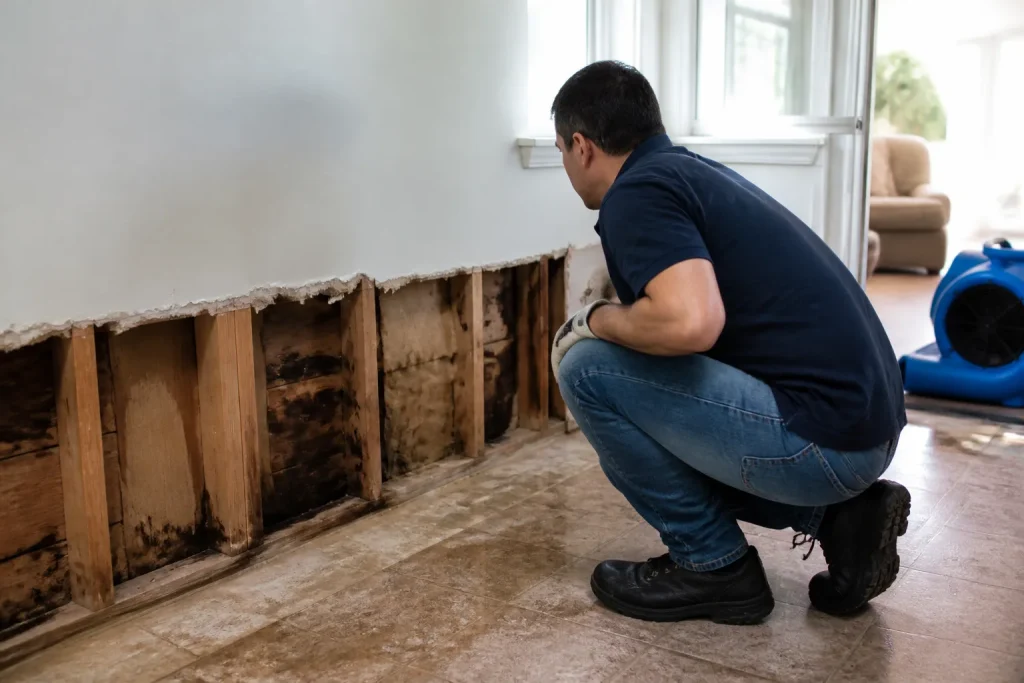
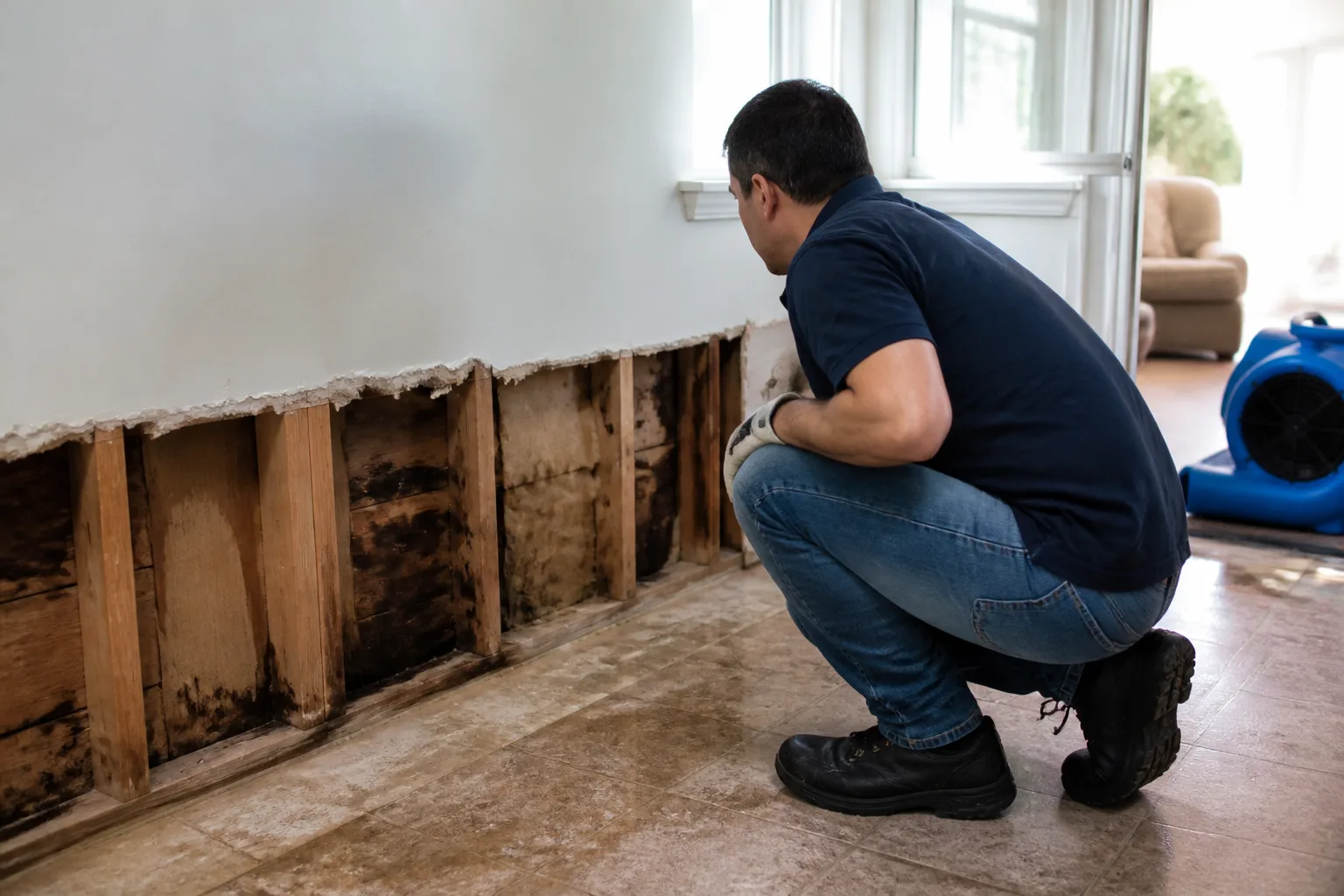
- Drywall: starts warping at 1% over baseline. Saturated above 5% over baseline. If the paper facing is bubbling, the gypsum core is crumbling, or the wall has been wet for more than 48 hours, it’s coming out. Full stop.
- Solid hardwood: can tolerate up to 12% moisture content (MC) during drying. Cupping appears past that. Above 17%, expect permanent deformation. Above 20%, start planning replacement for affected boards.
- Engineered wood: crosses the point of no return between 14% and 16% MC. The cross-ply layers delaminate and the tongue-and-groove joints swell shut. When that happens, no amount of drying will reseat the planks.
- Concrete subfloor: no upper MC limit for the concrete itself. It doesn’t rot. But it holds water longer than anything else in the house, and whatever sits on top of it, a wood floor, carpet pad, vinyl plank, has to dry through it, not around it.
- OSB (oriented strand board): begins permanent swell at 16% MC. Used in modern LA subfloors and roof sheathing. Swollen OSB edges don’t flatten when dried. If the edges feel raised, those sheets are done.
- Stucco (exterior): porous and slow-drying. Moisture trapped behind stucco is the most common source of hidden mold in Los Angeles homes we’ve inspected. The stucco itself usually survives. What’s behind it often doesn’t.
No contractor should quote you a tear-out or a dry-in-place plan without showing you readings from a calibrated moisture meter. If they’re not measuring, they’re guessing. You’re paying for the guess.
Why Los Angeles homes fail differently than East Coast restoration guides assume
Most water damage restoration guidebooks were written for homes with basements, vapor barriers under floor joists, and winters that freeze pipes. Los Angeles doesn’t build houses that way.
The typical LA home built after 1970 sits on a concrete slab. No basement. No crawlspace. The flooring is glued or floated directly onto that slab. When a supply line breaks or a water heater lets go, water runs across the slab and gets trapped between the concrete and whatever sits on top of it. The slab stays wet for weeks, sometimes months, because it has nowhere to drain.
That’s the slab-specific calculus we deal with constantly in Los Angeles. The repair-versus-replace question isn’t about the slab. Concrete doesn’t need to be replaced because it got wet. The question is about what’s trapped underneath it and how to extract the water without tearing out your kitchen floor.
In most cases, we can pull water from under flooring using a mat extraction system. Think of a network of flat panels placed over the floor that draw continuous suction through a hose connected to a truck or portable extractor. This pulls water through the floor surface from the space between the flooring and the slab beneath.
But here’s the catch: this works only when the flooring is non-porous, vinyl plank, tile, some laminate, or unfinished concrete. Once water gets under solid hardwood or engineered wood glued to slab, the extraction is less effective. The water has to be pulled through the wood itself, and wood doesn’t like that. The planks cup or delaminate before they dry.
So in a slab home, the repair-versus-replace question often comes down to what kind of floor you have, not how bad the leak was. Tile over slab usually survives. Vinyl plank usually survives. Engineered wood on a slab is a coin flip. And the sooner we get extraction going, the better that coin flip gets.
The Category problem: not all water is created equal
Restoration professionals sort water into three categories. The category determines whether repair is even on the table.
- Category 1 water comes from a sanitary source. A broken supply line under your kitchen sink. A leaking faucet. Clean water from your water heater’s cold side. With Category 1, most materials can be dried in place if you get to them within 24 to 48 hours.
- Category 2 water has significant contamination. Washing machine overflow, toilet overflow with urine only, dishwasher discharge. This water carries organic nutrients. Materials with any absorbency, carpet, pad, drywall, engineered wood, should be considered for replacement, not repair. Drying can work, but the risk window shrinks fast.
- Category 3 water is grossly unsanitary. Sewage, floodwater from outside, water from a roof leak that has been sitting in a wall cavity. Category 3 means replacement of all porous materials touched. No discussion. Drywall, carpet, pad, insulation, engineered wood. Hard surfaces get cleaned and sanitized. Soft surfaces get bagged and cut out.
Los Angeles gets fewer Category 3 flood events than Houston, but we see Category 3 damage regularly from sewer backups in older neighborhoods, Hollywood Hills homes on septic, parts of the Valley with aging clay sewer lines. If the water came up out of a drain, treat everything it touched as Category 3 until a restoration team tells you otherwise.
One more LA-specific factor: water travels horizontally along slab floors with surprising speed. A Category 1 leak in one room can become Category 2 water by the time it reaches the next room if it picks up dirt, pet waste, or household chemicals along the way. The source matters. The path matters too.
Engineered wood flooring: the narrow repair window LA homeowners don’t know about
Post-2000 LA renovations love engineered wood. It’s cheaper than solid hardwood, more dimensionally stable, and easier to install over slab. It’s also significantly less forgiving after a water event.
Solid hardwood comes from a single tree. When it gets wet, the boards cup. If you catch it in time and dry it slowly, the cupping can reverse. The boards can be sanded and refinished. Repair is genuinely possible.
Engineered wood is layers: a thin veneer of real wood glued to a cross-ply plywood, HDF, or MDF core. Those layers are bonded with adhesives. Water attacks the adhesive. The layers start to separate, a process called delamination. The core swells. Once delamination starts, there is no repair. You cannot reglue the layers inside a plank that is already installed. You cannot sand out the swelling.
After Category 2 or 3 water exposure, engineered wood almost always requires replacement. After Category 1, it’s a race against time. If the floor is drying within 24 hours and the MC never exceeds 14%, you likely keep it. Beyond that, budget for new flooring.
We see this in homes throughout Los Angeles every month, from condos in Koreatown to townhouses in Playa Vista. The phone call starts the same way: “The floor looks fine, just a little darker in the light.” A week later, the planks are raised at the seams and the homeowner is asking why the repair quote turned into a replacement quote. The answer is that engineered wood doesn’t announce its death until it’s too late.
When insurance says repair and your gut says replace
Here’s the part most restoration articles won’t tell you: your insurance adjuster and your long-term interest as a homeowner are not always aligned.
An adjuster’s job is to settle the claim at the minimum reasonable cost to the carrier. That’s the job. When an adjuster sees wet drywall, they’ll approve drying in place. When they see engineered flooring with moderate MC, they’ll approve targeted replacement of the affected areas only. They’re not wrong within the letter of the policy. But “reasonable” and “best for your house” are different standards.
A homeowner’s long-term interest may favor replacement where an adjuster pushes repair. Dried-in-place drywall that was saturated for three days has a higher mold risk six months later than drywall that was cut out and replaced. Partial flooring replacement leaves visible seams and color mismatches. The adjuster isn’t living with those seams. You are.
How do you make the case for replacement? In writing, with measurements. Document the MC readings. Document the water category. Document the hours of exposure. Reference the IICRC S500 Standard for Professional Water Damage Restoration, which specifically requires that affected materials be restored to their pre-loss condition, not merely made “dry enough.” Then submit that to the adjuster.
We prepare this documentation for our Los Angeles customers on every insurance job. Photo records, moisture logs, material-by-material recommendations with rationale. When a customer’s policy language supports replacement, we give them the file they need to push back. When it doesn’t, we’re honest about that too.
The repair-versus-replace decision should come with a cost comparison in writing before any demo begins, not as a surprise line item after drywall is already off. That’s the core of how Marsh Water Damage Restoration operates, and frankly, it’s the bare minimum a restoration company should offer.
When to call a professional (and what to do meanwhile)
You can mop up a Category 1 puddle yourself. You cannot dry a wall cavity, a slab, or an engineered floor without equipment. Here’s the honest list of moments to hand the job to someone like us:
- Water contacted drywall, baseboards, or flooring beyond a wet footprint the size of a bath mat.
- The water source is anything other than a clean supply line.
- You smell something musty within 48 hours of the leak. That’s microbial growth starting.
- Water pooled for more than 24 hours before you noticed.
- Engineered wood flooring anywhere near the water path.
- The leak was inside a wall or ceiling, no matter how small it looks from the outside.
If any of those match your situation, you’re in the zone where professional drying beats DIY airing. We run Dri-Eaz and Phoenix dehumidifiers with XPOWER air movers, commercial equipment that pulls water vapor out of materials at a rate a household fan cannot approach. Drying is a physics problem. The right equipment solves it. The wrong equipment just spreads the moisture around.
If you’re in Los Angeles and you’ve also noticed any musty smell or discoloration in the days after a leak, that’s a mold question, not just a water question. We handle that too: Mold Remediation in Los Angeles. And if the water came in through a damaged roof during one of our winter storms, that’s Storm Damage Restoration in Los Angeles territory. One wet house can need all three. We’d rather tell you that honestly than patch one surface and pretend the rest is fine.
The Bottom Line
Repair versus replace in Los Angeles water damage comes down to five questions: what material got wet, what category the water was, how many hours it sat, what the moisture meter says now, and what the material’s known failure thresholds are. Answer those five, and the decision nearly makes itself.
Key takeaways:
- Measure before you mope. No moisture readings, no tear-out recommendation should be trusted.
- Drywall, engineered wood, OSB, and stucco each have their own point of no return. Know the number.
- Slab homes in Los Angeles create a unique drying challenge: water trapped between flooring and concrete. Extraction mats can save certain floors but not all.
- Category 2 or 3 water exposed engineered wood? Plan on replacement. Category 1? You have a 24 to 48 hour window.
- Your insurance adjuster will push repair. Your long-term interest may favor replacement. Get the documentation to make the case in writing.
If you’re in Los Angeles and need help with a repair-or-replace decision, Marsh Water Damage Restoration offers free estimates. A live person answers the phone, day or night. Call (910) 613-6568. Every price is written before work begins. Every repair comes with our Done Right Promise. And every technician sent to your home is Threshold Verified, meaning you’ll know their name and see their photo before they knock.
Still not sure whether to call? Last month we pulled open a laundry room wall in a 1962 ranch over in Sherman Oaks. The homeowners thought the leak was small, maybe a half day of wet. The moisture meter read 28% MC in the sill plate. The drywall came off and the studs needed three days of drying before we could rebuild. By the time we closed the wall, the total was under what a full replacement would have cost, but only because they called when they did. Four more days of sitting and the studs would have rotted. That’s the whole repair-versus-replace conversation in one house: measured early, saved early.
Learn more about what we do at the Marsh Water Damage Restoration home page, or call us directly. Water damage in Los Angeles doesn’t wait, and neither should you.
Frequently Asked Questions
How do I know if my drywall needs replacing after water damage? Drywall needs replacement if it has been saturated for more than 48 hours, if the paper facing is bubbling or peeling away, if the gypsum core crumbles when pressed, or if a moisture meter reads more than 5% over baseline after drying has begun. Drywall that got wet from Category 1 water and dried within 24 hours can often be saved.
Will my insurance cover replacement if the adjuster only approved repair? Insurance policies cover restoration to pre-loss condition, not just to “dry enough.” If replacement is required to meet that standard, you can submit documentation, moisture readings, photos, material failure thresholds, and argue for full replacement. Marsh Water Damage Restoration provides this documentation to our Los Angeles customers on every insurance claim. A written comparison of repair versus replacement cost, prepared before demo begins, is a strong supporting document.
How long does it take to dry a slab floor in Los Angeles? A concrete slab that has absorbed water typically takes 3 to 7 days to reach acceptable moisture levels with commercial drying equipment. Los Angeles’s low humidity helps, but the lack of a basement means the water has nowhere to gravity-drain. Drying must happen through the floor surface, which is why extraction mats and high-capacity dehumidifiers are used. Tile and vinyl plank over slab can often be saved. Engineered wood often cannot.
Can I just dry out my engineered wood floor myself with fans? No. Household fans move air across the surface, but they cannot pull moisture from the cross-ply layers inside the planks. Engineered wood that has absorbed water requires inline drying equipment and continuous moisture monitoring. Even with professional equipment, engineered wood exposed to Category 2 or 3 water usually needs replacement. If you’re not sure what category your water was, call (910) 613-6568 and we’ll help you figure it out before the floor tells you the hard way.
Written by the team at Marsh Water Damage Restoration.
Need Damage Restoration Help?
Call Marsh Water Damage Restoration - licensed & insured, here with fast after-hours help in Los Angeles.
(910) 613-6568