
5 Mistakes to Avoid With Water Damage Restoration
The five costliest mistakes in water damage restoration aren’t about what homeowners do wrong. They’re about what homeowners agree to without reading. The average water damage insurance claim in California runs over $11,000, and most people spend less than four minutes reviewing the restoration contract before signing it. Those two facts are not unrelated. Here’s what to watch for, and what to ask before anyone sets up a fan.
If you’d rather skip the reading and just talk to someone, call (910) 613-6568 and a live person will walk you through your situation. No phone tree, no callback list.
Mistake 1: Signing a Direction-to-Pay Form Before Seeing a Written Scope
This is the quiet killer of water damage jobs. A direction-to-pay form authorizes your insurance company to pay the restoration contractor directly. Sounds convenient. The problem: it hands billing control to the contractor before anyone has agreed on what work actually needs to happen.
In Los Angeles, where adjusters juggle hundreds of claims after a heavy rain season, direction-to-pay forms often get signed in the first hour after a loss. The homeowner is standing in a flooded living room, stressed, tired, and someone in a polo shirt says “just sign here so we can get started.” Four minutes later, the contractor is authorized to bill your carrier directly, and scope creep begins: an extra containment chamber here, another air mover day there, additional demolition “discovered” mid-project. Each line item adds hours and dollars, and the homeowner has already signed away the approval checkpoint.
What to do instead: Get a written scope of work before signing anything. Not a verbal summary, not a text message, not a “we’ll figure it out as we go.” A line-by-line list of what will be removed, what will be dried, what will be replaced, and what it costs. At Marsh Water Damage Restoration, we put the price in writing before any work begins. Not a rough estimate that balloons after the drywall comes down. A written scope, agreed to in advance. Then, and only then, discuss payment authorization.
Mistake 2: Assuming “Dry to the Touch” Means Dry
A wall that feels dry on the surface can still be holding 25% moisture or more inside the wall cavity. Your hand is not a moisture meter. Never has been.
We’ve pulled baseboards off in Sherman Oaks homes where the sheetrock looked and felt fine, but the studs behind it read 30% moisture content. Left alone, that concealed moisture feeds mold growth in two to three days. By the time you smell it, the remediation cost has doubled.
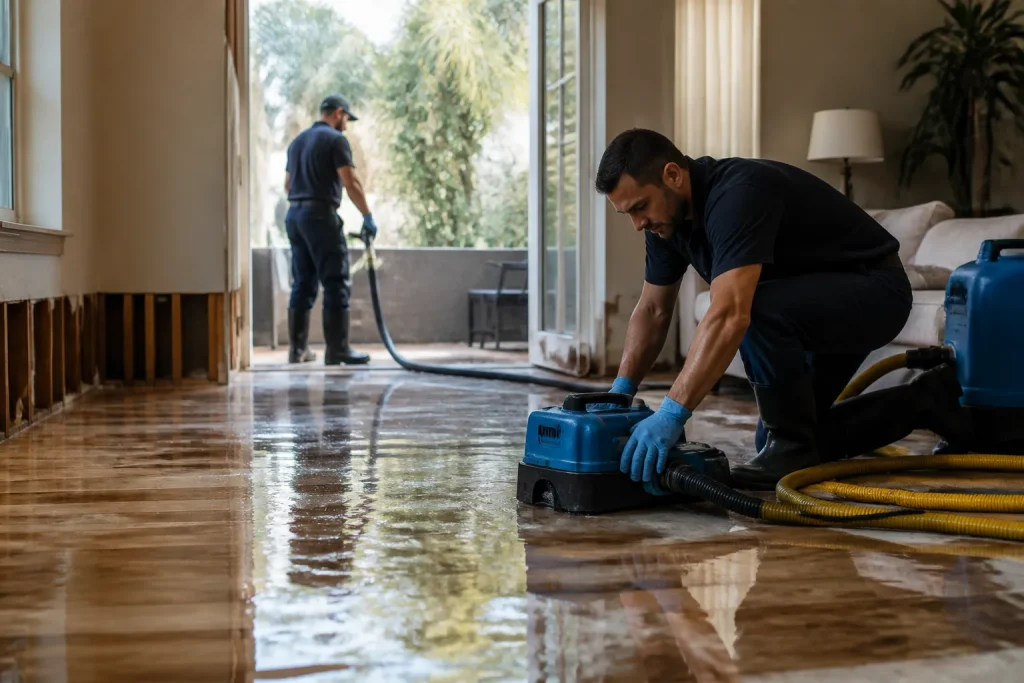
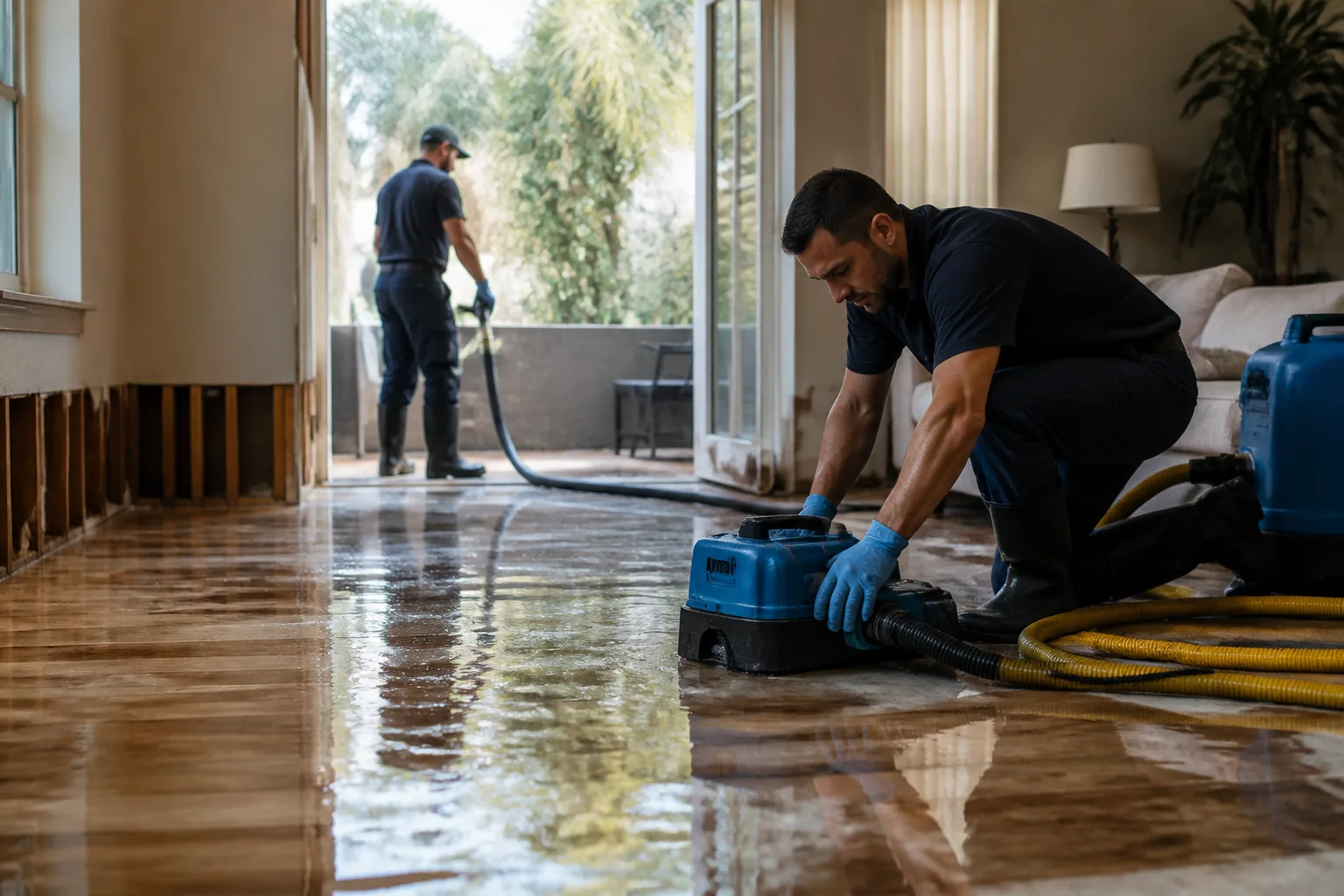
Professional restoration crews don’t use the back of a hand to decide when a structure is dry. They use moisture meters and psychrometric readings (measuring the moisture in the air, not just the surface) to track how much water is leaving the building materials. Wood, drywall, and concrete all release water at different rates. Concrete slabs in Los Angeles slab-on-grade homes can hold moisture for weeks after the carpet feels dry. Drywall wicks water upward far past the visible waterline.
What to do instead: Demand documented moisture readings, not a thumbs-up. Ask to see the meter numbers for the affected areas, and ask what the dry standard is for each material. A professional restoration technician with IICRC training knows those numbers: hardwood floors should return to within 2 – 4% of their pre-loss moisture content, drywall below 1% moisture content in most cases. If your contractor says “it feels dry,” you’ve got the wrong contractor.
Mistake 3: Using Box Fans Instead of Professional Air Movers and Dehumidifiers
This one feels like common sense. Water is wet, fans blow air, air dries things. So why pay a restoration company hundreds of dollars a day for equipment when you’ve got three box fans in the garage?
Because box fans don’t dry structures. They move humid air around the room. The moisture has to go somewhere, and in a closed house with box fans running, it goes back into the walls, under the floors, and into the furniture. You’re not drying; you’re recirculating.
Professional water damage restoration in Los Angeles uses two categories of equipment your home fans can’t match:
- Air movers (brands like XPOWER and B-Air) create focused, high-velocity airflow across wet surfaces to force moisture out of materials and into the air.
- LGR dehumidifiers (low-grain refrigerant) pull that moisture out of the air itself, dropping the humidity in the room so the materials have a place to release the water they’re holding.
The combination is the drying process. Air movers push water out, dehumidifiers remove it from the environment. Box fans, bathroom exhaust fans, and the ceiling fan in the hallway do not. They make you feel a breeze while the structure stays wet.
What to do instead: If the affected area is larger than a bath mat, call a professional who can deploy real drying equipment within hours. Every day of drying with inadequate equipment extends the timeline and increases the mold risk. We run Injectidry drying systems for hard-to-reach cavities too, something no homeowner has sitting on a shelf.
Mistake 4: Letting the Insurance Company Choose Your Restoration Contractor
Your adjuster works for the insurance company. Their “preferred vendor” is preferred for the carrier’s cost control, not for your outcome. That’s not cynicism; that’s how the arrangement is structured.
When an insurance carrier steers you to a preferred restoration vendor, that vendor has a contractual relationship with the insurer. Their incentive is to keep the carrier’s payout low, complete the job quickly, and stay on the preferred list for the next claim. Your incentive is to have your home restored correctly, completely, and for the long term. Those incentives don’t always point in the same direction.
In California, you have the right to choose your own restoration contractor. Your policy cannot legally force you to use the insurance company’s preferred vendor. The California Department of Insurance has reinforced this repeatedly: the choice of repair professional belongs to the policyholder. The adjuster can recommend, but they cannot require.
What to do instead: Choose a restoration contractor who works for you, not for the insurance carrier’s vendor network. Ask the contractor directly: “Who pays your invoice if the scope changes?” The answer tells you everything. At Marsh Water Damage Restoration, we work directly with your adjuster, provide photo documentation of every phase, and negotiate the claim on your behalf. Our loyalty is to the homeowner, which is the only relationship that makes sense when it’s your living room being gutted.
Water Damage Restoration in Los Angeles is our core service, and every job starts with a written scope and a clear explanation of who’s paying for what.
Mistake 5: Not Getting the Guarantee in Writing Before Work Starts
A verbal promise of satisfaction is unenforceable. It doesn’t survive disputes, it doesn’t survive a change in project manager, and it doesn’t survive the phone call where you explain that the baseboards are warping six months later.
This is the mistake that quietly depends on the others. A contractor who works from a verbal scope, uses inadequate drying equipment, and signs a direction-to-pay form before work begins is a contractor who will point to the fine print when something goes wrong. “We never said we’d cover that.” “That was pre-existing.” “The warranty was for 30 days.” You have no leverage without something in writing.
What to do instead: Require the guarantee written into the work order before any equipment enters your home. At Marsh Water Damage Restoration, our Done Right Promise is printed on every work order. It states: if the repair is not right within one full year, we make it right. No argument period, no fine-print exclusions. That includes a free second visit if a repair fails, automatically included, never something a customer has to request. We’ve been doing this, and our guarantee has been in writing the entire time. That’s not bragging; it’s the only way a guarantee means anything.
One more thing worth mentioning: the name. Marsh is low, wet ground. Water where it shouldn’t be. That’s literally what we deal with every day. We named the company for the problem. We’re located in Los Angeles, where water damage comes from slab leaks, water heater failures, washing machine hose bursts, and the occasional atmospheric river that turns a hillside yard into a mudslide. The geography changes; the mistake pattern doesn’t.
When to Call a Pro
If the water event involves standing water in multiple rooms, water that sat for more than a few hours, water that touched drywall, insulation, or flooring, or any water you suspect might be contaminated (sewage, storm runoff, appliance overflow that sat), call a professional. Same goes if you smell anything musty, if anyone in the house has asthma or allergies, or if the water touched electrical outlets or appliances. Water migrating behind walls is not visible from the living room, and invisible water is the most expensive kind.
Related services in Los Angeles: Mold Remediation in Los Angeles and Storm Damage Restoration in Los Angeles. If the water sat more than 48 hours or originated from storm flooding, we’ll almost always recommend a mold assessment as part of the scope.
The Bottom Line
The five mistakes to avoid with water damage restoration all share a pattern: don’t sign away control before you understand the scope, don’t accept a hand-feel assessment as structural drying, don’t substitute household fans for professional equipment, don’t assume the insurance company’s vendor is your advocate, and don’t accept a verbal guarantee. Each one is avoidable in the first hour after a water event. That’s also when most people are too panicked to think clearly, which is why the mistakes are so common.
Here’s the short version:
- Get a written scope before signing a direction-to-pay form.
- Demand documented moisture meter readings, not “feels dry.”
- Professional air movers and LGR dehumidifiers, not box fans.
- You choose the restoration contractor; your policy gives you that right.
- The guarantee belongs in writing, before work starts.
If you’re in Los Angeles and dealing with water damage right now, Marsh Water Damage Restoration offers free estimates and same-day response for active water events. Call (910) 613-6568 and you’ll talk to a live person who can tell you what to do next. That call costs you nothing, and it might save you the cost of a mistake you didn’t know you were making. Find out more at the Marsh Water Damage Restoration home page.
Frequently Asked Questions
Most residential water extractions in Los Angeles run between $1,200 and $4,500 depending on the size of the affected area, the category of water, and how long the water sat before extraction began. Structural drying typically adds $75 to $150 per day per room, and full reconstruction ranges from $4,000 to $25,000 or more for multi-room losses. These are working numbers we see regularly, not formal quotes. For an exact written scope, call (910) 613-6568 and we’ll send a technician to assess the damage.
In most cases, yes, if the water damage was sudden and accidental (a burst pipe, a failed water heater, a storm-related intrusion). Gradual leaks, poor maintenance, and flood damage from rising groundwater are typically excluded unless you carry a separate flood policy. Your adjuster will determine coverage. What’s important is that you choose your own restoration contractor, and if you’d like help presenting your claim with photo documentation and written estimates, call (910) 613-6568.
For active water events, same day in most Los Angeles neighborhoods. A live person answers our phone 24 hours a day, 7 days a week, and we dispatch technicians from multiple Los Angeles locations. The faster extraction and drying equipment gets running, the less damage the structure absorbs. If you’ve got standing water right now, call (910) 613-6568.
For anything larger than a small area dried within a few hours, you need professional equipment. Air movers and LGR dehumidifiers remove moisture from building materials in a way household fans cannot. Air drying a saturated room typically takes two to three times longer and increases mold risk. If you’re unsure whether your situation warrants professional drying, call (910) 613-6568 and describe what you’re seeing. We’ll tell you honestly whether it’s a professional job.
Written by the team at Marsh Water Damage Restoration.
Need Damage Restoration Help?
Call Marsh Water Damage Restoration - licensed & insured, here with fast after-hours help in Los Angeles.
(910) 613-6568