
Mold Remediation: Repair or Replace? How Los Angeles Homeowners Decide
Repair or replace comes down to one question: can you guarantee the moisture source is gone? If yes, cleaning and repair often work. If no, replacement is the only honest answer. Los Angeles makes that question harder than most cities because our stucco exteriors, cavity walls, and aging plumbing hide moisture until mold is already established. If you’d rather skip the detective work and have a straight answer, call (910) 613-6568 for a free assessment.
Most homeowners we meet in LA think mold remediation means scrubbing walls and spraying something. That’s the smallest part of the job. The decision that actually determines whether the problem stays solved is deciding what gets cleaned and what gets cut out. And in this city, contractors routinely recommend cleaning when replacement was the only defensible call, because cleaning is faster and the homeowner can’t see the difference until the mold comes back.
The Containment-Certainty Test: The Question Nobody Asks
Here is the test we use on every mold job in Los Angeles: if we cannot prove the source of moisture is eliminated, we do not recommend repair. We recommend replacement, with the moisture source fixed first. That sounds obvious, but it’s where most remediation recommendations fall apart.
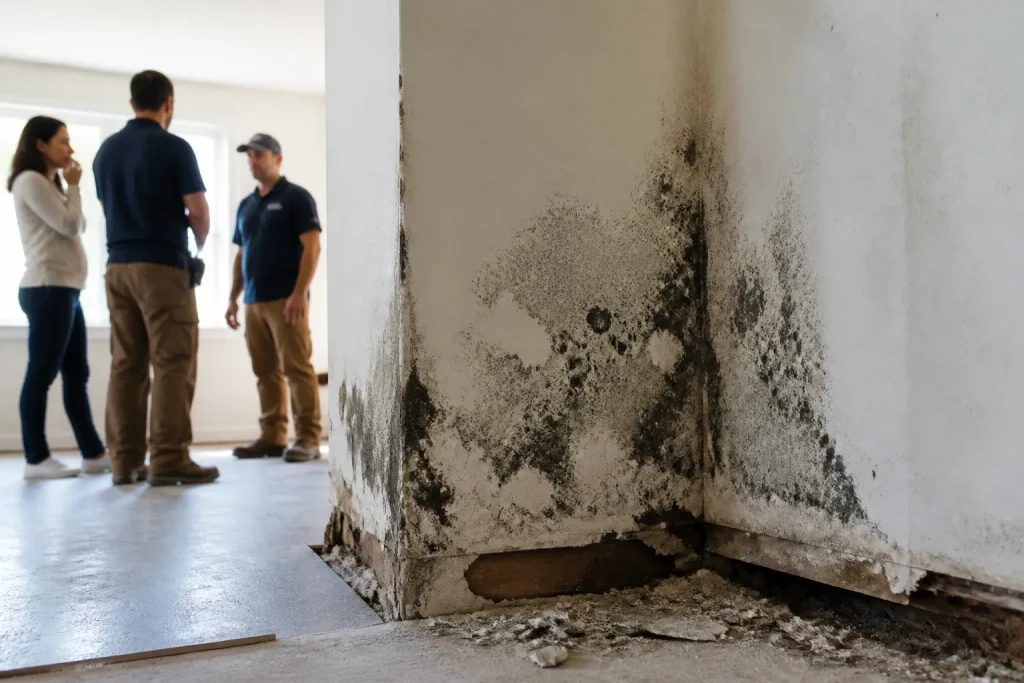
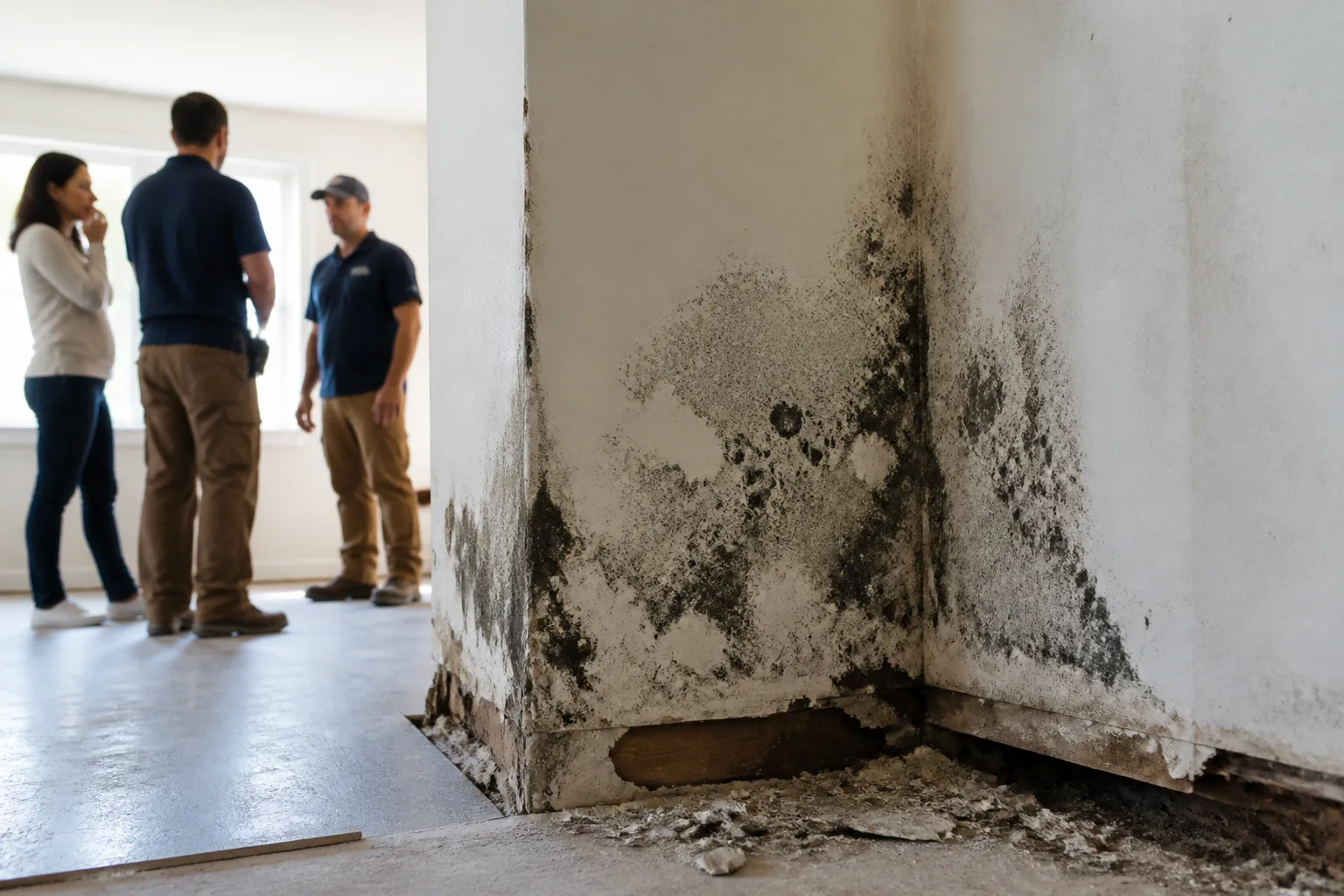
Los Angeles has an enormous stock of homes built between 1950 and 1985. The copper supply lines in those homes are now 40 to 70 years old. Copper develops pinhole leaks, often behind walls where nobody sees them for months. A contractor who recommends cleaning and encapsulating a moldy wall without putting a camera down the plumbing line is making a guess. The mold came from water. If the water is still getting in, every dollar spent on cleaning is wasted. We’ve opened walls in Silver Lake and Echo Park where the mold colony was fed by a pinhole leak the size of a sewing needle. The drywall was soaked, the insulation was black, and the homeowner had been told by someone else that a quick antimicrobial wipe would handle it.
Before any repair-versus-replace decision, ask the contractor this: “Have you confirmed the moisture source is gone?” If the answer is anything other than a clear description of how they verified it, insist on replacement. In our experience, that verification usually means a moisture meter, an infrared scan, and often a plumbing inspection. Anything less is a contractor rolling dice with your drywall.
What the IICRC S520 Standard Actually Says About the 10-Square-Foot Rule
The restoration industry’s governing document for mold is the IICRC S520 Standard. It is not a law, but it is the recognized professional benchmark, and it draws a line that Los Angeles homeowners should know: visible mold growth on porous materials exceeding 10 square feet generally requires removal, not cleaning. Drywall counts as porous. Insulation counts as porous. Ceiling tiles count as porous. These materials cannot be reliably cleaned once mold has penetrated the surface.
Why 10 square feet? Because at that point the colony has almost certainly extended into the material’s internal voids and behind the visible surface. You can wipe the face of the drywall clean and leave living mold in the paper backing and gypsum core. Spraying an antimicrobial on the surface does not reach it. The mold keeps respiring, keeps releasing spores, and the odor returns. We see this pattern constantly in Los Angeles rentals and flips where the previous owner cleaned the walls, painted over the stains, and sold the problem to the next buyer.
The replace threshold also applies to materials that got wet and stayed wet. If a wall cavity flooded during one of our winter storm events and was not professionally dried within 48 to 72 hours, you should assume mold is present even if you cannot see it. In that situation, opening the wall is the diagnostic step, not the scary step. A proper water damage restoration in Los Angeles company will tell you that inspection openings are cheaper than rebuilding a whole room later.
The Stucco Cavity Problem: Why LA Homes Fail the “Clean and Encapsulate” Approach
Los Angeles homes have a structural feature that makes mold uniquely dangerous: stucco on the exterior, drywall on the interior, and an air gap between them. That cavity is a highway for moisture. When stucco cracks, which it does constantly in our seismic climate, water gets into the cavity and runs down the inside face of the stucco. Mold grows there, invisible from both the outside and the inside, until the colony is extensive enough to stain through the drywall or the homeowner starts smelling it.
Encapsulation, meaning painting an antimicrobial sealant over mold, is a legitimate technique in narrow conditions. It works on smooth, non-porous surfaces where the moisture source is confirmed eliminated and the colony is small. It is also the cheapest thing a contractor can do, and it is the hardest outcome for a homeowner to verify. In an LA stucco home, encapsulation on an interior wall often hides a mold problem that is actually living in the cavity behind it.
We locate these hidden colonies with infrared imaging before we cut anything. A thermal camera shows temperature differences that indicate trapped moisture in the cavity. That moisture pattern tells us where the water is entering and how far the wet zone extends. Demolition without that image is blind work. With it, we open the smallest possible area, remove the wet insulation and contaminated drywall, dry the cavity with commercial equipment from companies like Phoenix and XPOWER, and rebuild. That is the difference between guessing and knowing.
What California’s CDPH Guidelines Mean for Encapsulation Recommendations
California’s Department of Public Health publishes microbial remediation guidelines that licensed mold contractors in Los Angeles are expected to follow. The practical effect for a homeowner is this: encapsulation is not a substitute for removal when mold is on porous materials or when the moisture source has not been eliminated. A contractor recommending encapsulation should be able to point to the specific regulatory basis for that recommendation.
If you hear someone say, “We’ll just seal it up,” ask them to explain why encapsulation is appropriate under CDPH guidelines for this specific situation. Ask them to put it in writing. If they hesitate, you have your answer. We have never had a homeowner regret asking for written justification. We have had several tell us that a previous contractor’s verbal encapsulation pitch evaporated the moment they asked for it in writing.
This is also a moment to think about credentials. The IICRC, RIA, and IFA certifications represent training standards in the restoration industry. A technician holding these credentials has been trained to know when encapsulation is defensible and when it is not. They were not handed a sprayer and told to sell sealant. If you are comparing bids in Los Angeles, ask which certifications the technicians hold. The answer tells you more than the price does.
Why a Written Guarantee Changes the Contractor’s Behavior
Here is something most homeowners never consider: the guarantee a contractor offers shapes the recommendation they make. If a contractor offers no written guarantee on mold work, they have no incentive to find the moisture source. They can clean the visible mold, collect payment, and vanish. If the mold returns in six months, that is your problem. If the contractor offers a written, time-bound guarantee that requires them to return and re-remediate at no charge if mold reappears in the same area, the incentives flip. Suddenly the contractor wants to know the moisture source is gone, because a callback is their money, their crew, and their schedule.
This is why we put the Done Right Promise on every work order, with the terms printed on paper. If mold returns in the same area within a full year, we re-remediate at no charge. We also include a free second visit if the repair fails. Those are not marketing phrases. They are printed commitments that our technicians and our customers see on every job. In a mold context, that promise means we will not recommend repair over replacement unless we are genuinely confident. The guarantee is what makes honesty the cheapest option for us.
When we pull out a moldy section of wall in a home near Runyon Canyon or over in the Valley, we document everything. Photos before, during, and after. Moisture readings from before we start and after we finish. Those records matter for the guarantee, and they matter if you are filing an insurance claim. A mold remediation in Los Angeles job done without photo documentation is a job you cannot prove was done right.
When Repair Makes Sense: The Cases Where You Do Not Need to Replace
Replacement is not always necessary. If the mold growth is less than 10 square feet, on a non-porous surface like tile or a metal duct, and the moisture source is confirmed eliminated, cleaning and repair are often appropriate. Bathroom ceiling mold from shower steam is a common Los Angeles example. Fix the ventilation, clean the surface with an appropriate antimicrobial, and you are done. The key is that the source in that case is steam, not a hidden leak, and the surface is cleanable.
Another repair candidate is solid wood framing with surface staining. Wood studs are semi-porous, but a surface colony on a stud that has been properly dried can often be sanded or media-blasted, then treated. If the wood has lost structural integrity from rot, that is not mold remediation anymore, that is carpentry, and replacement is required for safety. The distinction matters because it changes the scope and the cost. We would rather tell you that three studs need to be replaced than let you discover it during the next earthquake retrofitting inspection.
The Bottom Line
Repair or replace is not a coin flip. It is a decision based on three things: the certainty of the moisture source, the porosity of the material, and the structural context of the home. In Los Angeles, the stucco cavity problem and the aging pipe problem mean that the repair-or-replace decision defaults to replace more often than contractors want to admit. The contractor’s guarantee tells you how confident they are in their own recommendation. A contractor who will not put their guarantee in writing is telling you something important.
If you are looking at mold in a Los Angeles home and you are not sure what the right call is, we are glad to walk you through it. We have been doing this, our technicians are background-checked and identity-verified under the Threshold Verified standard, and you will know exactly who is showing up before the knock. The assessment is free and the written price comes before any work starts. Call (910) 613-6568 and you will get a live person, not a voicemail, any hour of the day.
Frequently Asked Questions
No. Drywall is porous, which means mold grows into it, not just on it. The IICRC S520 standard says visible mold on porous materials exceeding 10 square feet requires removal, not cleaning. Even below 10 square feet, drywall that got wet and stayed wet should usually be cut out because the paper backing holds mold you cannot see. In Los Angeles homes with stucco exteriors, we often find the mold extends into the wall cavity even when the visible surface looks manageable. Call us at (910) 613-6568 and we will tell you what a proper inspection actually requires.
You usually will not know without the right tools. The signs are a persistent musty odor, water stains on the interior drywall, or bubbling paint, especially after rain. Infrared thermal imaging can show temperature differences that indicate trapped moisture in the stucco cavity without demolition. That scan tells us where water is entering and how far the wet zone extends, so we open the smallest possible area. Los Angeles stucco cracks constantly from seismic movement, so a small exterior crack near an interior odor is worth checking.
Encapsulation is legal but only under specific conditions: non-porous surfaces, a confirmed eliminated moisture source, and a small colony size. California’s CDPH microbial remediation guidelines do not support encapsulation on porous materials like drywall or insulation, or when the moisture source has not been addressed. If a contractor recommends encapsulation, ask them to put the specific regulatory basis in writing. In our experience, that request alone separates legitimate recommendations from shortcut pricing.
It depends entirely on your policy language and the source of the moisture. Sudden and accidental water damage, like a burst pipe, is often covered, including the resulting mold remediation. Gradual leaks or long-term humidity issues are frequently excluded because insurers consider them maintenance failures. We document every job with photos and moisture readings and can work directly with your adjuster. Ask your insurer whether mold remediation from your specific loss is covered before you assume the answer. For help navigating it, call (910) 613-6568.
Written by the team at Marsh Water Damage Restoration.
Need Damage Restoration Help?
Call Marsh Water Damage Restoration - licensed & insured, here with fast after-hours help in Los Angeles.
(910) 613-6568