
Same-Day Water Damage Restoration in Los Angeles, CA: How It Works
Same-day water damage restoration means a technician is inside your home within a few hours of your call, moving wet material out, placing drying equipment, and recording baseline moisture readings that same calendar day. That is the promise. The reality in Los Angeles varies wildly from one company to the next, so here is exactly what a genuine same-day job should look like, hour by hour, and what questions to ask before you book one.
If you’re reading this with water spreading across a floor right now, call (910) 613-6568. A live person answers 24 hours a day, and we’ll tell you honestly whether we can get a crew to your door today.
What “Same-Day” Actually Means Versus What Most Companies Deliver
When a company says “same-day service,” most homeowners imagine a crew at their door within an hour. What often actually happens: a salesperson arrives same-day, assessment is scheduled next-day, and equipment shows up the day after. Those are not the same thing.
Each 24-hour delay adds measurable moisture penetration depth. Water moves through drywall, subfloor, and framing at a predictable rate. A Category 1 water loss (clean water from a supply line) left untreated for 48 hours degrades into a Category 2 situation as contaminants from building materials leach into standing water. By 72 hours, you are often looking at microbial growth conditions you cannot see behind baseboards.
In our experience across Los Angeles neighborhoods from Sherman Oaks to Echo Park to Torrance, the company that answers the phone with a real person and dispatches a technician (not a sales rep) to your door same-day is the rare exception, not the rule. Ask the person on the phone a simple question: “Is the person arriving today a technician with equipment on hand, or an estimator with a clipboard?” The answer tells you everything about their definition of same-day.
Hour by Hour: What a Real Same-Day Job Looks Like in Los Angeles
Here is the breakdown of what should happen when a restoration company genuinely commits to same-day work. This is the standard we hold the local pros to, and it is a reasonable standard for you to expect from anyone you call.
Hours 1 – 2: Assessment and Containment
The first 120 minutes are about stopping further damage and understanding what you are dealing with. A technician should walk the affected area, identify the water source, and shut it off if it is still active. They should check whether water has migrated under walls, into closets, or through floor penetrations. In Los Angeles, this matters because many homes are slab-on-grade with raised foundations in certain areas like the older streets of Pasadena or Long Beach, and water movement patterns differ between those construction types.
Containment happens next: blocking furniture, removing wet rugs or pads, extracting standing water with a truck-mounted or portable extraction unit. The goal in these first hours is not to dry everything. It is to remove the bulk water that is actively wicking further into porous materials every minute it sits.
Hours 3 – 6: Equipment Placement and Baseline Readings
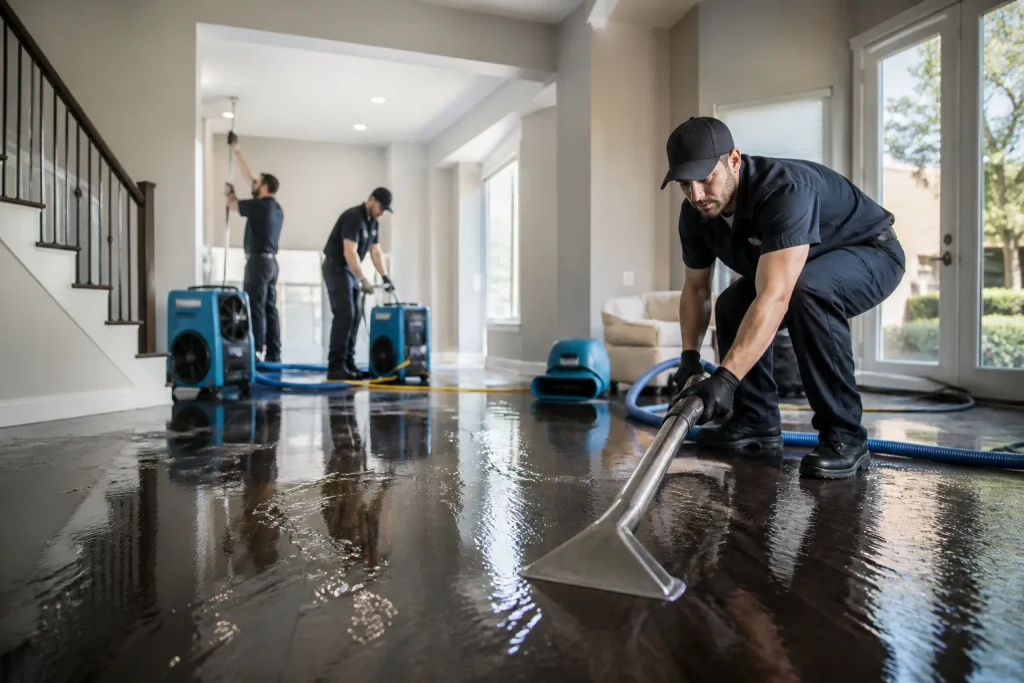
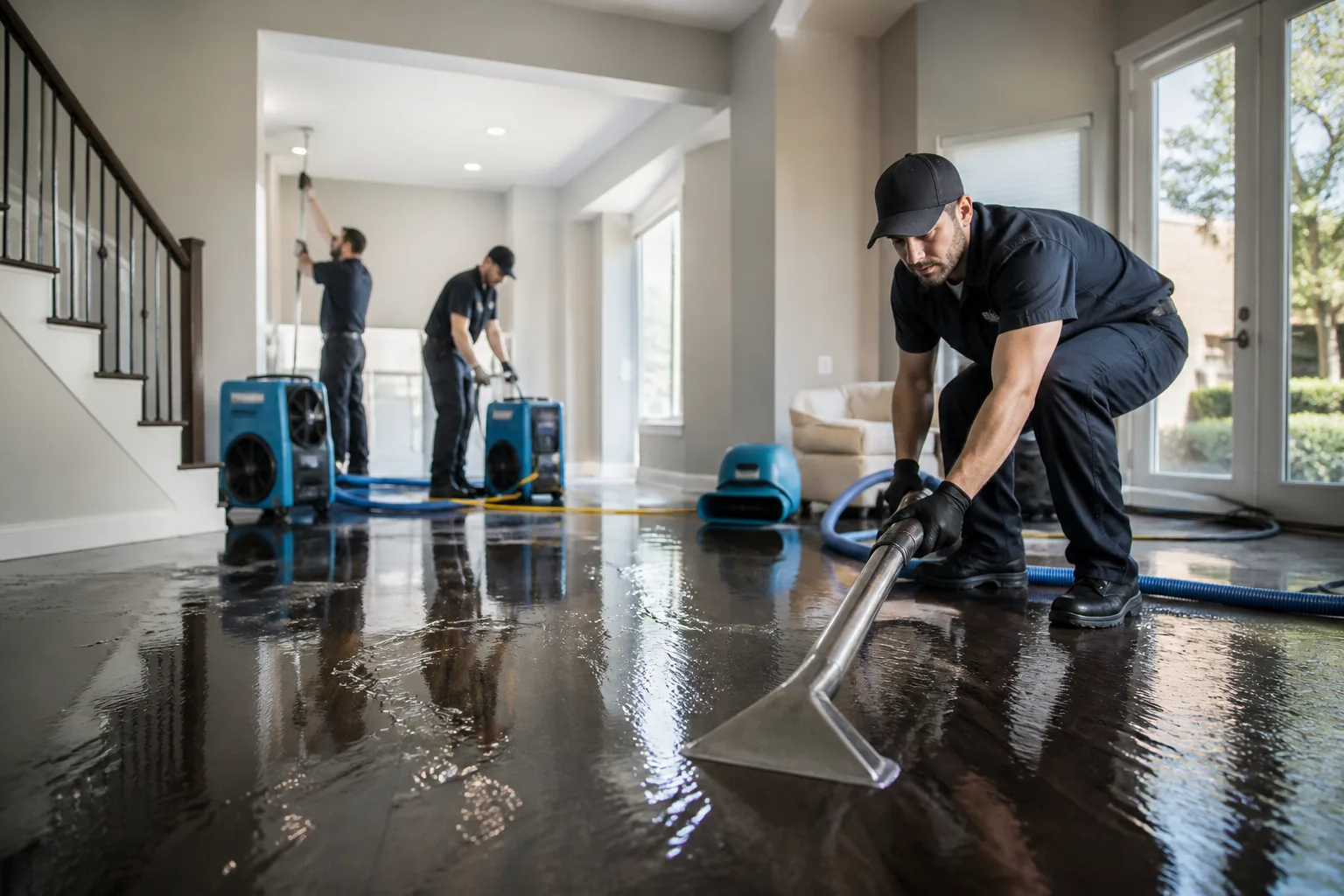
Once extraction is done, commercial drying equipment goes in. Industrial air movers and dehumidifiers cannot wait until tomorrow. Every hour of delay means water has moved deeper into drywall cavities, under vinyl plank flooring, and into the pores of wood framing.
This is also when a competent technician takes psychrometric readings. That mouthful simply means measuring the temperature, humidity, and dew point in the affected room and comparing them to the same readings in an unaffected control area of your home. Those numbers tell us the actual drying load: how much moisture is in the air, how much is in the materials, and what it will take to pull the structure back to a stable state.
Here is the thing most Los Angeles homeowners never hear: those initial readings are the only proof that same-day work actually started. If a company cannot show you a written log with dated baseline readings from day one, you cannot verify when their drying actually began. Ask for the printed log. It takes a technician about 15 minutes to generate, and it should be handed to you or emailed before the crew leaves that day.
Hours 6 – 24: Active Drying and Monitoring Begins
With equipment running, the active drying phase starts. Air movers create evaporation at the surface. Dehumidifiers pull that moisture out of the air and drain it away. The two work as a team: movers push water vapor off the wet surface, and dehumidifiers capture it so it cannot recondense elsewhere in the house.
A same-day job means this cycle is underway by the time you go to sleep on the day of your call. Not scheduled to start tomorrow. Running. In a Los Angeles summer, where ambient humidity can spike in coastal neighborhoods like Venice or Marina del Rey, getting dehumidification running on day one matters even more. The outside air is fighting against the drying process if windows are left open or the affected area is not sealed off properly.
Monitoring visits typically happen every 24 to 48 hours after day one. The company should return, take new psychrometric readings, compare them to the baseline, and adjust equipment placement as the moisture map shifts. Drying is not a set-it-and-forget-it process. A room that reads dry at the surface can still hold elevated moisture in the drywall 18 inches up or in the subfloor below.
The Los Angeles Traffic Variable: How Dispatch Zones Affect “Same-Day”
Here is a question almost no one asks before booking: where is the crew actually located?
Los Angeles is a sprawling metro. A restoration company with one dispatch hub in Santa Clarita is not going to get a crew to Long Beach in 90 minutes at 3 p.m. on a Tuesday. Traffic is a physical law in this city. The 405 at rush hour does not care about your water emergency.
When you call a restoration company, ask directly: “Where are your technicians based, and how many crews are on call today in my area?” Some companies run multiple satellite dispatch points across the city. Others run a single office and hope for the best with freeway times. The difference determines whether “same-day” is a genuine operational capability or a call-center promise with no crew behind it.
At Marsh Water Damage Restoration, our dispatch structure is built around getting a Los Angeles-based technician to your door as fast as physically possible, not as fast as a marketing script claims. We will tell you the local pro’s current location, give you a realistic arrival window, and send you the technician’s name and photo before they head your way.
That last part matters more than most people realize until they are standing at their front door, alone with two young kids and a stranger on the other side. Our Threshold Verified protocol means every technician is background-checked, identity-verified, uniformed, and photo-badged. You know who is coming before the knock, and you can verify their photo ID when they arrive. In a city the size of Los Angeles, that is not a courtesy. It is the bare minimum for letting someone into your home during a crisis.
What Equipment Must Be On-Site Same-Day Versus What Can Wait
Not everything needs to happen on day one. Understanding the difference protects you from being oversold a full rebuild when the immediate need is simply to stop the water and start drying.
Must be on-site same-day:
- Extraction equipment: Whether truck-mounted or portable, standing water removal is an hour-one task, not a day-three task.
- Industrial air movers: These are not box fans. They move air at a volume and velocity that standard rental equipment cannot match. Without them, drying stall is virtually guaranteed.
- Commercial dehumidifiers: A homeowner-grade dehumidifier from a hardware store pulls a fraction of the moisture per day that a Dri-Eaz or Phoenix unit does. The difference is measurable in the time it takes to reach a dry standard.
- Moisture meters and psychrometer: If a technician arrives without the tools to measure moisture content and relative humidity, they cannot establish a baseline or prove drying is progressing.
Can wait:
- Final drywall repair and repainting
- Flooring replacement or refinishing
- Baseboard and trim work
- Any cosmetic carpentry
A company that tries to sell you on full reconstruction before the drying is even done is putting the cart before the horse. The priority on day one is extraction, equipment placement, and baseline data. A written scope of the repair work that will follow drying should be provided, with a price, before any demolition goes beyond removing already-damaged material. That is another place where Los Angeles homeowners get burned: the verbal estimate that balloons into a five-figure surprise after demo starts. Demand a written price before the work begins. If a company will not put it in writing, find one that will.
One more equipment note: the brands matter less than the class of equipment. A Dri-Eaz dehumidifier and a lesser-known commercial unit often perform comparably if properly sized. What matters is that it is genuine commercial drying equipment, not consumer fans and a rented Rug Doctor. If the company cannot tell you what equipment they are bringing and how many units per affected room, they are guessing.
Why the Written Guarantee Separates a Real Same-Day Promise from a Script
Same-day promises only mean something when they are part of a written commitment with consequences if missed. Verbal assurances over the phone are worth exactly zero when a crew fails to show and your water damage is spreading.
Ask the company you are considering: “If your crew does not arrive on the day you promise, what happens?” Most cannot answer that because there is no mechanism behind the promise. It is a marketing line.
Here is what we put on paper, on every work order, without exception:
- A written price before any work starts
- A written guarantee on every repair
- A free second visit if the repair is not right
- The Done Right Promise: if the repair is not right within a full year, Marsh makes it right. This is documented, time-stamped, and printed on every work order. No fine print. No arbitration clause. Just a standing commitment.
That is not marketing language. It is what you should expect from any restoration company you let into your home. If a company will not put its same-day promise in writing with stated consequences for missing it, assume the promise disappears the moment you hang up the phone.
The Bottom Line
Same-day water damage restoration in Los Angeles is a specific sequence of events: a technician on-site within hours, standing water extracted, commercial drying equipment placed, psychrometric baseline readings recorded, and a written log proving the drying process started that day. If any of those pieces are missing, you did not get same-day restoration. You got a same-day estimate.
Ask the right questions before you book. Where is the crew located? Is the person arriving a technician with equipment or a salesperson? Will I get baseline moisture readings on day one? Is the same-day promise in writing? These four questions take 90 seconds to ask and save days of drying delays and thousands in unnecessary secondary damage.
If you are in Los Angeles and dealing with water damage right now, call (910) 613-6568. A live person answers. We will tell you our current crew locations, give you an honest arrival window, and send you the name and photo of your technician before they arrive. Free estimates, written pricing, and no obligation.
For more on our approach, see Water Damage Restoration in Los Angeles, Mold Remediation in Los Angeles, or Storm Damage Restoration in Los Angeles. You can also learn more about Marsh Water Damage Restoration home.
Frequently Asked Questions
It depends entirely on the company’s dispatch structure and current crew locations. A company with multiple crews positioned across the city can often arrive in one to three hours from your call. A company with a single office may take four to six hours or more, especially during peak traffic. Ask where their technicians are based before you book. At Marsh, we use Los Angeles-based dispatch so we can give you a realistic window, not an optimistic guess.
Not at reputable companies. Same-day dispatch is about operational capacity, not a premium upsell. Most residential water extractions in Los Angeles run between $1,200 and $3,500 before drying equipment is set, depending on the size of the affected area and the amount of standing water. Beware of any company that charges an “emergency dispatch fee” simply for answering the phone. A written price before work starts should include everything, no surprise same-day surcharge.
Look for three things: a technician (not a salesperson) arriving same-day with equipment on hand, psychrometric baseline readings recorded on day one and provided to you in writing, and a written guarantee that covers the repair for a stated period. At Marsh, every job gets those three things plus our Done Right Promise, printed on the work order.
Most homeowners policies cover sudden and accidental water discharge, like a burst supply line or an overflowing appliance. Gradual leaks are typically excluded, so understanding the source matters. Your restoration company should document everything with photos and written moisture logs from day one. That documentation makes the insurance process far smoother. At Marsh, we coordinate directly with your adjuster and provide photo-documented evidence of the damage and the drying process. Call (910) 613-6568 and we will help you work through the coverage questions with your carrier.
Written by the team at Marsh Water Damage Restoration.
Need Damage Restoration Help?
Call Marsh Water Damage Restoration - licensed & insured, here with fast after-hours help in Los Angeles.
(910) 613-6568