
Water Damage Restoration Pricing Breakdown: What Los Angeles Homeowners Pay in 2026
Most Los Angeles homeowners will pay between $1,800 and $9,000 for water damage restoration in 2026, with smaller contained leaks running $1,800 – $4,500 and multi-room events with structural drying reaching $8,000 – $22,000 or more. The single largest line item on almost every invoice is drying equipment rental, billed per day per unit, not the labor itself. If you’d rather skip the math and talk to someone directly, call (910) 613-6568 and we’ll walk you through what your specific situation will cost.
Here’s the thing nobody tells you: the average water damage restoration invoice in Los Angeles includes at least four line items that homeowners have never heard of and can’t verify. Not because contractors are dishonest. Because the pricing system was built for insurance adjusters, not for the person standing in a wet hallway at 2 a.m. trying to figure out if $11,000 is reasonable. This is a translator.
What the Numbers Actually Look Like in Los Angeles
Before we get into line items and software, let’s put real dollar figures on the three most common scenarios we see in LA homes. These are 2026 ranges based on what we’ve written on actual work orders across the city, from West Adams to Sherman Oaks to Long Beach.
- Bathroom leak contained to one room: $1,800 – $4,500. This covers extraction, demolition of wet drywall or baseboards, drying equipment for 3 – 5 days, and basic reconstruction prep. The low end assumes the leak was caught within hours and flooring was tile, not wood.
- Kitchen water line failure with subfloor involvement: $4,000 – $9,000. Subfloors change everything. Once water sits under flooring, you’re looking at floor removal, subfloor drying or replacement, cabinet toe-kick drilling, and a longer equipment cycle.
- Multi-room event with structural drying: $8,000 – $22,000+. Think supply line rupture on an upper floor that soaked through ceilings into lower rooms. Now you’re drying wall cavities, running containment, possibly drying hardwood in place with specialized mats, and managing demo in multiple rooms.
What moves a quote from the low end to the high end in each range? Contamination level (clean water vs. sewage-adjacent), accessibility (crawl spaces and tight LA basements add labor hours), and how long the water sat before mitigation started. A leak that ran all weekend while you were away costs more to fix than one caught in an hour. Time is literally money here because wet materials absorb more water and begin warping or growing microbial colonies the longer they stay wet.
The Pricing System Behind Your Invoice: Xactimate Explained
If you’ve ever gotten two quotes from different Los Angeles restoration companies and noticed they’re suspiciously similar, there’s a reason. Almost all insurance adjusters and most reputable contractors price jobs using a software platform called Xactimate. It’s a national cost database with line items for everything: demolition per square foot, equipment rental per day, labor categories, materials, even disposal fees. The software then applies regional pricing multipliers that account for local labor rates, material costs, and licensing overhead.
Here’s why that matters to you: two contractors who both use Xactimate and both assess your damage honestly should submit scopes that are within 10 – 15% of each other. A quote that’s dramatically higher or dramatically lower than a competitor’s isn’t a deal or a rip-off, necessarily. A dramatically lower quote usually means someone is skipping line items (often drying equipment or containment). A dramatically higher one means someone is padding labor hours.
In Los Angeles, Xactimate rates run 20 – 35% above the national baseline for licensed contractor labor. That’s prevailing wage pressure, licensing costs, workers’ compensation insurance, and the general cost of operating in one of the most expensive metro areas in the country. So when you Google “average water damage cost” and see a national figure, add about a third. That’s what LA actually costs.
Line Items That Surprise Everyone: Equipment Rental
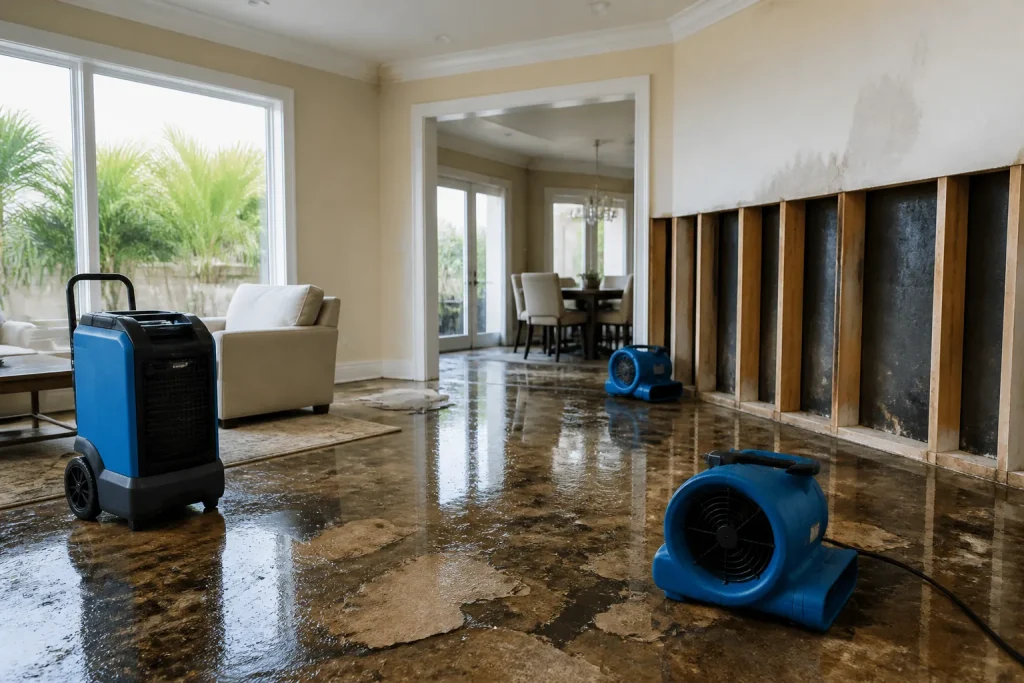
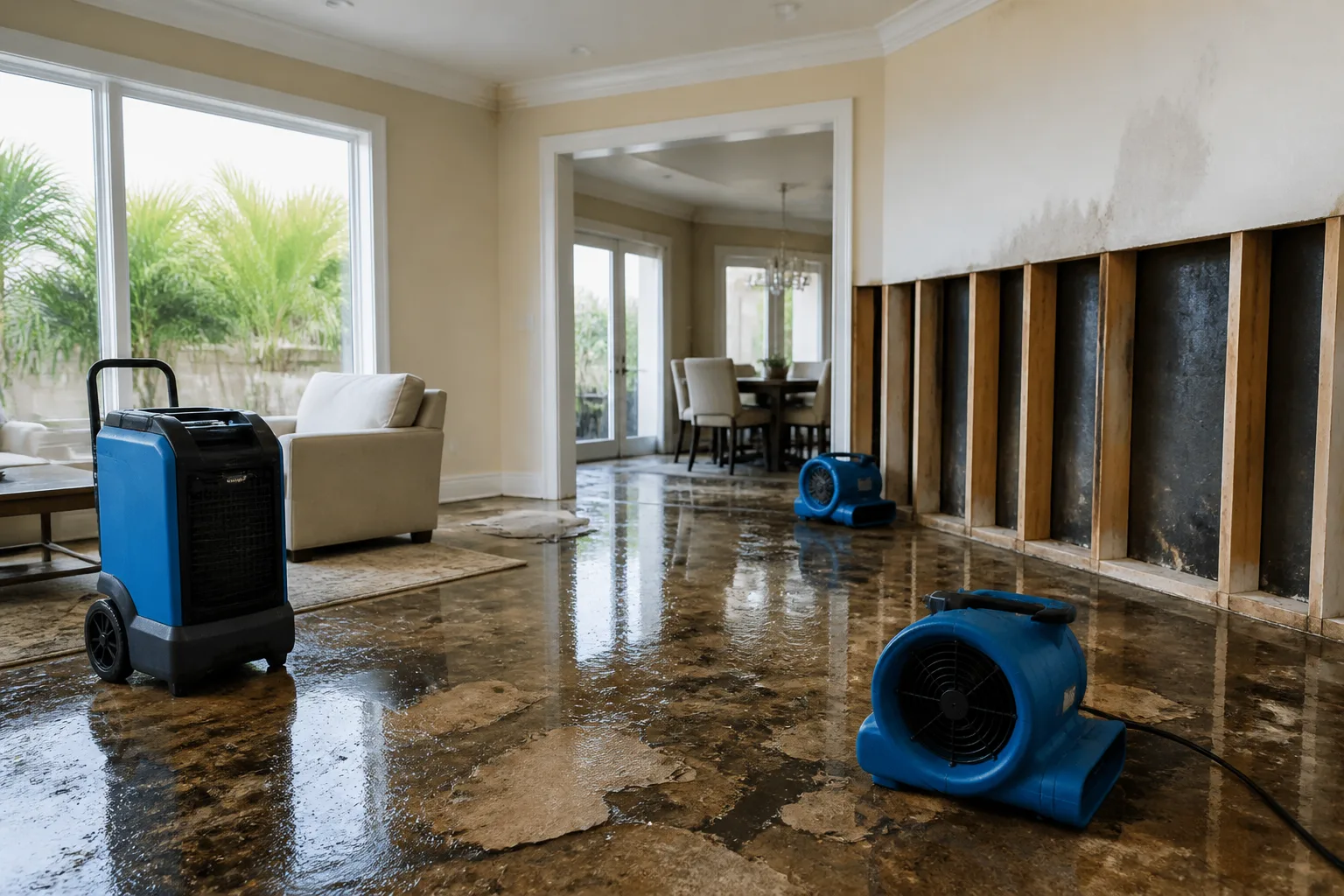
This is the line item that generates more phone calls to the office than anything else. A work order will list “Air Mover – 3 days – 8 units” and “Dehumidifier – 3 days – 2 units” and the total looks huge. Homeowners assume this is where the contractor is hiding profit. It’s not. Drying equipment is legitimately expensive, and it’s billed per day per unit because that’s how the machines earn their cost back.
A single commercial air mover from a manufacturer like Dri-Eaz or B-Air costs between $25 and $45 per day to run through a restoration job. A refrigerant dehumidifier runs $125 – $175 per day. A room that’s been properly flooded and needs structural drying might need six to ten air movers and two dehumidifiers running for four to seven days. Do the math and you can see how equipment alone hits $3,000 – $8,000 on a bigger job. That’s not profit padding. That’s what the gear costs to operate.
Now, the flip side: if a quote doesn’t include equipment line items at all, that’s a red flag. It means the drying step is being skipped, or worse, subcontracted away to someone who will bill you separately. Either way, you’re not getting a real restoration. You’re getting a mop and a promise. The water damage restoration process in Los Angeles requires actual mechanical drying, not just surface cleanup. Psychrometric readings (measuring the moisture in the air and in materials) tell us when the structure is genuinely dry, not just dry to the touch. Equipment is how you get there.
The Two Pricing Red Flags Specific to LA
We’ve been doing this, and in that time we’ve seen two patterns show up again and again in Los Angeles specifically. Both are worth watching for.
Red flag one: a lump-sum estimate with no line-item breakdown. You get a number like “$7,500 for full restoration” with no explanation of what that covers. Lump-sum estimates are almost always written for the contractor’s benefit. They give the contractor room to cut corners and pocket the difference. A legitimate restoration quote reads like an itemized receipt: demolition here, equipment there, labor at X hours, materials at Y cost. If someone won’t show you the math, ask why.
Red flag two: no drying equipment listed anywhere on the quote. We touched on this above, but it bears repeating because it’s the most common way homeowners in LA get burned. A quote for “water extraction and cleanup” without air movers, dehumidifiers, or drying mats means the contractor plans to suck up standing water and leave. The structure stays wet inside the walls and under the flooring. Six weeks later, you’ve got a mold problem and the original contractor is unreachable. At that point, you’re calling someone like us for mold remediation in Los Angeles, and the total bill is now double what a proper drying job would have cost.
We pulled a job out of a garage over in Mar Vista last month where exactly this happened. A homeowner had a water heater fail, paid a cut-rate crew to “take care of it,” and three weeks later called us because the drywall was growing something. The original invoice didn’t include a single day of equipment rental. The drying never happened. The repair cost more than if we’d been called first.
What Equipment Actually Gets Used on an LA Job
When we show up to a water damage job in Los Angeles, we’re bringing the same gear that large commercial restoration firms deploy. Air movers from Dri-Eaz and B-Air. Dehumidifiers sized for the square footage. For hardwood floors, Injectidry drying mats that pull moisture through the boards without tearing them out. Moisture meters and thermal imaging cameras to find water that’s hidden in wall cavities and under cabinets.
Each piece of equipment serves a specific purpose. Air movers create airflow across wet surfaces to speed evaporation. Dehumidifiers pull that evaporated moisture out of the air so it doesn’t just resettle somewhere else. Injectidry mats apply negative pressure to hardwood floors, drawing water up through the gaps between boards. The technician running all of this should have IICRC certification (the restoration industry’s primary training body) or RIA credentials (the Restoration Industry Association). Equipment without training is just a pile of loud fans.
If you’re dealing with storm-related water intrusion rather than an indoor plumbing failure, the equipment list expands. Storm damage in Los Angeles often brings contaminated water, which changes the containment and sanitation requirements. Our storm damage restoration services cover that side of things, and the pricing structure shifts accordingly.
How the Threshold Standard Changes What You’re Paying For
Here’s where I’ll mention something that matters when you’re comparing quotes. Every company quotes numbers. Fewer companies tell you exactly who will be standing in your living room. We do. Every Marsh technician is background-checked, identity-verified, and sent to you by name and photo before the visit. When they knock, they show a photo ID badge. Every time, not just on the first job.
That’s the Threshold Verified standard, and it’s built into the pricing. A background-checked, credentialed technician costs more per hour than a day laborer with a wet-vac. That’s not marketing spin. That’s a wage difference. So when you’re comparing quotes in Los Angeles, ask yourself: does this price include an actual vetted professional showing up with the right equipment, or does it include whoever was available and a truck rented that morning?
We also put a written price in your hand before any work starts, and a written guarantee on every repair. If the repair fails within 365 days, we make it right, and the second visit is free. That’s automatic, printed on every work order, not something you have to negotiate for. It’s a gamble.
Will Insurance Cover Any of This?
Short answer: usually yes, for sudden and accidental water damage. A burst supply line, a failed water heater, a storm-related intrusion, those are typically covered perils on a standard homeowner policy. What’s often not covered: gradual leaks that have been ongoing for weeks or months, or damage from lack of maintenance, or flooding from an external water source without a specific flood policy.
The pricing breakdown matters for insurance because adjusters and restoration companies speak the same language: Xactimate. When your restoration contractor writes a scope in Xactimate and your adjuster reviews it in Xactimate, the negotiation is about facts and line items, not opinions. That’s one more reason a line-item quote matters. If you hand your adjuster a lump-sum invoice from a contractor who refuses to itemize, expect pushback. If you hand them a detailed scope with equipment days, labor categories, and material quantities, the conversation is much shorter.
Photo documentation helps too. We document everything before, during, and after, which gives your adjuster exactly what they need to process the claim quickly. That documentation is part of our standard process on every job, not an add-on.
When to Call a Professional Right Now
Some water damage situations genuinely need a professional immediately. If water has been running for more than a few hours, if it’s soaked into drywall, if it’s near electrical outlets, or if the water came from a source that might be contaminated, don’t wait. The longer water sits, the more expensive the restoration becomes. A $600 wet-vac job becomes a $4,500 drying job becomes a $12,000 mold and structural repair job. The timeline from one to the next is shorter than most people think.
Electrical is the one thing I’ll always flag as genuinely dangerous. Water and wiring don’t mix, and a flooded room with live outlets is not a DIY situation. Cut the power at the breaker if you can do so safely and from a dry location, then call someone who knows what they’re doing. If you can’t reach the breaker or aren’t sure the panel is safe, stay out of the room entirely and call a professional.
If you’re in Los Angeles and you’re not sure whether your situation is a weekend project or a professional restoration, call us. We’ll tell you straight. Sometimes we tell people to just run fans and wait. Other times we tell them to shut the water off and stay out of the room until we get there. Either way, you get a real answer from a live person, 24 hours a day, including holidays. That’s (910) 613-6568.
Related services in Los Angeles: Marsh Water Damage Restoration home covers full-service water damage restoration, mold remediation, and storm damage response across the greater LA area.
The Bottom Line
Water damage restoration pricing in Los Angeles follows a consistent structure: labor at regional Xactimate rates, equipment rental billed daily per unit, demolition and material costs, and disposal. The equipment is the biggest cost driver, not the labor. A legitimate quote will itemize every one of those categories. A lump-sum quote won’t, and that’s a signal to ask more questions.
Most jobs fall between $1,800 and $9,000, with larger multi-room events pushing past $22,000 when structural drying and reconstruction are involved. Insurance usually covers sudden and accidental damage, and a detailed, line-item scope makes the insurance conversation significantly smoother.
If you’re in Los Angeles and need help, Marsh Water Damage Restoration offers free estimates. Call (910) 613-6568 and you’ll get a real person, a straight answer, and a written price before any work begins. No surprises, no pressure, just the truth about what your water damage will cost to fix properly.
Frequently Asked Questions
Most Los Angeles water damage restoration jobs cost between $1,800 and $9,000 in 2026. Contained single-room leaks run $1,800 – $4,500, kitchen water line failures with subfloor involvement run $4,000 – $9,000, and multi-room events with structural drying typically cost $8,000 – $22,000 or more. The largest cost driver is drying equipment rental, billed per day per unit. Call (910) 613-6568 for a specific estimate based on your situation.
LA labor rates for licensed restoration contractors run 20 – 35% above the national Xactimate baseline due to prevailing wage pressures, licensing costs, workers’ compensation insurance, and the region’s overall cost of operating. A national cost average you find online will almost always understate what an LA homeowner actually pays.
Check for a line-item breakdown that includes drying equipment, and check for the equipment line items specifically. A lump-sum estimate with no detail is written for the contractor’s benefit, not yours. A quote with no drying equipment means the drying step is being skipped or subcontracted, which leads to hidden moisture and eventual mold problems.
In most cases, yes, for sudden and accidental water damage like a burst supply line, failed water heater, or storm-related intrusion. Gradual leaks, lack-of-maintenance damage, and external flooding without a flood policy are typically not covered. A detailed, line-item scope written in Xactimate makes the insurance claims process faster because adjusters and contractors speak the same pricing language. Call (910) 613-6568 if you need help navigating your claim.
Written by the team at Marsh Water Damage Restoration.
Need Damage Restoration Help?
Call Marsh Water Damage Restoration - licensed & insured, here with fast after-hours help in Los Angeles.
(910) 613-6568