

Free visual inspection and a written scope of work before any mitigation begins - photos, moisture readings, and drying logs go in your claim file
The scope we write is the scope we bill. Anything new gets shown to you, in writing, before we touch it.






 Before
 After
After Before
 After
After Before
 After
AfterRestoration Company in Covina, CA
Restoration work in Covina comes down to two recurring problems: slab leaks from aging galvanized pipe, and smoke or stormwater intrusion tied to the San Gabriel Mountains and the Santa Ana winds. We respond to all three service lines here – water, mold, and storm damage – but the way we approach a Covina job is shaped by houses built between 1950 and 1975 on concrete slabs, with original supply plumbing that hasn’t been touched in sixty years. If you’re standing in water or watching a ceiling stain spread, call (910) 613-6568 and a live person will answer.
Why Covina Homes Are Different
Covina’s post-WWII boom produced block after block of single-story ranch homes on concrete slabs. Those slabs are the problem. Original galvanized steel supply lines run beneath them, and Covina’s municipal water is hard – harder than most of coastal LA – which accelerates corrosion from the inside out. When a line finally lets go, water travels up through the slab and wicks into baseboards, drywall, and door casings before anyone sees a puddle. By the time you notice damp carpet in a hallway, the perimeter of the foundation has usually been wet for days.
Summer complicates things. Covina’s inland valley air stays dry enough that a slow slab leak can evaporate at the surface while the subfloor and wall cavities stay wet. Mold establishes itself behind drywall long before staining appears. Then winter atmospheric rivers arrive, dumping rain on soil that has baked hard through months of drought. Older clay sewer laterals in the flat blocks south of Badillo and around the historic downtown core back up, and low-lying yards become ponds. Homes near Charter Oak and the northern foothill streets also catch Santa Ana-driven smoke and ash from San Gabriel Mountain fires – sometimes the same house files a smoke claim in September and a stormwater claim in January. That two-phase cycle is something we treat as normal in Covina, because it is.
Our Main Covina Services
Most Covina calls come in as water damage first, then mold if the leak sat hidden through a dry summer. Storm damage spikes during atmospheric-river season and Santa Ana wind events. Each service has its own page with pricing, process, and the local details that matter.
Water Damage Restoration in Covina
Slab leaks are the biggest driver of water damage in Covina, and they demand a different drying protocol than, say, an overflowed tub in a second-floor bathroom. Water trapped under a slab perimeter doesn’t respond to surface fans alone; the floor assembly has to be opened and dried from below while the supply line is being diagnosed. Our crews run professional extraction and drying gear – Dri-Eaz and Phoenix equipment, the same commercial units used on large losses – paired with moisture readings that tell us when the structure is genuinely dry, not just dry on the surface. Full details live on our dedicated page: Water Damage Restoration in Covina.
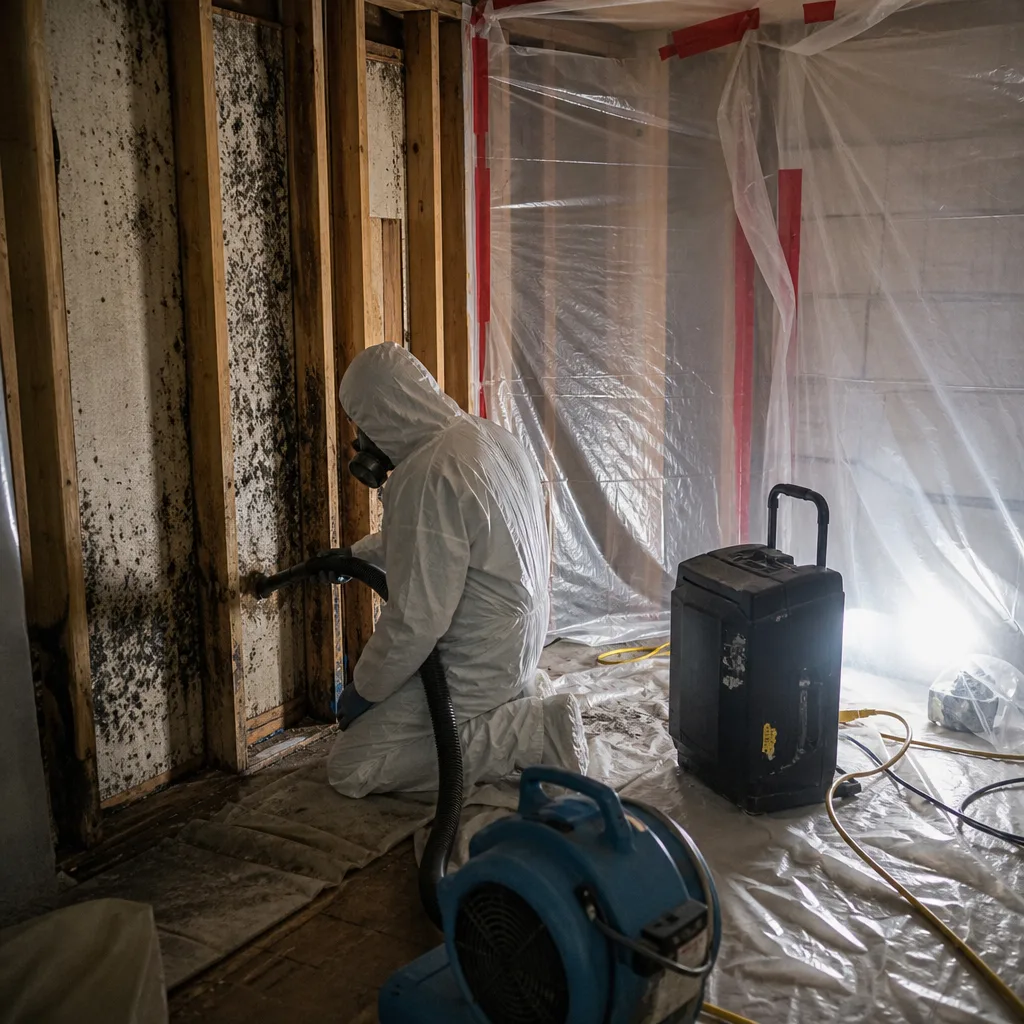
Mold Remediation in Covina
Covina’s dry summers hide slow plumbing leaks, and that is exactly the condition mold needs: moisture trapped behind drywall, warm air, and no visible water to prompt a phone call. By the time black staining shows at the baseboard or a musty smell settles into a hallway, the colony is usually well established. Remediation here means more than spraying a corner with bleach – it involves containment, removal of affected material, and air scrubbing to capture spores that have already spread through the HVAC system. We walk through every step in plain English on this page: Mold Remediation in Covina.
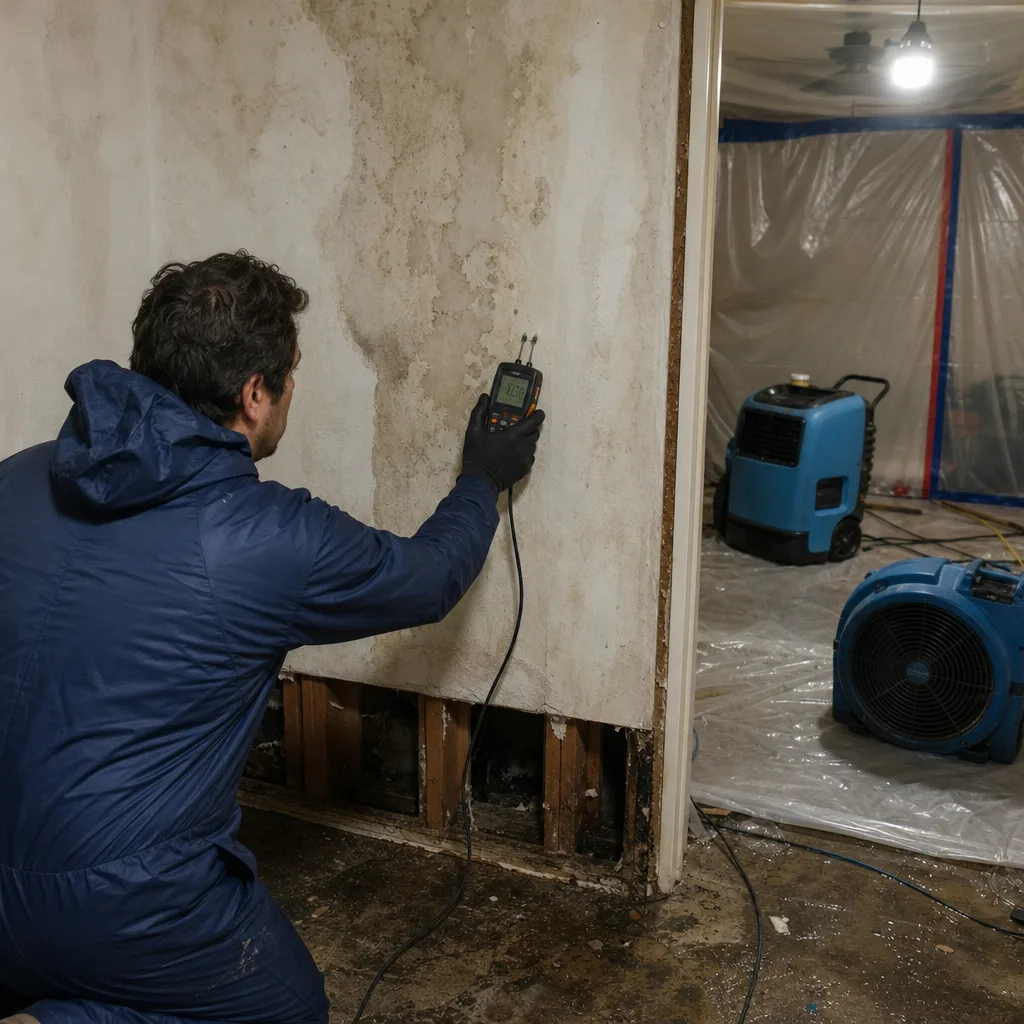
Storm Damage Restoration in Covina
When the Santa Anas push embers and smoke from the foothills through Covina’s northern neighborhoods, or when an atmospheric river overwhelms a clay sewer lateral and sends sediment-laden water into a garage, the work is different from a clean-water plumbing loss. It usually involves contamination – soot, ash, and stormwater carrying silt and whatever it crossed on the way in. Extraction, disposal of unsalvageable materials, and structural drying all move faster, and the contamination means PPE and containment protocols from the start. The full scope of what we handle is here: Storm Damage Restoration in Covina.
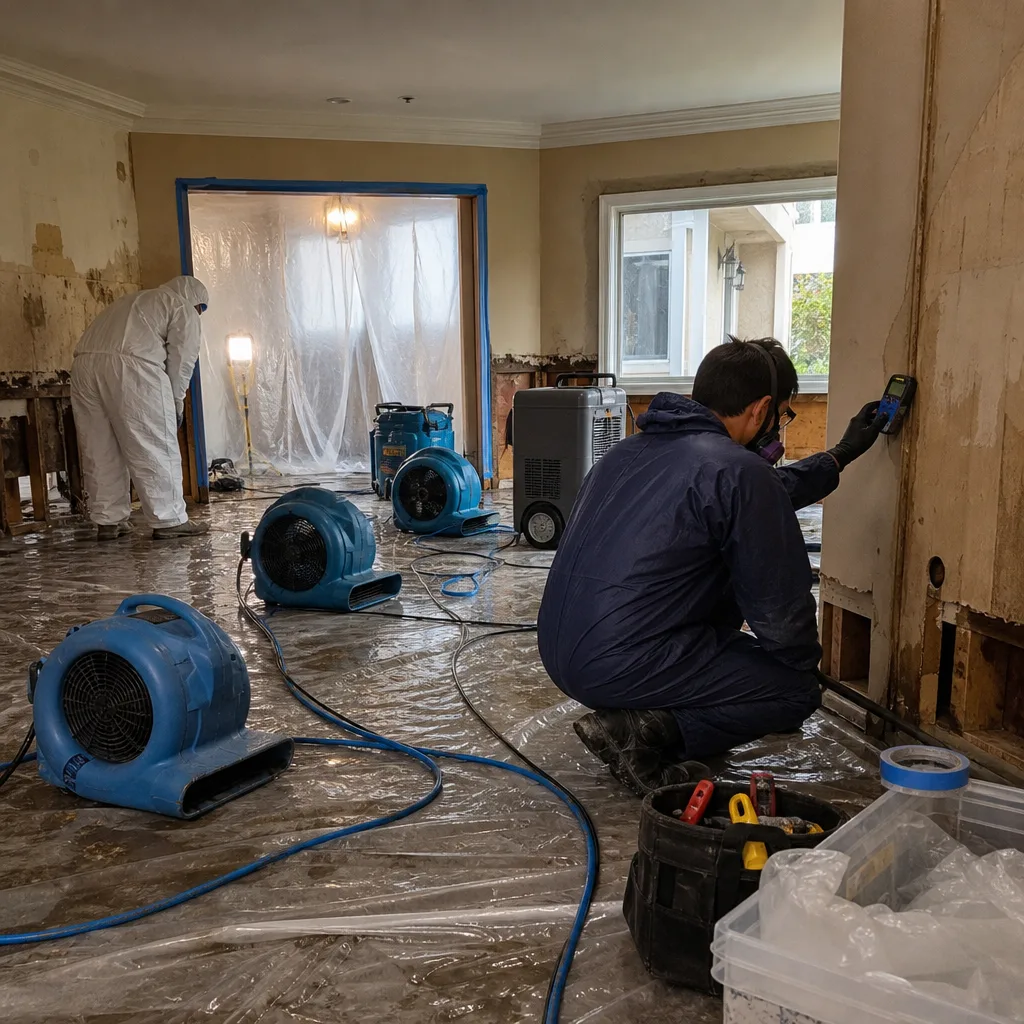
What happens when you call
- 1
A real person answersNo phone trees - you reach a local pro.
- 2
You get an upfront price rangeHonest numbers before anyone is dispatched.
- 3
A background-checked tech heads outLicensed & insured, dispatched right away.
- 4
You approve before work beginsNothing starts until you say go.
Brands We Service in Covina
We bring the same equipment brands to Covina homes that commercial restoration firms deploy on large losses: Dri-Eaz and Phoenix extraction and drying units, XPOWER air movers for rapid surface drying, and professional-grade dehumidification matched to the square footage. Parts are stocked locally in the metro area, so turnaround on equipment swaps is usually same-day. Our brands page shows the full lineup.
Pricing for Restoration Company in Covina, CA
| Service | Typical range in Covina |
|---|---|
| Water extraction (clean water, no structural drying) | $400 – $800 |
| Full water mitigation with drying equipment | $2,500 – $6,000 |
| Slab leak water damage (opening floor, drying perimeter) | $3,000 – $8,000 |
| Sewage or contaminated water remediation | $4,000 – $12,000 |
| Mold remediation (contained area, single room) | $1,200 – $3,500 |
| Mold remediation (multiple rooms, HVAC involvement) | $3,500 – $9,000 |
| Stormwater extraction and debris removal | $1,500 – $5,000 |
| Smoke and soot cleanup after a wildfire event | $2,000 – $7,500 |
| Structural drying after storm intrusion | $2,500 – $6,500 |
Covina prices trend higher when a slab leak has spread under multiple rooms, when a 1960s home still has original plaster-and-lathe walls that require delicate demo, or when smoke damage has worked into the HVAC ducts and every register needs cleaning. Whatever the scope, you’ll have a written price before any work starts – not an estimate that balloons after demolition begins.
Neighborhoods We Serve in Covina
Covina is compact enough that our crews move across the whole city in a single day, but we know the patterns in each pocket.
- Charter Oak and the northern foothill blocks – highest wind-driven smoke and ash exposure
- The historic downtown core and older Craftsman streets – 1920s and 1930s homes with wood-lathe-and-plaster interiors
- The slab-ranch tracts south of Badillo – the bulk of Covina’s 1950s – 1970s housing stock
- The apartment and condo clusters near the 10 and 210 corridors – shared-wall drying complications
- The low-lying residential blocks that catch stormwater runoff during winter atmospheric rivers
For most of Covina, we can have a crew on site within 60 to 90 minutes of your call. Foothill blocks during a Santa Ana event may run a bit longer because those are the calls that spike all at once.
Service Area – Cities Near Covina
Our Covina crews also handle jobs in the surrounding San Gabriel Valley cities, so if you’re just over the line you’re still in our coverage area. We respond regularly to Azusa, CA, West Covina, CA, Baldwin Park, CA, and Glendora, CA. The same Threshold Verified standard – background-checked techs sent to you by name and photo before arrival – applies everywhere we work.
Serving Covina, CA - Our Local Coverage Area
We’re based in the Covina area and know this community well. Use the map below to see our service coverage - if you’re nearby, we can almost certainly help.
FAQs About Restoration Company in Covina
Most Covina calls get a crew on site within 60 to 90 minutes. During a Santa Ana event or the first heavy atmospheric-river storm, response stretches slightly because calls spike across the foothill neighborhoods at the same time. A live person answers the phone 24/7 at (910) 613-6568 and will tell you a real arrival window, not a vague promise.
Water extraction, drying, and mold containment typically don’t require permits. Structural repairs or rebuild work – replacing drywall, flooring, or roof sections – may trigger Covina’s building department depending on the scope. We flag permit requirements in the written scope before any work starts, so you’re never surprised by a code issue mid-project.
Every technician is background-checked, identity-verified, and sent to you by name and photo before the visit. When they arrive, they show a photo ID badge – every time. That’s the Threshold Verified standard, and it’s applied to every job in Covina, not just first impressions.
What happens when you call
- 1A real person answersNo phone trees - talk to a local damage restoration pro.
- 2You get an upfront price rangeHonest numbers before anyone is dispatched. No surprises.
- 3We come out and measureLicensed & insured, at a time that suits you - the visit and the quote are both free.
- 4You get the price in writingLine-itemed, yours to keep, and nothing starts until you say go.
What Covina Customers Say
"Knowing the techs were background checked was a big deal with them working in our home for days. Respectful and careful with our belongings."
- Priya S."Washing machine hose burst while we were out. The crew arrived with badges, set up fans and dehumidifiers, and checked the wall cavities with a moisture meter. Floors were dry in four days."
- Colleen A."Clear communication about what insurance would cover and what wouldn't. Never felt pushed."
- Oscar P.