

Free visual inspection and a written scope of work before any mitigation begins - photos, moisture readings, and drying logs go in your claim file
The scope we write is the scope we bill. Anything new gets shown to you, in writing, before we touch it.






 Before
 After
After Before
 After
After Before
 After
AfterFast, Reliable Mold Remediation Across Closter
Mold remediation in Closter typically costs between $1,800 and $6,500 for a contained basement job, and most projects can be scoped within 24 hours of your call. If you’re seeing black spots spreading across drywall, noticing a musty smell that won’t quit, or dealing with a basement that flooded after the last nor’easter, the mold is already active. Our local crews know Closter’s postwar split-levels and colonials, we know how Closter Brook behaves when it overtops, and we know the streets where oak and maple limbs come down first. Call (910) 613-6568 and a live person answers, day or night.
Key Takeaways:
- Typical Closter mold remediation runs $1,800 – $6,500 depending on containment size, hidden cavity drying, and whether asbestos abatement enters the picture.
- Storm-driven basement flooding along the Closter Brook corridor grows mold within 48 – 72 hours, so speed matters.
- Every tech we send to your door is background-checked and photo-badged under the Threshold Verified standard. You’ll know who’s coming before the knock.
- Written price before any work starts. 365-Day Done Right Promise. Free second visit if the repair isn’t right.
Why Marsh Water Damage Restoration Is Closter’s Preferred Mold Remediation Company
Closter homeowners call us because we answer the phone and tell them the truth. Tobias Reyner, who leads our team, has built a restoration operation around two things: professional-grade drying technology and a safety protocol that respects who you’re letting into your house. Since 2005, Marsh Water Damage Restoration has operated as part of the Threshold Group family of restoration companies, and the Threshold Verified standard applies to every visit we make in Closter, no exceptions.
Here’s what that means when we show up: every technician is background-checked, identity-verified, uniformed, and photo-badged. You get a name and photo sent to you before the visit. The tech shows a photo ID badge at the door. No mystery crews, no “someone will be out sometime this week.” Our response time to Closter averages under 90 minutes for emergency calls because we stage equipment regionally and dispatch from the brand’s New York City office to Closter streets every day.
Local knowledge matters. We know which Closter homes hide asbestos floor tile under newer flooring. We know which basements in the borough’s lower-lying streets take on water every time Closter Brook rises. We know the original 1960s French drains that have silted in and never moved a gallon since Reagan was president. That’s not generic restoration talk. That’s Closter.
Mold Remediation Services in Closter
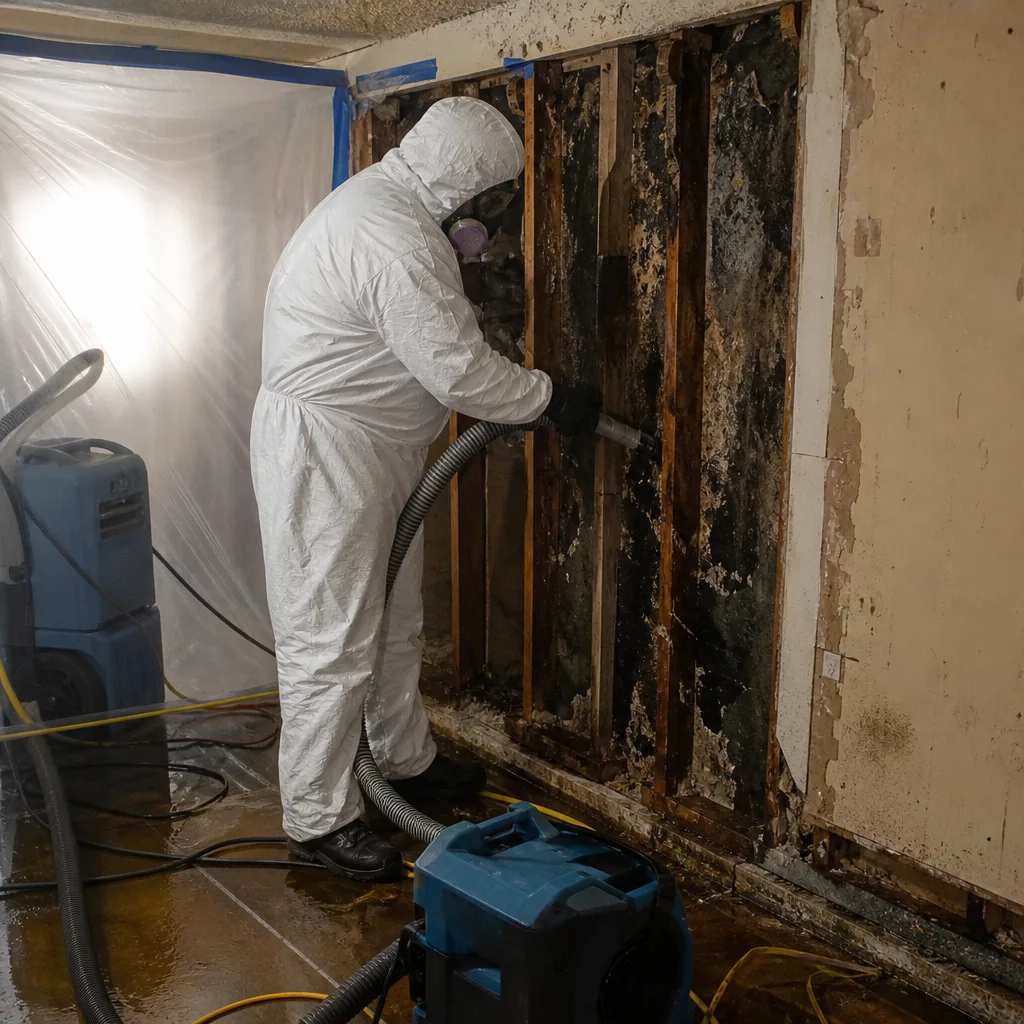
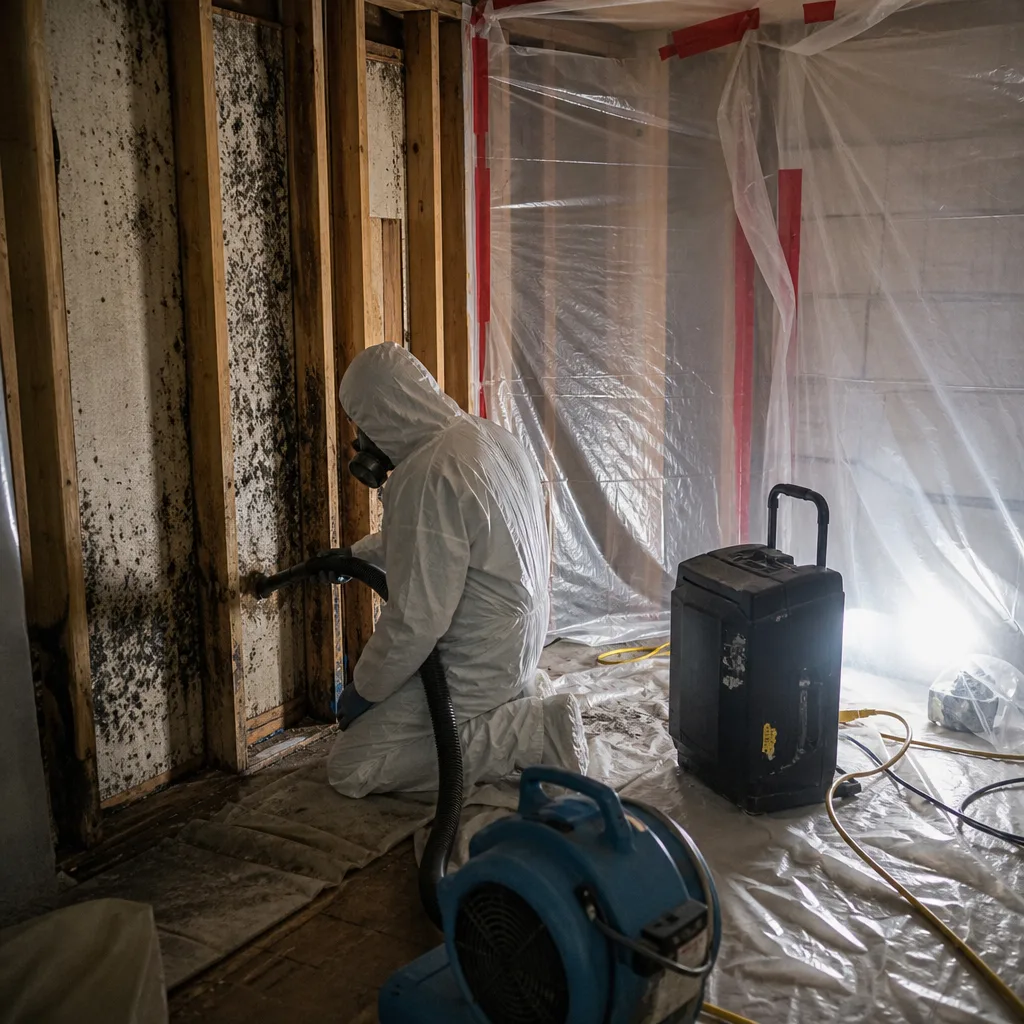
Mold Remediation services in Closter begin with a containment plan that stops spores from migrating into clean areas while we remove the affected material. In a typical borough split-level, that means setting up negative-air containment in a finished lower level, cutting out the damaged drywall, treating the framing with antimicrobial solution, and running commercial drying equipment until the moisture readings confirm the structure is actually dry. Most Closter basement remediations run $2,200 – $4,800 before we talk about hidden moisture in wall cavities or behind paneling. We flag the asbestos question before we cut, not after.
Containment and Air Quality Control
We run HEPA-filtered negative-air machines from XPOWER and Dri-Eaz during every Closter mold job. Psychrometric readings (measuring the moisture in the air, not just guessing) tell us when the environment has stabilized enough to prevent regrowth. After remediation we conduct a clearance reading, and you get documentation of pre-loss and post-remediation conditions if you’re filing an insurance claim.
Bilingual Scope Walk-Throughs
For Closter homeowners who prefer Korean, our bilingual estimator walks through the moisture mapping, drying logs, and containment plan line by line before any work is approved. Insurance documentation can be produced in Korean, which helps when the carrier asks questions and you want answers you can read yourself, not just sign.
What happens when you call
- 1
A real person answersNo phone trees - you reach a local pro.
- 2
You get an upfront price rangeHonest numbers before anyone is dispatched.
- 3
A background-checked tech heads outLicensed & insured, dispatched right away.
- 4
You approve before work beginsNothing starts until you say go.
Professional Mold Removal in Closter
Professional Mold Removal in Closter means cutting out and carting away the material that’s already infected, not just spraying bleach on drywall and calling it done. Bleach doesn’t kill mold behind paneling or inside wall cavities. It bleaches the surface. The mold colony survives, goes dormant, and comes back when the humidity climbs again. In Closter’s housing stock, where 1950s block foundations hold moisture like a sponge and original cast-iron drain stacks have been weeping for decades, surface treatment fails within a season. Our Mold Remediation team cuts back to clean substrate, treats what remains, and dries the cavity so the problem doesn’t just pause. Professional removal in a finished Closter lower level typically runs $2,800 – $5,500, with asbestos-tile abatement adding $1,200 – $2,400 when it’s uncovered.
Basement and Lower-Level Removal
Closter basements flood, and flooded basements grow mold in the trim, behind baseboards, and inside wall cavities where the water wicked up and never dried. We remove the baseboard and drywall up to the moisture line, treat the framing, and dry with Injectidry panel systems that pull water from behind walls without ripping out more than necessary. The goal is to save what’s salvageable and remove what isn’t.
Crawl Space Treatment
Borough split-levels often have half-crawlspace, half-basement foundations. The crawlspace side collects condensation, rot, and mold on floor joists that most homeowners never see until the smell migrates upward. We treat the affected wood, install vapor barriers where appropriate, and adjust ventilation so the moisture source gets addressed instead of just scrubbed.
Trusted Brands We Service in Closter
Our Closter crews run Dri-Eaz air movers and dehumidifiers, Phoenix drying systems, and XPOWER negative-air machines, all IFA-credentialed technician standards in the restoration industry. These aren’t rental-counter units. They’re commercial-grade drying platforms, the same equipment used on large commercial losses, applied to a Closter basement or crawlspace. We stock parts and replacement filters locally for Closter customers, so a mid-job equipment swap doesn’t mean three days of waiting. If a dehumidifier faults at 8 p.m., we replace it that night, not next Tuesday.
Common Mold Remediation Problems We See in Closter Homes
- Storm-driven black water from Closter Brook. When the nor’easter pushes the brook’s drainage corridor over capacity, finished lower levels take Category 3 water, which carries sewage and pathogens. Treating it as clean water skips the antimicrobial treatment that Closter basements specifically need.
- Original 1960s French drains that have silted in. A French drain from the Kennedy administration isn’t moving water anywhere. Moisture builds behind block foundations, wicks into paneling and drywall, and the mold cycle repeats every storm season until the drainage gets addressed.
- Hidden asbestos under postwar flooring. Successive renovation layers in Closter colonials hide asbestos-containing floor tile and vermiculite. Crews that don’t flag this before cutting trigger mandatory abatement mid-job, which expands the scope and timeline before structural drying ever starts. We test and document first.
- The oak and maple canopy delays containment. Almost every Closter street has mature oaks and maples. After a storm, branch-and-debris clearing has to happen before we can stage containment and air movers. The 24-to-48-hour mold clock is running while a chainsaw is still clearing the side door. We plan for that overhead on every Closter storm response.
Pricing for Mold Remediation in Closter, NJ
Here’s what Closter homeowners can expect to pay. A contained bathroom or closet mold job runs $1,200 – $2,500. A finished basement or lower-Level remediation with containment, demo, antimicrobial treatment, and drying equipment runs $2,800 – $5,500. Full crawlspace treatment with vapor barrier installation adds $1,500 – $3,500. If asbestos tile or vermiculite shows up, abatement adds $1,200 – $2,400. Factors that move the number: square footage of affected material, how much hidden moisture is in wall cavities, whether the French drain needs repair, and whether a canopy-clearing crew has to work before we can stage equipment. Every job gets a written price before any work starts. No estimate that balloons after demo begins. Call (910) 613-6568 for a free estimate and a walk-through.
We Also Serve Cities Near Closter
We’re the Mold Remediation in Closter team, and our crews also cover Demarest, Norwood, Haworth, and Harrington Park. If you’re in a neighboring borough, the same Threshold Verified protocol applies: background-checked techs, photo ID at the door, written price before work starts. Call (910) 613-6568 and we’ll route the nearest crew your way.
Serving Closter, NJ - Our Local Coverage Area
We’re based in the Closter area and know this community well. Use the map below to see our service coverage - if you’re nearby, we can almost certainly help.
FAQs About Mold Remediation in Closter
Mold germination begins within 24 to 48 hours after floodwater recedes, and on humid summer days in Bergen County, visible growth can appear in 72 hours. That’s why we treat Closter Brook overtopping as a mitigation emergency: we pull standing water, set containment, and start drying before the colony has time to establish in porous materials. If you’re inside that 48-hour window, call (910) 613-6568 and we’ll be there the same day.
Yes. A 1960s French drain that has silted in doesn’t move groundwater away from the foundation, so moisture builds behind the block wall whether the weather is wet or not. We map the drainage failure before we cut, because remediating mold without addressing the water source means the mold returns next season. We’ll scope the drain condition, note it for your records, and tell you whether it’s a simple cleanout or a full replacement before any mold work starts.
It’s common in Closter homes built between the 1950s and early 1980s. Asbestos-containing floor tile often hides under newer flooring, and vermiculite in attic spaces is a known issue in postwar colonials. We test before we cut. If abatement is required, it gets handled by a licensed abatement contractor and documented for your carrier, so the scope expansion is planned, not discovered mid-demo.
Because mature oaks and maples overhang almost every Closter street. After a storm, branches block the access points, the driveway, even the electrical panel on the exterior wall. Our storm response includes clearing those branches before containment and air movers can be staged. It’s labor overhead that open-lot suburbs to the south don’t carry, and it’s factored into our Closter response times.
Closter has one of the densest concentrations of Korean-American homeowners in Bergen County. When an insurance claim involves mold, the adjuster asks for moisture readings, drying logs, photos, and a written scope. Having that documentation in Korean means the homeowner can read and verify what’s being submitted, rather than relying on a summary from someone else. Our bilingual estimator walks through every line. It closes claims faster and with fewer disputes. Call (910) 613-6568 and ask for the bilingual scope walk-through.
Written by Tobias Reyner, Owner at Marsh Water Damage Restoration, serving Closter since 2005.