

Free visual inspection and a written scope of work before any mitigation begins - photos, moisture readings, and drying logs go in your claim file
The scope we write is the scope we bill. Anything new gets shown to you, in writing, before we touch it.






 Before
 After
After Before
 After
After Before
 After
AfterFast, Reliable Mold Remediation Across Queens Village
Mold remediation in Queens Village typically runs $1,800 – $4,200 for a contained basement or wall-cavity job, and most of our Queens Village calls start with either a sewage backup or a slow leak that’s been hiding behind plaster for weeks. We respond to Queens Village addresses the same day you call, because mold on a shared party wall doesn’t wait while spores drift into the neighbor’s half of the semi-detached. Call (910) 613-6568 any hour, and a live person answers, not a voicemail tree. Tobias Reyner built Marsh around a simple promise that matters here more than most places: you know exactly who’s walking through your door before the knock.
Why Marsh Water Damage Restoration Is Queens Village’s Preferred Mold Remediation Company
Queens Village homes are mostly 1920s – 1950s brick capes and Dutch colonials, many semi-detached, almost all with plaster-lath walls and finished basements. That housing stock has specific failure patterns we’ve mapped over hundreds of jobs, and it’s why our crews treat this neighborhood differently than a drywall-and-slab suburb across the county line. We know that a pipe burst in one half of a semi-detached on 104th Avenue doesn’t stop at the party wall, and we know that a Category 3 sewage backup in a Springfield Boulevard basement is a hazmat containment job before it’s anything else.
Every technician who arrives at your Queens Village door is background-checked, identity-verified, and sent to you by name and photo before the visit, then shows a photo ID badge when you open the door. That’s the Threshold Standard, and it’s printed on every work order along with a written price agreed before demolition starts and our 365-Day Done Right Promise: if the repair isn’t right within a year, we return and make it right, with a free second visit included automatically. Queens Village homeowners often tell us the badge at the door was the reason they picked up the phone instead of gambling on an unknown crew.
We’ve been part of the Threshold Group family of restoration companies since 2005, with technicians credentialed through IICRC, RIA, and IFA. The equipment on our trucks, Phoenix, XPOWER, and Injectidry, is the same commercial-grade gear used on large losses, and it’s what a plaster-lath wall cavity needs to actually dry, not just look dry on the surface.
Mold Remediation Services in Queens Village
Mold Remediation Services in Queens Village start with containment and moisture mapping, not demolition. The first sentence of every job is figuring out where water is still entering or trapped. On a 1,400-square-foot cape with a finished basement, that means pulling baseboards, drilling small inspection ports into wall cavities, and taking psychrometric readings (measuring moisture in the air and materials) to find what’s wet behind the plaster. Once the source is stopped and the affected area is contained under negative air pressure, we remove porous materials that can’t be cleaned: drywall sections, carpet pad, insulation, and any plaster that’s gone soft or crumbled. Then structural wood gets sanded, wire-brushed, or media-blasted, treated with an EPA-registered antimicrobial, and dried to a documented moisture standard before rebuild.
A typical contained mold remediation job in Queens Village runs $1,800 – $4,200. Small jobs, think a bathroom ceiling or a single closet, land at the lower end. A Category 3 sewage backup in a finished basement with wall-cavity drying and partial demo runs toward the higher end, plus DEP asbestos survey costs if pre-1980 materials are disturbed. You get the written price before any cutting starts.
Containment and Structural Drying
We build a physical containment barrier with negative air pressure before touching moldy surfaces. That’s what keeps spores from migrating through open doorways into your living space, and in a semi-detached Queens Village house, it’s what keeps spores from moving through the shared attic plane or party wall into the neighbor’s unit. Drying then runs on a documented schedule, Dri-Eaz dehumidifiers and XPOWER air movers, with daily moisture readings logged until the structure hits the target.
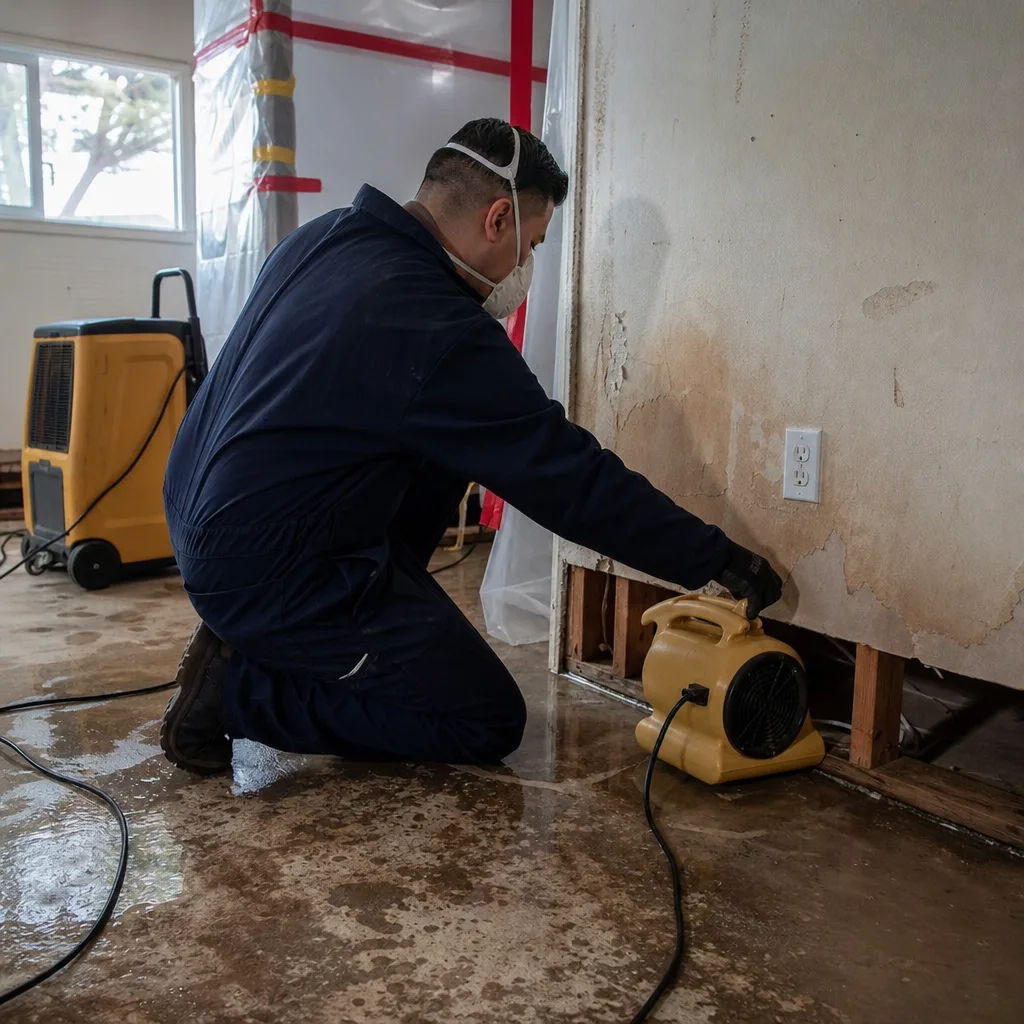
Black Mold and Air Quality Restoration
Stachybotrys, the “toxic black mold” you hear about, needs consistent moisture and cellulose to grow, and Queens Village plaster walls over old lath provide both when a leak goes undiscovered. We test before assuming, remove contaminated material under containment, and run HEPA air scrubbing and fogging to bring the air back to a baseline comparable to the exterior. Air quality restoration is standard on our mold jobs, not an add-on, because a basement that smells clean but still has spore-saturated air hasn’t been remediated.
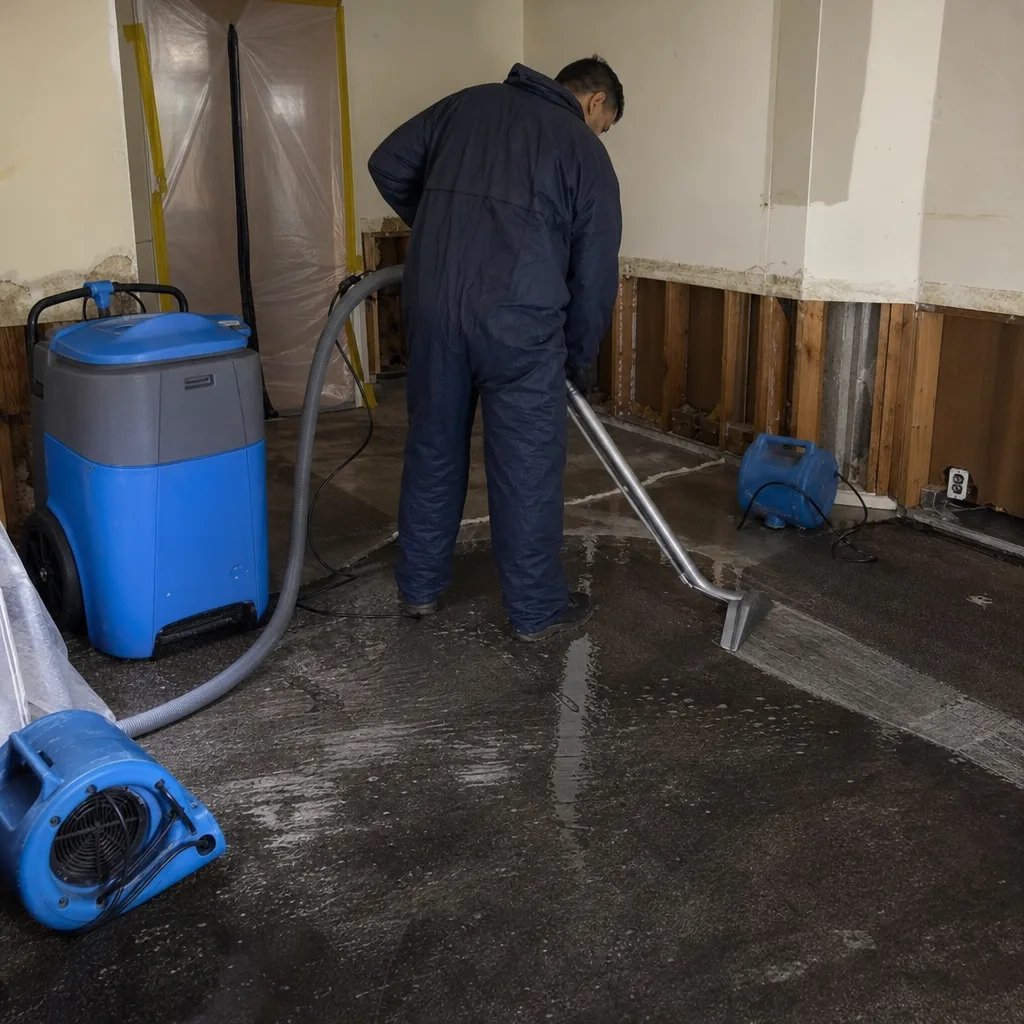
What happens when you call
- 1
A real person answersNo phone trees - you reach a local pro.
- 2
You get an upfront price rangeHonest numbers before anyone is dispatched.
- 3
A background-checked tech heads outLicensed & insured, dispatched right away.
- 4
You approve before work beginsNothing starts until you say go.
Professional Mold Removal in Queens Village
Professional Mold Removal in Queens Village is the physical removal of contaminated material and the drying of what remains, and it’s the part of the job where experience with plaster-lath construction shows. Plaster holds moisture invisibly. A wall can feel dry to the back of your hand while the lath behind it is at 30% moisture content, quietly feeding mold for months. Our crews know to inspect behind baseboards, around window frames, and at the bottom of exterior walls, the places where Queens Village capes and colonials trap moisture against brick and frame.
Removal on a standard Queens Village job means cutting out affected plaster and lath, bagging it under containment, and disposing of it as regulated waste, then treating the exposed framing and cavity with antimicrobial before rebuilding. It is not a bleach-and-paint situation, and anyone who tells you otherwise is giving you a cleaning, not a remediation. Cost for professional mold removal in Queens Village runs $1,200 – $3,800, with the range driven by square footage, cavity depth, and whether asbestos survey and abatement coordination is required before we can open walls.
Plaster-Lath Wall Cavity Drying
When we can dry a plaster wall instead of removing it, we use Injectidry panels to pull moisture out of the cavity without gutting the room. That’s the difference between a three-day job and a three-week rebuild. We’ll tell you honestly when drying is possible and when removal is the only correct answer.
Basement Mold and Sewage Cross-Contamination
A finished basement in Queens Village that backed up with storm sewer water is a Category 3 contamination event, not a mold job you can treat with a fan and bleach. Porous materials that absorbed sewage, carpet pad, drywall, baseboard, insulation, need removal, not drying. Treating Category 3 water as Category 1 is the most common mistake we correct in this neighborhood, and it’s how mold ends up growing inside the wall cavity weeks after the visible water is gone.
Trusted Brands We Service in Queens Village
We work on homes with equipment from every major dehumidification and air-movement brand, and we stock parts and supplies for Queens Village jobs from our New York City warehouse, so there’s no week-long wait on a Phoenix dehumidifier sensor or an XPOWER air mover motor. Our extraction and drying fleet runs on Dri-Eaz and Phoenix dehumidifiers, XPOWER and B-Air air movers, and Injectidry panel systems for plaster-lath cavity drying. If your home’s mold problem sits behind plaster and brick, that’s the gear that reaches it. Dispatch and scheduling for Queens Village are coordinated from our New York City office, and crews serve the neighborhood locally.
Common Mold Remediation Problems We See in Queens Village Homes
- Sewage backups misdiagnosed as clean water. Queens Village sits on an elevated inland plateau, so coastal surge isn’t the threat, but aging combined sewer lines surcharge during nor’easters and summer storms, sending Category 3 black water back through floor drains into finished basements. Porous materials that absorbed sewage need removal, not drying, or mold returns inside the cavity.
- Pre-1980 demolition stopped by DEP asbestos rules. Almost every home in Queens Village predates 1980, and NYC DEP requires a licensed asbestos investigator to survey and clear plaster, floor tile, and pipe insulation before any demolition phase. Homeowners who don’t know this find out when the contractor stops work and hands them a compliance notice, adding days and cost before rebuild.
- Shared-wall contamination in semi-detached homes. A mold bloom inside the party wall of a semi-detached brick colonial doesn’t respect the property line. Without proper containment and negative air pressure, spores move through shared attic planes and wall cavities into the neighbor’s unit, and suddenly one job becomes two insurance claims and two unhappy owners.
- Surface drying that leaves hidden moisture in plaster. Plaster-lath walls hold water differently than drywall. A standard air mover and a day of open windows won’t reach the lath behind the plaster, and we regularly find mold growing in cavities that a previous “remediation” simply painted over. Moisture mapping and cavity drying are not optional on these homes.
Pricing for Mold Remediation in Queens Village, NY
Here are honest numbers for the Queens Village market. A contained mold remediation with removal of affected plaster, wall-cavity drying, and antimicrobial treatment on a typical cape or colonial runs $1,800 – $4,200. A smaller job, like a bathroom ceiling or a single closet, lands around $1,200 – $1,800. A Category 3 sewage backup in a finished basement, which requires contaminated-material removal, full containment, structural drying, and rebuild, runs $3,500 – $8,000 depending on the extent of demolition. DEP asbestos survey and clearance costs, when triggered, add $450 – $1,200 depending on the materials tested. Every price is written before work begins, and the 365-Day Done Right Promise stands behind the repair. Call (910) 613-6568 for a free estimate from a Threshold Verified technician.
We Also Serve Cities Near Queens Village
Our Queens Village crews regularly work in Oakland Gardens, Hollis, Bellerose, and Floral Park, and the same written-price, Threshold Verified protocol applies in every one of those neighborhoods. If you’re just across the Nassau County line or a few blocks over on Hillside Avenue, call (910) 613-6568 and we’ll get a crew to you the same day. For the broader picture on our process, see our Mold Remediation service hub.
Serving Queens Village, NY - Our Local Coverage Area
We’re based in the Queens Village area and know this community well. Use the map below to see our service coverage - if you’re nearby, we can almost certainly help.
FAQs About Mold Remediation in Queens Village
Because plaster and lath hold moisture deep inside the wall cavity, and surface drying never reaches it. Plaster acts like a sponge, absorbing water from a leak or backup and releasing it slowly into the lath and framing behind it, where mold grows for weeks or months after the visible water is wiped up. That’s why our crews in Queens Village always moisture-map cavities and use Injectidry panels to dry inside the wall, not just the room air. Call (910) 613-6568 and we’ll tell you whether your walls are actually dry, not just dry-feeling.
It’s a Category 3 black water contamination event, which means the sewage-saturated materials have to be removed and the space decontaminated before any drying or mold treatment makes sense. Treating it as a simple water or mold job is the most common mistake we correct in this neighborhood, and it leaves spores and pathogens inside the wall cavity. We handle the full sequence: containment, removal, decontamination, structural drying, and rebuild, in that order.
Yes, for almost every home in Queens Village, because the housing stock predates 1980, and NYC DEP requires a licensed asbestos investigator to survey and clear plaster, floor tile, and pipe insulation before demolition begins. We sequence the job around the survey so you’re not stuck with a stopped work order and a compliance notice. Call (910) 613-6568 and we’ll explain exactly what’s required for your specific house.
We build physical containment with negative air pressure before any moldy surface is disturbed, and we seal off shared attic planes and party-wall penetrations so spores can’t migrate into the neighbor’s unit. That’s standard on every semi-detached job we do in Queens Village, and it’s why neighbors on both sides of the wall stay informed and uncontaminated. The containment stays up until the affected area is cleaned and air scrubbed.
A contained mold remediation with removal of affected plaster, cavity drying, and antimicrobial treatment on a standard Queens Village cape or colonial runs three to five days from setup to final clearance, assuming no delays from asbestos survey scheduling. Larger Category 3 sewage jobs or multi-room contamination can run seven to ten days, with rebuild scheduled after. We give you a written timeline with your written price, and we hit it.
Call (910) 613-6568 for a free estimate on mold remediation in Queens Village. A live person answers, day or night, and the technician we send to your door arrives with a name, a photo, and a badge you’ll see before they step inside.
Written by Tobias Reyner, Owner at Marsh Water Damage Restoration, serving New York City since 2005.