

Free visual inspection and a written scope of work before any mitigation begins - photos, moisture readings, and drying logs go in your claim file
The scope we write is the scope we bill. Anything new gets shown to you, in writing, before we touch it.






 Before
 After
After Before
 After
After Before
 After
AfterMold Remediation in Wilmington, CA: Why This Harbor Town Has a Different Mold Problem
Mold remediation in Wilmington runs between $900 and $4,200 for most residential jobs, with full black mold containment and structural drying landing between $2,500 and $6,500 depending on how far the growth has spread behind walls and under slabs. We respond to Wilmington calls the same day, usually within 60 to 90 minutes. The reason mold here behaves differently than in Torrance or Long Beach comes down to geology and salt air, which we’ll get into below. If you’re seeing staining, smelling must, or just got a bad inspection report, call (910) 613-6568 and a live person answers, day or night.
Fast, Reliable Mold Remediation Across Wilmington
Mold doesn’t wait, and neither do we. When a Wilmington homeowner calls about a musty bedroom wall or a dark bloom spreading under the kitchen sink, our crews are dispatched from the Los Angeles office and typically arrive within an hour. We know the streets here. Avalon Blvd, Pacific Coast Highway, the neighborhoods off L Street and Eubank, the older blocks near Banning Park. Our Mold Remediation team has worked enough of them to know what a 1940s bungalow’s plumbing looks like before we even open the door.
What makes Wilmington different is that the water feeding your mold problem often isn’t from a storm or an overflowing bathtub. It’s from under the slab. The ground here has been moving for decades, and that movement cracks supply lines and pulls galvanized pipe apart at the joints. By the time you see mold, the leak that fed it may have been seeping for months. That’s why our Wilmington mold jobs start with a moisture map and a slab-leak scan, not a surface guess.
Mold Remediation Services in Wilmington
Mold Remediation Services in Wilmington mean diagnosing the water source first, containing the affected area second, and removing the mold third. Skip the first step and the mold comes back in eight to twelve weeks. We’ve seen it happen. A homeowner wipes down the visible growth, paints over the stain, and the colony just keeps feeding on moisture trapped in a wall cavity fed by a pinhole leak in a galvanized branch line.
Read on for how we handle the specific conditions we see in Wilmington homes, and what those jobs typically cost.
Containment and Source Removal
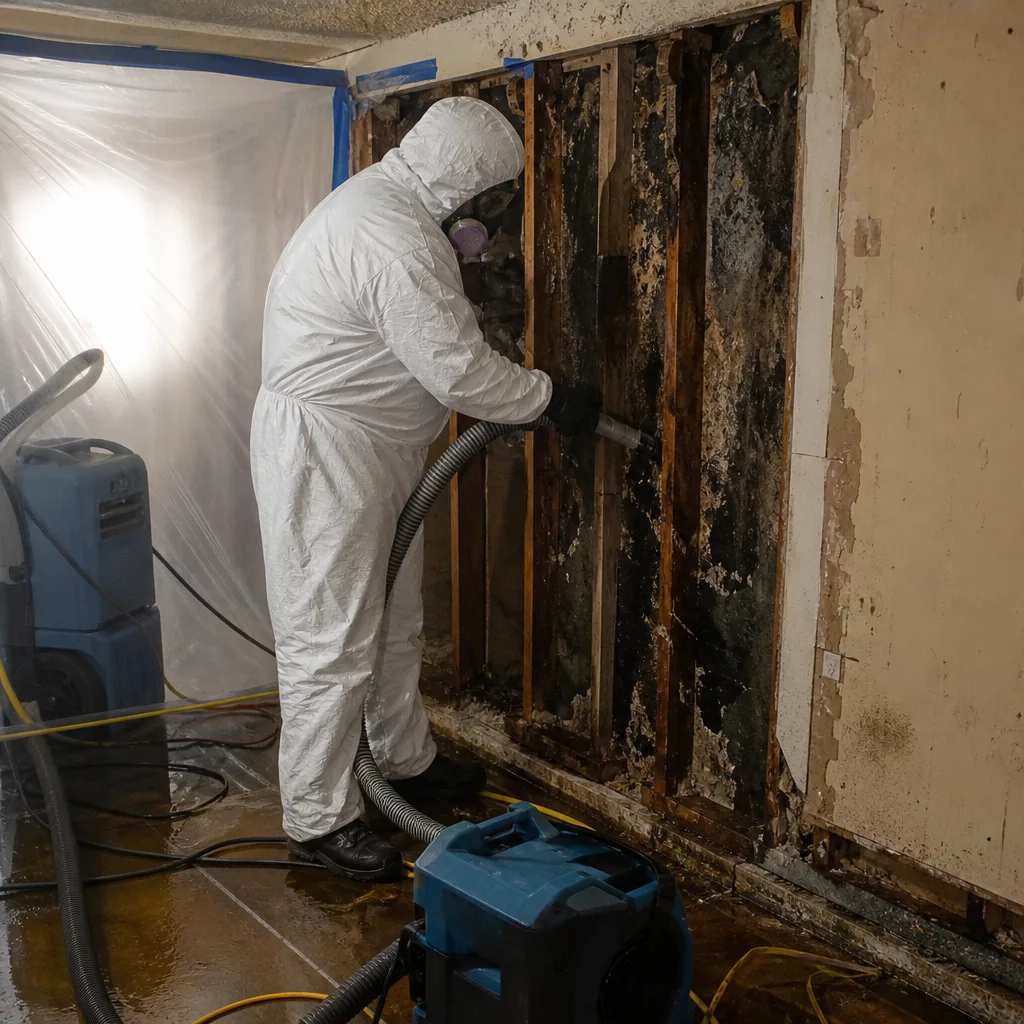
Every mold job starts with containment. Plastic sheeting, negative air pressure, sealed doorways. This keeps spores from spreading through the rest of the house while we work. In Wilmington, we set containment wider than the visible stain because the marine layer keeps humidity high enough that growth often extends farther inside the wall cavity than it does on the drywall surface.
Slab-Leak Forensics
Before we remove anything, we scan for the water source. Because Wilmington sits on the Wilmington Oil Field, slab movement and cracked branch lines are the most common root cause of concealed mold here. A moisture meter reading behind a baseboard tells us whether that bedroom wall is wet from a one-time spill or a slow seep that’s been running for months.
What happens when you call
- 1
A real person answersNo phone trees - you reach a local pro.
- 2
You get an upfront price rangeHonest numbers before anyone is dispatched.
- 3
A background-checked tech heads outLicensed & insured, dispatched right away.
- 4
You approve before work beginsNothing starts until you say go.
Professional Mold Removal in Wilmington
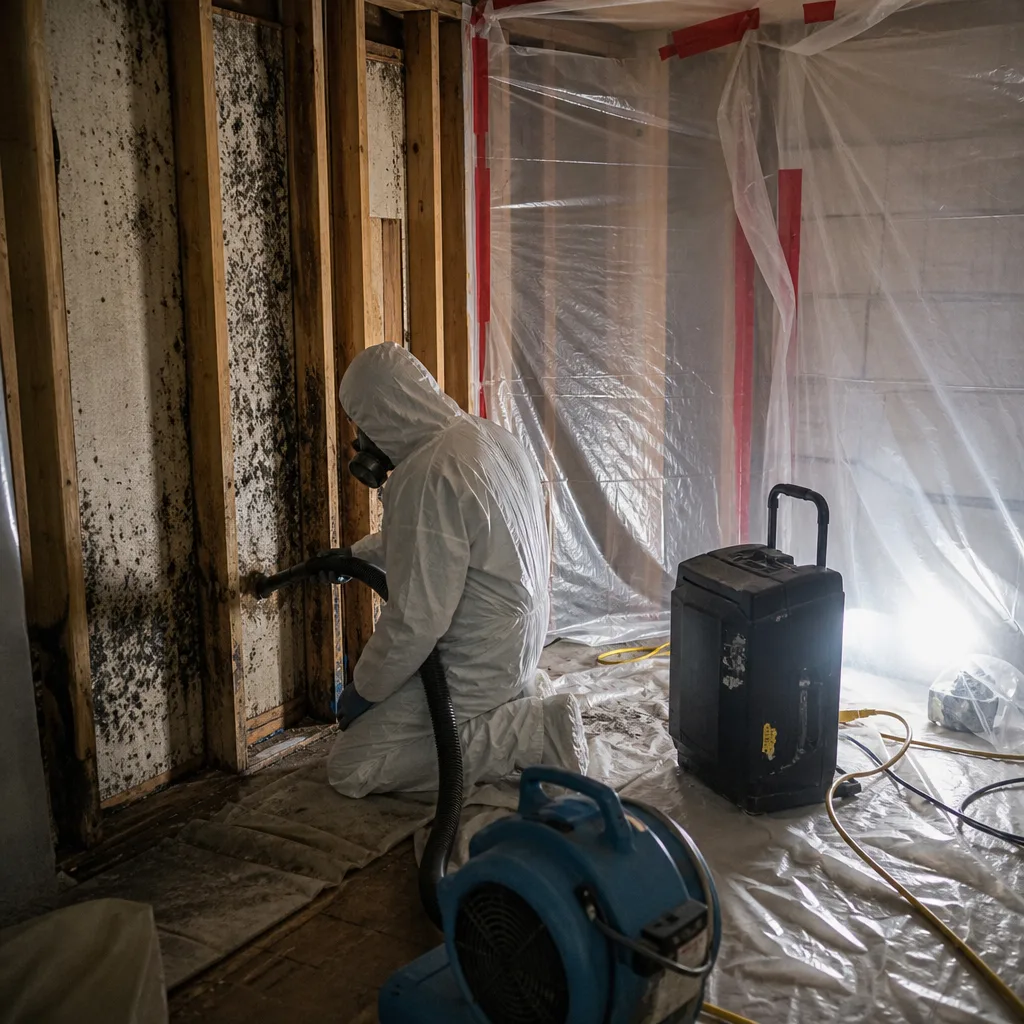
Professional Mold Removal in Wilmington means physically cutting out colonized drywall and insulation, not spraying bleach on the surface and calling it done. Bleach doesn’t kill mold roots inside porous building materials. It bleaches the surface pigment while the colony beneath keeps growing. Our techs remove the affected material, HEPA-vacuum the framing, apply antimicrobial treatment, and dry the cavity to below the threshold where mold can survive.
Here’s what that looks like on the inside of a typical Wilmington job.
HEPA Vacuuming and Antimicrobial Treatment
After the colonized material is removed and bagged for disposal, every exposed surface gets HEPA-vacuumed to capture loose spores. Then we apply a registered antimicrobial to the remaining framing, subfloor, and any adjacent materials. In salt-laden harbor air, we pay special attention to metal connectors and fasteners, which corrode faster here and can create hidden moisture paths if they’ve failed.
Structural Drying With Coastal Humidity
This is where Wilmington’s climate changes the playbook. The harbor basin traps a persistent marine layer that keeps relative humidity higher than inland neighborhoods like Lakewood. That means we run drying equipment longer and log psychrometric readings (measuring the moisture in the air) daily to verify the cavity has actually dried, not just that the surface reads dry. Dri-Eaz dehumidifiers and XPOWER air movers are standard on our Wilmington jobs.
Trusted Brands We Service in Wilmington
We run professional restoration equipment from Phoenix, XPOWER, and Injectidry on Wilmington mold jobs, and we stock consumables so we don’t lose a day waiting on parts. Phoenix dehumidifiers for large loss containment areas, XPOWER air movers for airflow that dries framing evenly, Injectidry systems for wall-cavity and floor-assembly drying where standard equipment can’t reach. Our techs are trained and credentialed through IICRC, RIA, and IFA, so the gear and the judgment match.
Common Mold Remediation Problems We See in Wilmington Homes
Here’s what we run into again and again on mold calls across Wilmington. If any of these sound familiar, call us before the problem moves into more material.
- Corroded galvanized supply lines from the 1940s to 1960s. Wilmington’s residential core was built for refinery and port workers in the post-war decades, and most of those bungalows still have their original galvanized steel plumbing. It corrodes from the inside out, and the pinhole that forms behind a wall cavity feeds mold for months before anything is visible.
- Mold that returns because only the visible growth was treated. We see this constantly. A homeowner removes the stain but never fixes the slab crack or pipe pinhole feeding moisture into the wall. The mold recolonizes in weeks. Our Mold Remediation in Wilmington work always starts with identifying the water source.
- Salt air corroding metal framing connectors and HVAC coils. Harbor air accelerates corrosion on older metal hardware. A failed fastener that lets a moisture barrier sag, or an HVAC coil sweating because the drain pan corroded through, can create a secondary moisture path that throws off the entire scope of work.
- Treating slab seep as a fresh water event. A visible wet spot on a Wilmington floor is often the tail end of a cracked branch line that’s been seeping into the subgrade for months, not a fresh supply-line burst. Without a slab-leak scan, the water category gets misclassified and containment gets set in the wrong place.
Pricing for Mold Remediation in Wilmington, CA
A small contained mold job in Wilmington, like a bathroom wall repair with a confirmed leak source, typically runs $900 to $1,800. A full room with containment, removal, antimicrobial treatment, and structural drying lands between $2,500 and $4,200. Large jobs where mold has traveled through a subfloor or into multiple wall cavities can reach $6,500. Black mold jobs with category 3 water classifications cost more because safety protocols require full PPE and extended containment. We write the price before any work starts, and that written price is what you pay. Call (910) 613-6568 for a free inspection and quote.
We Also Serve Cities Near Wilmington
In addition to Wilmington, our crews regularly handle mold jobs in Wilmington neighbors like Harbor City where slab foundations share the same subsidence history. We also serve Lakewood, Mt Baldy, and Toluca Lake for homeowners facing coastal moisture problems and aging plumbing issues. Call (910) 613-6568 to get on the schedule.
Serving Wilmington, CA - Our Local Coverage Area
We’re based in the Wilmington area and know this community well. Use the map below to see our service coverage - if you’re nearby, we can almost certainly help.
FAQs About Mold Remediation in Wilmington
Because the leak that fed it is under the slab or inside the wall cavity, not on the surface. Wilmington sits on the Wilmington Oil Field, and decades of petroleum extraction caused documented ground subsidence that cracked branch lines and shifted slabs across the neighborhood. A pinhole leak in an original galvanized supply line can feed wall-cavity mold for months before any visible stain appears. We run a slab-leak scan on every mold job here because of this geology. Call (910) 613-6568 for an inspection.
It keeps relative humidity elevated well above inland LA neighborhoods, which means mold colonizes faster after a water event and spreads farther inside a wall cavity before it’s discovered. Drying must be verified with psychrometric readings (measuring actual moisture content in the air), not by touch. We run dehumidifiers longer in Wilmington than we would for the same job in Lakewood, and we log daily readings until the structure is genuinely dry. If you suspect mold, call us at (910) 613-6568.
Yes, and it usually does. Mold only needs three things, moisture, a food source like drywall paper or wood framing, and the right temperature. Remove the visible growth without repairing the slab crack or pinhole leak feeding the cavity, and the colony reconstitutes within weeks. Our mold removal in Wilmington includes source identification and plumbing repair coordination before we close the wall back up. Call (910) 613-6568 for a slab-leak scan.
Yes, on every job. Containment with plastic sheeting and negative air pressure prevents spores from spreading while we work, and a registered antimicrobial applied to exposed framing and adjacent materials kills remaining mold roots. We set containment wider in Wilmington than in drier inland neighborhoods because the marine layer lets growth travel farther behind drywall. Call (910) 613-6568 for a free inspection.
Dri-Eaz dehumidifiers and XPOWER air movers for structural drying, Phoenix systems for larger containment areas, and Injectidry equipment for wall-cavity and floor-assembly drying. We also bring moisture mapping tools and slab-leak detection gear, because Wilmington’s oil-field subsidence means the water source is often underground. Call (910) 613-6568 to schedule a mold assessment.
Call Marsh Water Damage Restoration in Wilmington
We’ve been doing this since 2005, and we’ve spent enough of those years under Wilmington slabs and behind Wilmington walls to know exactly what this town’s geology and climate do to a house. Tobias Reyner leads our team, and every tech is background-checked, identity-verified, and photo-badged under the Threshold Verified standard. You’ll know who’s coming before they knock. We write the price before we start, and every job carries the 365-Day Done Right Promise. If the mold is still an issue within a year, we come back. No arguments, no upcharges. Call (910) 613-6568 now, a live person answers 24 hours a day, every day.
Written by Tobias Reyner, Owner at Marsh Water Damage Restoration, serving Wilmington since 2005.