
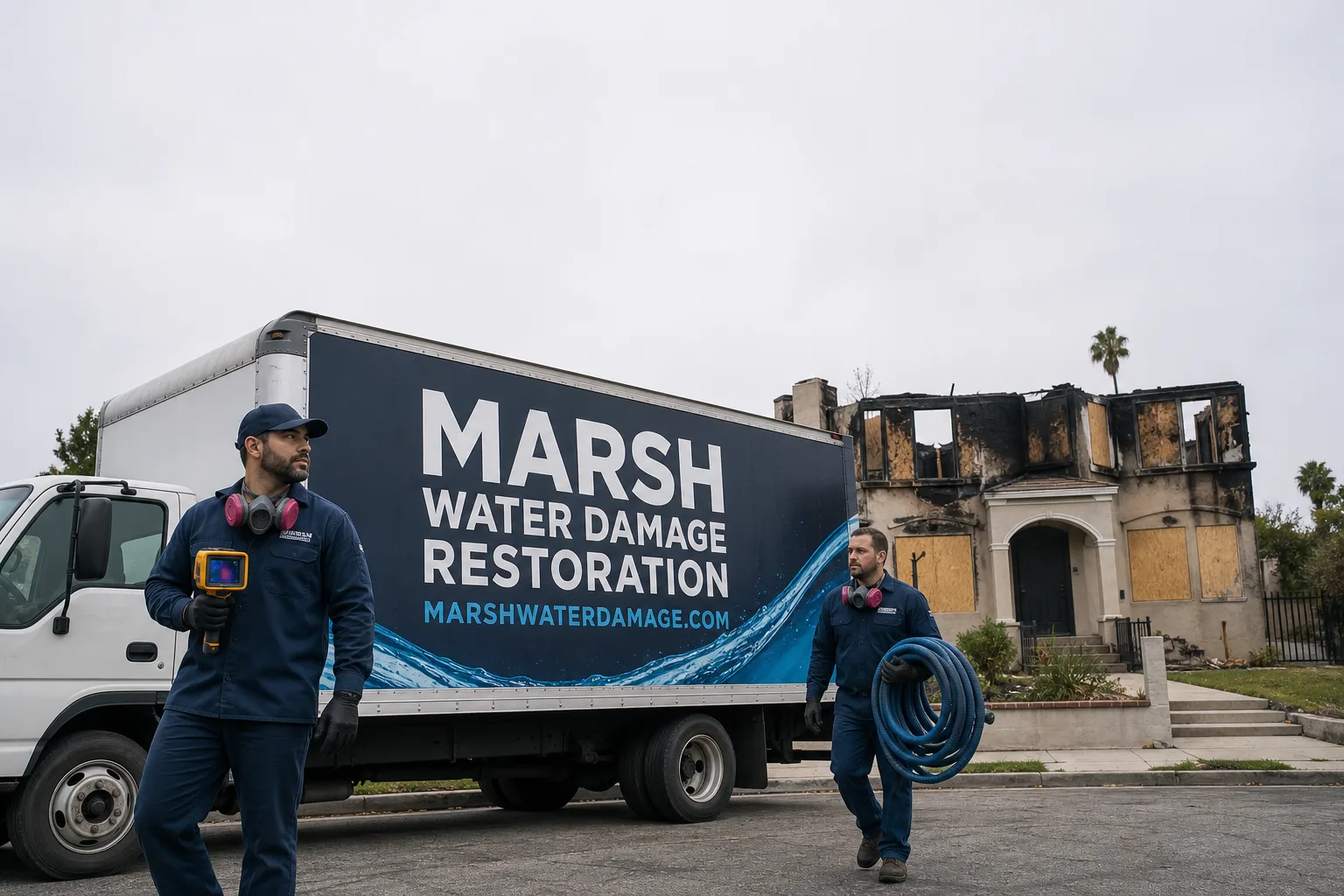
Free visual inspection and a written scope of work before any mitigation begins - photos, moisture readings, and drying logs go in your claim file
The scope we write is the scope we bill. Anything new gets shown to you, in writing, before we touch it.






 Before
 After
After Before
 After
After Before
 After
AfterFast, Reliable Storm Damage Restoration Across Flushing
Storm damage in Flushing rarely looks like a single wet carpet. It shows up as sewage backing into a basement on Roosevelt Avenue, a roof leak cascading through three stacked kitchens on Main Street, or tree debris tearing a membrane over a converted cellar apartment near Kissena Boulevard. When that happens, you need a crew that knows Flushing’s buildings, understands the block-by-block drainage problems, and answers the phone with a live person at 3 a.m. That’s us. Call (910) 613-6568 and we’ll have a verified technician headed to your street within the hour.
Why Marsh Water Damage Restoration Is Flushing’s Preferred Storm Damage Restoration Company
We’ve been doing Storm Damage Restoration across Flushing since 2005, and the work here looks different than it does anywhere else in Queens. Mixed-use buildings dominate the downtown core. Ground-floor restaurants sit under apartments. Basements get converted into storage, offices, or living space without permits. When water comes in, it doesn’t respect lease lines or floor separations. That’s why our team documents every affected occupancy before we start, because insurance claims for multi-unit buildings in Flushing hinge on showing exactly where the damage started and spread.
Our crews know the streets from College Point Boulevard east to Kissena Park. We’ve handled storm losses in 1920s brick row houses off Northern Boulevard, in the semi-detached homes around Bowne Street, and in the 4-to-7 story mixed-use buildings near the Flushing LIRR station. Flushing is a tight, vertical, heavily occupied neighborhood. One pipe failure can disrupt four businesses and three families in the same afternoon. We work like that’s the normal case, because here it usually is.
Every technician who shows up at your door follows the Threshold Verified protocol: background-checked, identity-verified, and sent to you by name and photo before the visit. Then they show a photo ID badge at your door, every time. Madeleine Hayes, our lead field supervisor who has worked Flushing claims since 2011, runs dispatch for this service area. No anonymous crews. No mystery subcontractors.
Flooded House in Flushing
A Flooded House in Flushing usually means a basement full of water from a different source than the homeowner assumes. On the residential streets off Kissena Boulevard and Parsons Boulevard, the houses were built between 1920 and 1955. Cast-iron drain pipes run through crawlspaces and basement slabs. A heavy storm overwhelms the combined sewer. The water that comes up isn’t rainwater. It’s Category 3: sewage-contaminated, full of bacteria, and carrying whatever flowed through every drain upstream. In Flushing, that’s often restaurant grease, produce wash, and raw waste from the commercial core.
What a Flooded House Job Involves Here
We start with extraction using truck-mounted and portable Dri-Eaz systems to pull the standing water out fast. Then we run psychrometric readings, which is measuring moisture in the air and inside wall cavities, to find where the water climbed that you can’t see. In Flushing row houses, water forces its way up behind the plaster and through the joist bays. It travels sideways to the party wall and soaks the neighbor’s side, too. We map all of it before we start cutting.
What It Costs
A flooded basement in a typical Flushing row house runs $2,800 – $6,500 for water extraction, demolition of soaked drywall and flooring, and drying equipment placement, before any rebuild work. If the sewer backed up and Category 3 protocols are required, the higher end of that range applies. You get a written price before we touch anything. Not an estimate that balloons after demolition starts. A printed figure, signed, with the 365-Day Done Right Promise on the same work order.
Flood Restoration in Flushing
Flood Restoration in Flushing means putting the property back together after the water is gone. It is not the same as the emergency extraction. This is the phase where we restore surfaces, treat studs, replace materials, and make sure the building passes a moisture audit before we hand it back. In Flushing, that phase is complicated by the age of the building stock and the fact that a lot of sub-grade space was finished without permits decades ago.
Documentation Before Demolition
In an unpermitted basement conversion off Union Street, we photograph and catalogue the pre-loss condition before removing anything. Insurance adjusters routinely ask for proof that the space was finished and furnished before the storm. If we don’t document it, the claim gets denied and the homeowner eats the cost. Our team builds the record before we pull the first baseboard. Then we run antimicrobial treatment on every structural contact surface and set containment with negative air pressure to stop aerosolized contaminants from drifting into the living space above.
What Flood Restoration Costs in Flushing
Full flood restoration for a finished basement, including drying, decontamination, and rebuilding to functional condition, typically runs $9,000 – $24,000 in Flushing depending on square footage and the extent of finish work. Simple unfinished basements that flooded and need drying and cleaning come in lower, closer to $4,000 – $9,000. The cost driver here is almost always the sewage contamination, not the water volume. Clean rainwater is a fast job. Flushing Creek floodwater and combined sewer backup is a remediation job.
Trusted Brands We Service in Flushing
We build our Flushing service around equipment that gets basements dry when the air outside is already saturated. Dri-Eaz dehumidifiers and Phoenix air movers run the low-grain drying systems you need in a below-grade space, where ambient humidity from Flushing Bay’s proximity keeps drying times longer than a contractor’s guess would suggest. XPOWER pumps move water out of tight stairwells and sub-cellar spaces where a full-size truck-mounted hose won’t reach. We stock parts and replacement filters locally, so a damaged unit doesn’t stall a drying job.
Common Storm Damage Restoration Problems We See in Flushing Homes
- Combined sewer backup into basements: Flushing sits inside NYC’s combined sewer network, which means stormwater and sewage share the same pipe. When heavy rain overloads the system, the mix backs up into the lowest drain. Any restoration that skips Category 3 protocols here is a second disaster waiting to happen.
- Stacked occupancy water migration: In the mixed-use buildings on Main Street and Roosevelt Avenue, water from one unit travels down through concrete, steel, and old joist pockets into the businesses below. We moisture-map every affected level, not just the one with the visible puddle.
- Cast-iron plumbing failures after freeze-thaw cycles: Pre-war cast-iron pipes in Flushing’s 1920s and 1930s housing stock crack under winter freeze-thaw stress. Every January and February we see the same burst-pipe pattern in the 11355 and 11354 zip codes.
- Unpermitted basement conversions without documentation: When a storm floods a finished basement that was never permitted, the insurance company wants proof of what was there before. We handle photo documentation and scope descriptions that hold up to adjuster review, which is not something every restoration estimate includes.
Pricing for Storm Damage Restoration in Flushing, NY
We Also Serve Cities Near Flushing
If you’re in College Point, Whitestone, East Elmhurst, or Corona, we run crews into those neighborhoods daily and carry the same equipment, the same written-price promise, and the same Threshold Verified technician standard. Storm damage doesn’t respect municipal boundaries, and neither do our response routes.
Serving Flushing, NY - Our Local Coverage Area
We’re based in the Flushing area and know this community well. Use the map below to see our service coverage - if you’re nearby, we can almost certainly help.
FAQs About Storm Damage Restoration in Flushing
Because Flushing’s downtown core sits on a combined sewer system that mixes stormwater with raw sewage. When heavy rain overwhelms the pipes, the water entering basements near Main Street and Roosevelt Avenue is contaminated with fecal matter and bacteria, which means it is classified as Category 3 water by IICRC standards. Any materials it touches must be removed or disinfected under containment, not just dried. If you treat it like clean rainwater, you leave pathogens in the structure.
Mold can begin forming within 48 to 72 hours in a Flushing row house, especially in the humid basement conditions where moisture from Flushing Bay keeps ambient humidity high. In brick and plaster construction, the window is shorter than in modern drywall homes because the masonry holds moisture longer. If you had a leak last night, call us today. The equipment we run in the first day prevents the problem that costs ten times as much in week two.
Yes. We specialize in the vertical water migration cases that define Flushing’s mixed-use buildings, where ground-floor restaurants, second-floor offices, and upstairs apartments all feel the same leak. We moisture-map every affected level, document each occupancy separately, and coordinate with the NYC Department of Health when commercial kitchens are involved. A single claim can cover three tenants and two insurance policies. We write scopes that make that sequence legible to every adjuster involved.
Yes. A significant portion of Flushing property owners, particularly commercial landlords in the downtown core, operate primarily in Mandarin, Cantonese, or Korean. We provide bilingual scope-of-work documents, drying logs, and photo reports so insurance claims move forward without language friction. When a Main Street restaurant owner needed to file a storm damage claim with documentation their carrier would accept, we ran the full IICRC-standard drying record alongside translated summaries. The claim processed without delay.
Shut off electricity to the affected area if you can do so safely, avoid contact with the water, and call us at (910) 613-6568 immediately. Category 3 sewage water carries serious health risks, and every hour it sits, the contamination spreads through porous materials and up walls. We extract, contain, disinfect, and document the loss so your business interruption claim has a complete record from hour one. Do not open the door to just anyone. Our technician’s name and photo arrive at your phone before they arrive at your door.
Written by Tobias Reyner, Owner at Marsh Water Damage Restoration, the Threshold Group’s restoration brand serving Flushing since 2005.
If storm water is in your Flushing home or business right now, call (910) 613-6568. A live person answers. We’ll send a verified technician with a written price before any work starts.