
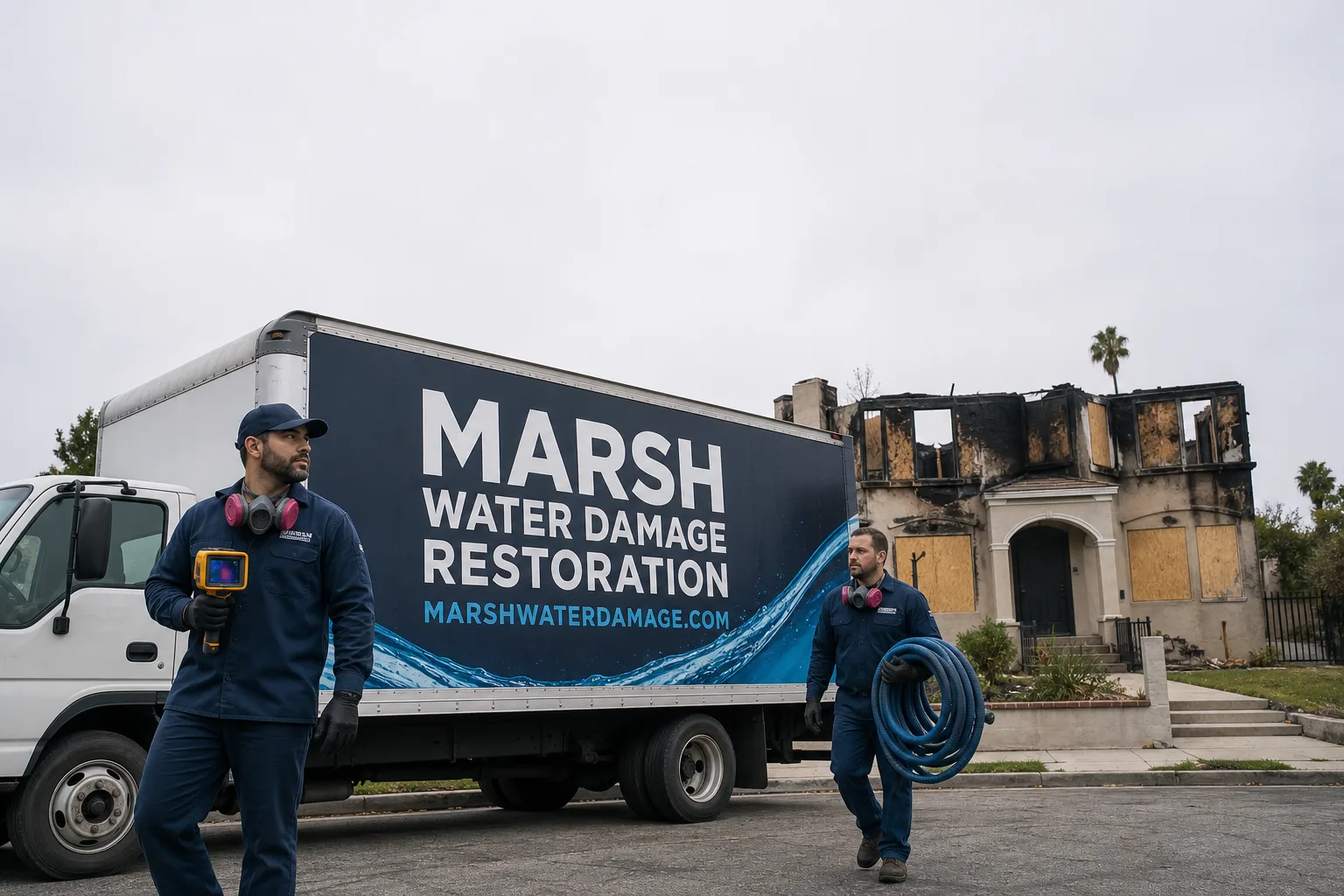
Free visual inspection and a written scope of work before any mitigation begins - photos, moisture readings, and drying logs go in your claim file
The scope we write is the scope we bill. Anything new gets shown to you, in writing, before we touch it.






 Before
 After
After Before
 After
After Before
 After
AfterFast, Reliable Storm Damage Restoration Across Palmdale
When a 70-mph wind gust tears a section of stucco off your Palmdale home or a flash flood pushes water through your garage, you need someone who knows this city’s specific failure points. Not a generic restoration crew. We’ve spent nearly two decades responding to storm losses across Palmdale, from Rancho Vista to the neighborhoods east of the 14 Freeway. Storm damage here doesn’t behave like it does in Santa Clarita or Los Angeles. The wind hits harder, the freezes bite deeper, and the ground sheds water instead of absorbing it. If you’re standing in a flooded house right now, call us at (910) 613-6568. A live person answers, 24 hours a day, and dispatch to most Palmdale neighborhoods takes under an hour.
Our Storm Damage Restoration crews respond to Palmdale with equipment that matches what national franchises deploy. Dri-Eaz dehumidifiers, XPOWER air movers, Phoenix axial fans, and Injectidry extraction systems. Every technician arrives in uniform with a photo ID badge, and you’ll see their name and photo before they knock. We believe you should know exactly who’s walking up your driveway before you open the door.
Why Marsh Water Damage Restoration Is Palmdale’s Preferred Storm Damage Restoration Company
Palmdale homeowners face a unique set of storm damage risks that most restoration companies simply don’t scope for. The San Andreas Fault trace runs directly beneath this city, and that’s not trivia. Seismic micro-movement opens hairline cracks in stucco envelopes that wind-driven rain then exploits. Add the Antelope Valley’s hard caliche soil, which sheds flash-flood runoff against slab foundations instead of absorbing it, and you have a storm damage profile that doesn’t match any coastal California playbook. Our technicians are trained to identify damage that has both wind and seismic origins, because misdiagnosing one as the other changes the entire drying strategy.
Every Palmdale job is led by Tobias Reyner, who has directed restoration work in this high-desert market since 2005. Tobias and his technicians hold IICRC, RIA, and IFA credentials, and they’ve seen the specific failures that plague 1980s-2000s tract construction here: EIFS cladding that traps moisture behind wind-cracked surfaces, single-coat stucco that crumbles after repeated freeze-thaw cycles, and slab foundations that channel water laterally in ways that look like settling but are actually storm intrusion.
The Palmdale team operates under the Threshold Verified standard, which means every technician dispatched to your home has completed a background check and identity verification. You get their name and photo before arrival. At the door, they show a photo ID badge. It’s not a one-time courtesy. It’s how we run every single visit.
Our 365-Day Done Right Promise is printed on every work order in Palmdale. If a repair fails within a year, we come back and make it right. Free second visit, automatically included. No argument, no negotiation. Just a written commitment.
Flood Cleanup in Palmdale
Flood cleanup in Palmdale means moving fast on water that arrived through two very different paths: wind-driven rain breaching the envelope, or flash-flood runoff slamming against slab foundations because the caliche hardpan won’t let water drain. Most Palmdale flood cleanup jobs run between $1,800 and $4,200 before drying equipment is set, depending on square footage and the number of affected rooms. Here’s how the work breaks down.
Extraction and Containment
We start with commercial extraction, using truck-mounted and portable units to pull standing water from floors, wall cavities, and saturated carpet. In Palmdale tract homes with slab foundations, water doesn’t just sit on concrete. It wicks into drywall and baseboards within hours. We set containment barriers to prevent contaminated Category 2 water from spreading through HVAC returns and doorways.
Structural Drying with Monitored Readings
We set Dri-Eaz dehumidifiers and XPOWER air movers, then take psychrometric readings (measuring moisture in the air) and moisture-content probes twice daily. This tells us when the structure is genuinely dry, not just dry on the surface. Slab homes in Palmdale dry slower on the west-facing walls where afternoon sun bakes moisture deeper into framing before the temperature drops 30 degrees overnight.
Flooded House in Palmdale
A flooded house in Palmdale is never just a floor problem. On a slab foundation with caliche soil around it, water pools against the exterior walls and finds entry along hairline cracks in the stem wall. Wind-driven rain at 60 mph doesn’t fall vertically – it comes in sideways through window seals, garage door weatherstripping, and ridge vents. Expect a flooded house restoration in Palmdale to run between $3,500 and $9,000 for extraction, drying, and initial repairs, with heavier losses crossing $15,000 when stucco tearout is required. Here’s what we handle.
Envelope Breach Assessment
Before we ever set a fan, we probe the failure points that let water inside. On Palmdale homes, that means ridge lines, parapet caps, HVAC curbs, and EIFS seams. A 1994 tract home in Rancho Vista may look fine from the street while wind-driven debris has cracked the cladding open above the slab, soaking the OSB substrate behind it.
Category Separation and Drying Logs
A winter storm in Palmdale can deliver wind-driven rain and a frozen-pipe burst in the same event. Those are different water categories with different drying protocols. Category 1 from the burst supply line dries one way. Category 2 storm water carrying soil and debris requires antimicrobial treatment and separate containment. We document both zones with separate moisture logs and photos for your insurance adjuster.
Trusted Brands We Service in Palmdale
Palmdale homes carry a wide range of building materials, from original 1980s single-coat stucco to newer EIFS systems, and we’re equipped to restore all of them. Our crews run Phoenix air movers and B-Air drying systems alongside Dri-Eaz dehumidifiers, which means we can match drying capacity to the specific wall assembly in your home. For Palmdale customers, we maintain quick access to replacement components for common local systems, so you’re not waiting on a part shipped from a coastal warehouse while the moisture keeps spreading. The equipment we deploy on residential jobs here is the same gear we’d use on a commercial loss in the Antelope Valley.
Common Storm Damage Restoration Problems We See in Palmdale Homes
- Latent moisture behind EIFS and stucco that nobody flagged. Wind-driven debris cracks the cladding, monsoon rain soaks the OSB substrate, and the exterior looks fine from the street. By the time you see interior staining, the mold bloom behind the cladding has been growing for weeks. We map moisture with thermal imaging before recommending tearout.
- Water tracking along slab foundations mistaken for settling. Hard caliche soil forces runoff against the foundation, and water bleeds laterally along the slab. Hairline cracks that look like normal settling are often storm intrusion. Coastal LA techs rarely see this pattern, which is why you want a Palmdale-trained crew.
- Overlapping Category 1 and Category 2 losses after a winter storm. A freeze bursts a supply line in the same event that wind drives rain through a breached envelope. Treating both as one water category means missed antimicrobial treatment and incomplete drying. We scope them separately, every time.
- Micro-cracked ridge lines and parapet caps from extreme temperature swings. Palmdale’s 30-degree diurnal swings flex roofing membranes and stucco far faster than coastal conditions. The intrusion pathway is almost never where the visible staining is. We probe the high points first.
Pricing for Storm Damage Restoration in Palmdale, CA
We Also Serve Cities Near Palmdale
Our Palmdale crews also respond to storm damage calls in Acton, Littlerock, Mount Wilson, and La Canada Flintridge. Each of those communities has its own terrain and wind patterns, but the same Threshold Verified standard applies: background-checked technicians, written pricing, and photo-documented drying logs. If you’re just over the county line and wondering whether we serve your area, call (910) 613-6568. We’ll tell you straight.
Serving Palmdale, CA - Our Local Coverage Area
We’re based in the Palmdale area and know this community well. Use the map below to see our service coverage - if you’re nearby, we can almost certainly help.
FAQs About Storm Damage Restoration in Palmdale
Why do Palmdale storm damage calls often turn into hidden mold jobs behind the stucco?
Because the moisture gets trapped behind EIFS or single-coat stucco cladding that was cracked open by wind-driven debris or seismic micro-movement, and the exterior surface hides the damage until it’s extensive. Palmdale homes built in the 1980s-2000s boom used cladding systems engineered for coastal tolerances, not the 2,659-foot high desert’s freeze-thaw cycles and 60-80 mph wind gusts. Once water enters behind the cladding, it sits against OSB substrate and framing with poor ventilation, and mold grows within 48-72 hours. Call (910) 613-6568 and we’ll inspect with thermal imaging before recommending any tearout.
Does the San Andreas Fault actually change how you scope a storm damage restoration in Palmdale?
Yes. Seismic micro-movement along the fault trace opens hairline cracks in slab foundations and stucco envelopes that wind-driven rain then exploits. We routinely see homes where the visible storm damage is minor, but moisture mapping reveals water tracking laterally along a slab through cracks that existed before the storm. Treating that as a normal flood dry-out misses the structural issue. Our protocol includes probing those cracks and documenting whether they’re seismic, settling, or storm-related.
What does caliche hardpan have to do with flooded houses in Palmdale?
Caliche is a hard, impermeable soil layer beneath much of the Antelope Valley. When a monsoon pulse or heavy storm drops rain on Palmdale, the water doesn’t percolate downward. It sheets across the surface and slams against slab foundations, finding entry through stem-wall cracks, garage door thresholds, and utility penetrations. Homes on caliche flood differently than homes on coastal soils, and the drying strategy has to account for water that pools against the foundation for hours after the rain stops. If you’ve got water in your garage this afternoon, don’t wait. Call us now.
Can you tell the difference between a wind-driven roof leak and a frozen-pipe loss when both hit after a Palmdale winter storm?
We can, and it matters. A wind-driven roof leak is typically Category 2 water, carrying debris, soil, and biological contamination. A frozen-pipe burst from a Palmdale winter freeze is Category 1 clean water. They require different drying logs, different antimicrobial protocols, and different documentation for your insurance claim. In Palmdale, both often happen in the same storm. We scope each loss zone separately, rather than treating the whole job as one water category. That’s the difference between a claim that gets paid and one that gets kicked back for incomplete documentation.
Do you have to tear out the stucco on every Palmdale storm damage claim?
No. We recommend tearout only when moisture mapping and thermal imaging confirm saturated cavities, hidden mold, or compromised substrate. Many wind-driven leaks behind EIFS or stucco can be remediated with targeted openings, antimicrobial treatment, and structural drying with Dri-Eaz dehumidifiers. After a 70-mph event in Rancho Vista, we responded to a 1994 stucco tract home where a cracked EIFS wall had let monsoon rain soak the OSB. We opened the affected sections only, treated the microbial growth, dried the assembly to pre-loss condition with XPOWER air movers, and documented daily moisture readings until the walls were genuinely dry. You don’t pay for a full re-cladding unless you actually need one. Every scope is written, priced, and agreed before any demolition starts.
Written by Tobias Reyner, Owner at Marsh Water Damage Restoration, serving Palmdale since 2005.