
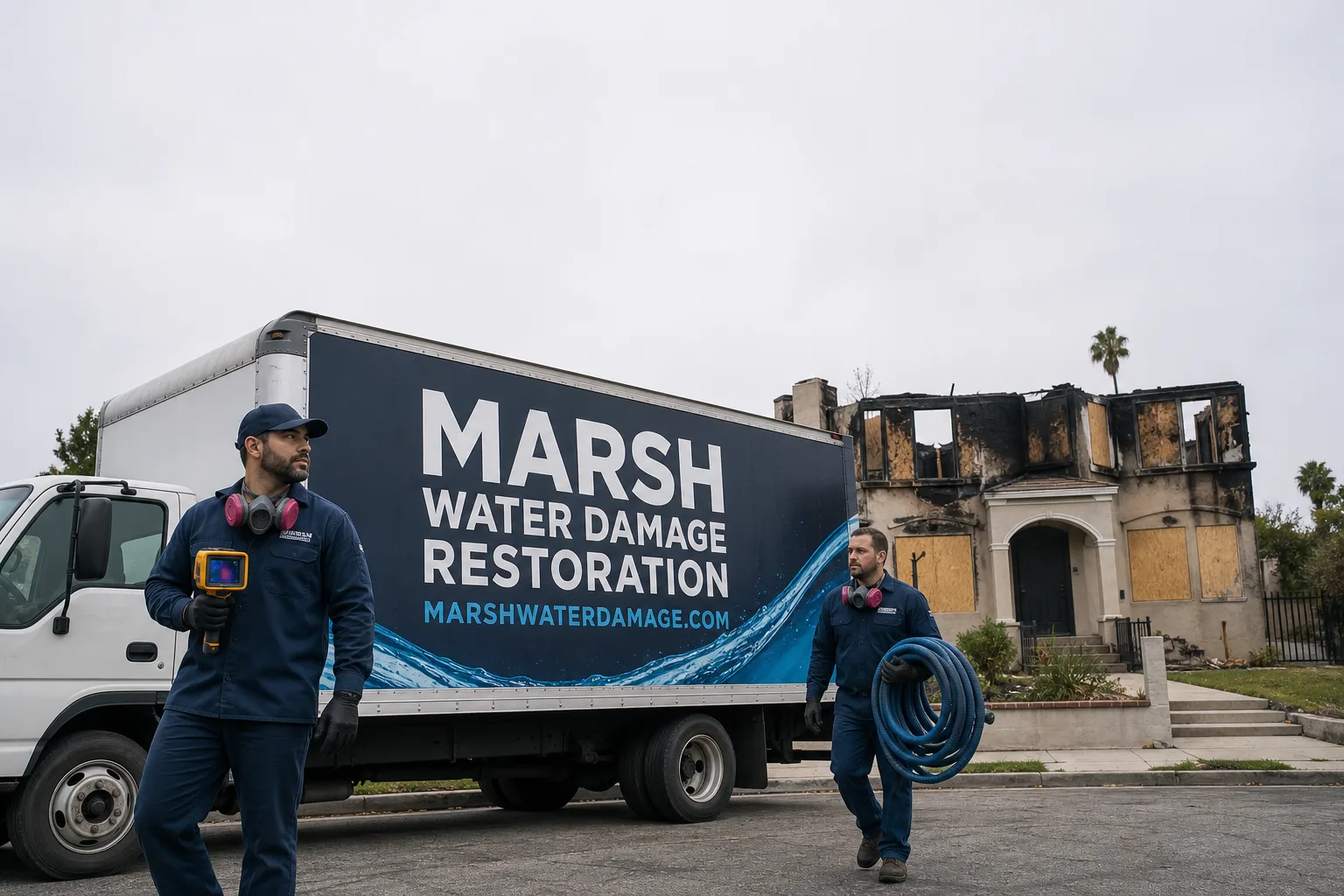
Free visual inspection and a written scope of work before any mitigation begins - photos, moisture readings, and drying logs go in your claim file
The scope we write is the scope we bill. Anything new gets shown to you, in writing, before we touch it.






 Before
 After
After Before
 After
After Before
 After
AfterFast, Reliable Storm Damage Restoration Across San Dimas
Storm damage in San Dimas rarely looks like it does in other San Gabriel Valley cities. You may be dealing with water under the doors and mud across the living room floor after a heavy rain, or smoke residue in the attic from a fire that burned in the mountains above San Dimas Canyon weeks earlier. Either way, the work needs to start now, not after a claims adjuster gets back to you. Our Storm Damage Restoration crews work throughout San Dimas daily, and a live person answers when you call (910) 613-6568, any hour.
We know the streets here, from Baseline Road up to the canyon mouth. We know which foothill neighborhoods sit in the debris-flow path and which older ranch homes carry galvanized plumbing that fails after the first heavy storm. That local knowledge changes how we scope a job, and it’s why San Dimas homeowners call us before the water spreads further.
Why Marsh Water Damage Restoration Is San Dimas’s Preferred Storm Damage Restoration Company
San Dimas sits directly below the San Gabriel Mountains at the mouth of San Dimas Canyon. That geography creates a damage cycle most flat-valley restoration companies have never dealt with. A wildfire burns above the city and leaves the slopes denuded with hydrophobic soil that sheds water instead of absorbing it. Then the first winter atmospheric river hits, and that same water rushes down the canyon carrying ash, sediment, and rock into the streets and homes along the northern edge of the city. The result is a compound emergency: smoke residue and ash intrusion in the fall, followed by category 3 mud and water intrusion in January or February, often in the same house.
Tobias Reyner, who leads our restoration team, has worked this cycle for years. He trains every technician to look past the visible damage and map what the water actually touched. That means checking wall cavities in older San Dimas ranch homes where original copper or galvanized supply lines hide behind drywall, and where water from a storm can travel far from the entry point before showing itself.
Every Marsh technician is background-checked and identity-verified before they ever knock on a San Dimas door. You get the tech’s name and photo sent to your phone before arrival, and they show a photo ID badge at the door. No unmarked vans, no strangers. That’s the Threshold Verified standard, and it’s printed on every work order we write. If the repair isn’t right within 365 days, we come back and make it right at no charge. That includes a free second visit, automatically, no arguing required.
Flood Restoration in San Dimas
Flood Restoration in San Dimas usually means one of two things: storm water pushed under doors and through window wells during a heavy rain event, or the aftermath of a debris flow that carried mud, ash, and whatever the canyon picked up into a finished living space. Most residential flood extractions here run between $1,800 and $4,200 before drying equipment gets set, with the higher end typical when mud and contaminated water have reached carpet, pad, and drywall in multiple rooms.
What We Do First
We stop the water at the source, extract what we can with truck-mounted or portable extraction units, and then take moisture readings throughout the affected area. In San Dimas homes with original 1960s and 1970s drywall, that means drilling small inspection ports in walls where water may have wicked upward. We log those readings daily, and we only declare a structure dry when the numbers confirm it, not when the surface feels dry to the touch.
Mud Is Not Just Water
When storm water carries mud from the burn scar above San Dimas Canyon, we treat it as category 3 water. That requires removing saturated carpet, pad, and any drywall that absorbed the water, followed by antimicrobial treatment on the framing and flooring underneath. A simple extraction and fan setup won’t fix a debris-flow intrusion, and pretending otherwise leaves a home vulnerable to mold inside the wall cavities.
Basement Flood Cleanup in San Dimas
Basement Flood Cleanup in San Dimas comes up most often in the older bungalows near the historic downtown core and in split-level and hillside homes along the northern edge of the city where basements sit partially below grade. When storm water comes down San Dimas Canyon faster than the drainage can carry it, those below-grade spaces flood first. A standard basement flood cleanup in San Dimas runs from $2,200 to $5,500, depending on how much finished space was affected and whether sewage or mud contaminated the water.
Older Plumbing, Hidden Water
Many San Dimas basements belong to homes built between the 1960s and 1980s, and a meaningful number still have original galvanized supply lines. The region’s moderately hard groundwater has spent decades stressing those pipes. After a flood, even the ones that didn’t visibly burst may be leaking behind a wall from joints that gave way under pressure changes. We check the plumbing as part of every basement cleanup, because drying the floor while a supply line drips inside a wall cavity just sets up a mold problem for next month.
Containment and Drying
Once the standing water is out, we set containment barriers to keep dust and airborne particles out of the rest of the house, then place Dri-Eaz dehumidifiers and air movers to pull moisture from the structure. We measure moisture in the air with psychrometric readings so we know exactly when the drying is complete, rather than guessing based on how the room feels. The equipment runs until the numbers are right, and you see those readings on the daily log we leave at the property.
Trusted Brands We Service in San Dimas
Our crews work with the restoration equipment brands San Dimas homeowners ask about by name. That includes Dri-Eaz dehumidifiers and air movers, Phoenix extraction units, and XPOWER fans for rapid air circulation. We keep parts and replacement filters stocked for the equipment we deploy, so a San Dimas job doesn’t pause while we wait on a shipment. The gear we run is the same standard used on commercial losses, and it gets applied to every residential job we take in San Dimas.
Common Storm Damage Restoration Problems We See in San Dimas Homes
- Debris-flow mud intrusion treated as clean water. When a burn scar above San Dimas Canyon releases mud into foothill streets, the water that enters a home carries ash, soil, and whatever animal waste it picked up along the way. It is category 3 water. Extracting it without removing saturated materials and applying antimicrobial treatment leaves dangerous contamination behind, even if the floor looks clean after a mop.
- Delayed mitigation waiting on an insurance decision. Wet drywall and carpet in a San Dimas home begin growing mold within 24 to 48 hours. We hear it often: a homeowner waits for an adjuster to visit before authorizing any work. The delay turns a $3,000 extraction into a $15,000 or $20,000 rebuild. Our recommendation is always to document first, then begin mitigation. Photo documentation and our written scope satisfy the carrier later; mold does not wait.
- Hidden secondary water in older ranch homes. San Dimas’s 1960s and 1970s ranch tract homes often have original galvanized plumbing that has been stressed by hard water for half a century. After a storm event, water travels along pipe chases and behind wall cavities before it becomes visible. Using only air movers without mapping the moisture source misses that secondary damage, and the rot that follows shows up months after the claim is closed.
- Tight access and alley-load constraints. Several San Dimas neighborhoods, particularly near the downtown area, have narrow driveways, garage conversions, and alley-load garages that complicate equipment setup. We plan for that before we arrive, not after. Smaller containment chambers and portable extraction units get used where a full truck-mounted setup won’t reach, and we protect flooring and walls along the access path.
Pricing for Storm Damage Restoration in San Dimas, CA
Flood restoration in San Dimas typically runs $1,800 to $4,200 for a standard residential extraction with drying equipment. Basement flood cleanup runs $2,200 to $5,500, with the higher end applying when finished space and contaminated water are involved. Mud intrusion from debris flows adds cost because the affected materials must be removed rather than dried in place, and antimicrobial treatment on framing is mandatory. You get a written price before any work begins. Not a verbal estimate, not a range that grows once demo starts. A printed scope with line items and a number on it. Call (910) 613-6568 for a free assessment, and we’ll put it in writing before any equipment leaves the truck.
We also bill directly to your insurance carrier when coverage applies. We photograph everything, log moisture readings daily, and send the documentation your adjuster needs. If you have questions about what’s covered, call us. We’ll walk you through it in plain English, and we’ll coordinate with the adjuster on your behalf.
We Also Serve Cities Near San Dimas
Marsh Water Damage Restoration serves all of San Dimas, from the foothills along San Dimas Canyon Road down to the neighborhoods around Baseline Road. Our crews also cover La Verne, Glendora, Covina, and Azusa. If you’re in one of those cities and dealing with storm damage, call the same number, (910) 613-6568. For more about our broader service area, see Storm Damage Restoration in San Dimas.
Serving San Dimas, CA - Our Local Coverage Area
We’re based in the San Dimas area and know this community well. Use the map below to see our service coverage - if you’re nearby, we can almost certainly help.
FAQs About Storm Damage Restoration in San Dimas
You should expect the risk to rise sharply with the first winter storm after the fire. Burn-scar soil above San Dimas Canyon becomes hydrophobic, meaning it sheds water instead of absorbing it. The first atmospheric river of the season can send mud and debris down into foothill streets within hours of heavy rain starting. If you live along San Dimas Canyon Road or Baseline Road near the canyon mouth, prepare before the forecast turns bad. Have our number ready, and if water enters, call (910) 613-6568 immediately.
Because the water that flows off a burn scar carries ash, soil, and whatever contaminants it picked up on the way down San Dimas Canyon. Category 3 water is the classification for water that may contain pathogens or harmful substances, and debris-flow water from our local foothills qualifies. That means we remove saturated carpet, pad, and drywall rather than attempting to dry them in place, and we treat the affected framing with antimicrobial agents. The alternative is a house that smells clean but grows mold inside its walls within weeks. Call (910) 613-6568 and we’ll scope it correctly the first time.
Yes. We run portable extraction units and compact drying equipment in tight spaces where a large truck-mounted setup won’t reach, and we plan our access path before arriving. Several San Dimas townhome communities have narrow alleys, shared walls, and garage conversions that require smaller containment chambers. That’s part of why we send the tech’s name and photo before we arrive, so you know exactly who’s walking through your gate. To schedule a crew for a tight-access San Dimas property, call (910) 613-6568.
Moisture mapping locates exactly where water has traveled inside your walls and floors, including places you can’t see. In a 1960s or 1970s San Dimas ranch home with original galvanized lines, that matters because a storm can push water into wall cavities while the visible damage stays in one room. We take readings throughout the affected area, mark the wet zones, and monitor them daily until the structure is genuinely dry. That prevents the hidden secondary damage that turns a storm-damage call into a full reconstruction months later. If you’d like us to map a storm-affected home in San Dimas, call (910) 613-6568 for a free assessment.
Yes. When storm water or debris-flow mud forces us to remove drywall, flooring, or cabinetry from a San Dimas home, we coordinate a pack-out of your belongings from the affected areas first. We photograph and inventory everything before it’s moved, and those photos go into the documentation file your insurance adjuster receives. Your items stay protected while structural work proceeds, and nothing gets thrown away without your written sign-off. For a storm-damaged San Dimas home that needs a pack-out, call (910) 613-6568.
Our crew was called to a 1970s ranch home on San Dimas Canyon Road after the first winter storm following a burn scar above the city sent muddy water under the doors and into the living area. We performed water extraction and moisture mapping, pulled wet carpet and pad, and set up containment with Dri-Eaz dehumidifiers and air movers to begin structural drying on the saturated drywall. Because the original galvanized plumbing had already been stressed by the region’s moderately hard groundwater, we logged moisture readings daily and used antimicrobial treatment on the affected framing before completing the scope of work.
If storm damage has reached your San Dimas home, call (910) 613-6568 now. A live person answers, day or night. We’ll send a verified technician with a name, a face, and a photo ID badge, and we’ll put the price in writing before any work begins.
Written by Tobias Reyner, Owner at Marsh Water Damage Restoration, serving San Dimas since 2005.