
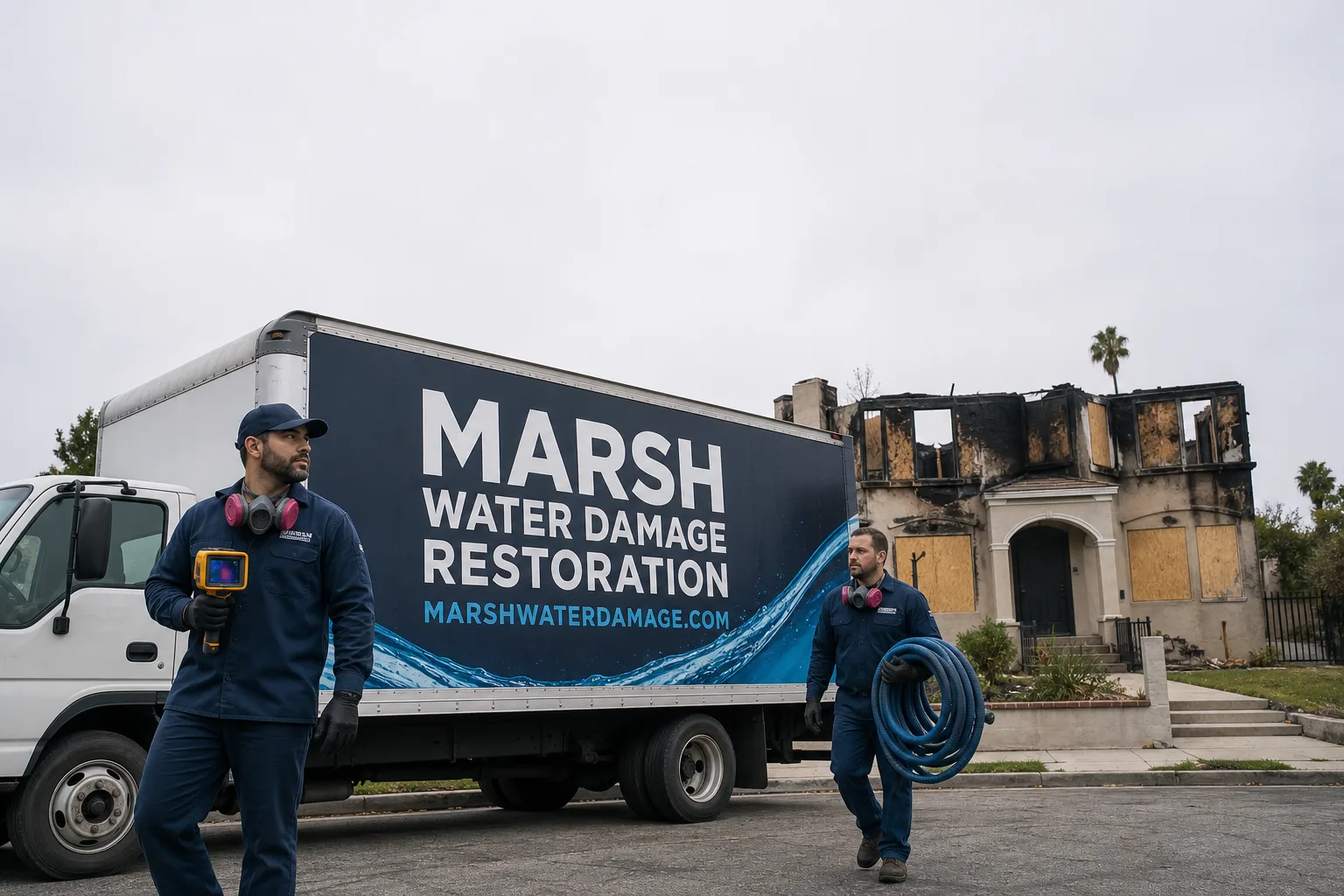
Free visual inspection and a written scope of work before any mitigation begins - photos, moisture readings, and drying logs go in your claim file
The scope we write is the scope we bill. Anything new gets shown to you, in writing, before we touch it.






 Before
 After
After Before
 After
After Before
 After
AfterFast, Reliable Water Damage Restoration Across Aguanga
Water damage in Aguanga almost never starts the way it does in town. There’s no curb-side shutoff to twist, no municipal water department to dispatch. Most properties here run on private wells, septic fields, and ranch road access, so when a pipe lets go or a Santa Ana storm drives runoff under a door, the clock starts before anyone can get to a valve. Marsh Water Damage Restoration has been handling exactly these jobs since 2005, and our crews know the difference between a Temecula subdivision response and an Aguanga ranch response. If water is moving through your house right now, call (910) 613-6568. A live person answers, day or night, and we’ll tell you who’s coming before they knock.
Why Marsh Water Damage Restoration Is Aguanga’s Preferred Water Damage Restoration Company
Most Aguanga homeowners have called a contractor at least once who promised a Temecula-style turnaround and didn’t understand why the driveway wasn’t paved, why there was no street meter, or why the well pump was still pushing water into the slab. We don’t start jobs that way. Our crews arrive already knowing what Aguanga properties look like: custom ranch builds and manufactured homes from the 1970s through the 1990s, well heads, septic tanks, long unpaved drives, and elevations between 2,600 and 3,000 feet that change how fast things dry. That local knowledge affects every decision we make, from where we stage equipment to how we calculate drying time. Marsh is the restoration brand of the Threshold Group family, founded in 2005, and every technician who arrives at an Aguanga property is background-checked, identity-verified, and sent to you by name and photo before the visit.
We also know that opening your door to a restoration crew you’ve never met is half the stress of the job itself. That’s why the Threshold Verified standard is non-negotiable on every visit: every tech shows a photo ID badge at the door, wears a uniform, and matches the name and photo you already received. No surprise subcontractors. No unmarked vans. When you call Marsh for Water Damage Restoration, you know who’s coming, what they’ll do first, and what it will cost in writing before work begins.
Emergency Water Removal in Aguanga
Emergency water removal in Aguanga usually starts with the well. Because there’s no municipal shutoff at most properties, the first thing we do is kill the well pump at the breaker or pull the disconnect at the pressure tank, then cut power to anything the water has reached. From there we extract standing water with truck-mounted or portable extraction units, map the moisture migration with meters, and set drying equipment matched to the structure, not to a generic Inland Empire drying chart. Most residential water extractions in Aguanga run between $1,200 and $3,400 before drying equipment is staged, depending on how far the water traveled and whether it got under cabinets or into wall cavities.
Speed matters more in Aguanga than in town. Water sitting in a 70s-era ranch home with an uninsulated slab or wood subfloor starts wicking into framing within hours. Left alone through a hot afternoon, a clean Category 1 pipe break can degrade into Category 2 or Category 3 as it pulls contaminants through building materials. We respond from our Los Angeles dispatch, and for Aguanga jobs we stage what the property actually needs, including on unpaved drives when a truck can’t safely reach the structure.
Ranch Driveway Staging and Equipment Access
Many Aguanga homes sit far enough off Sage Road or Highway 79 that a heavy extraction truck can’t back up to the door without risking a stuck axle or a damaged septic line. We plan for this. Our crews carry portable extraction and drying units sized for those approach conditions, and we stage air movers and dehumidifiers where they can run safely and where our moisture mapping says they’ll do the most good. We don’t wait for a bigger truck to figure it out.
Photo-Documented Assessment Before Any Cutting
Before we cut drywall or pull baseboards, we document the pre-loss condition of the area with photos and moisture readings. That record matters in Aguanga because there’s no municipal meter to compare against later. If an adjuster asks what was wet, when, and how far it spread, we have time-stamped drying logs and a written scope, not a memory. Insurance claims go smoother when the evidence is already organized.
Flood Damage Restoration in Aguanga
Flood damage restoration in Aguanga often follows the fire. When winter rains hit the burned, unprotected hillsides above valley properties, debris flows and mud push into foundations, garages, and crawlspaces that were dry through the summer. We’ve handled enough of these post-wildfire double events to know that treating only the smoke damage and leaving the slope above the structure unaddressed means another loss six to nine months later. The flood work itself starts with a written scope: where the water and mud entered, what it touched, what needs removal versus what can be dried in place. Aguanga flood jobs with mud intrusion typically run $2,800 to $8,500, with the range driven by how much sediment entered and whether structural drying is needed after extraction.
We treat floodwater as contaminated until proven otherwise. That means full containment where Category 3 water is involved, proper disposal of saturated porous materials, and antimicrobial treatment on surfaces that can be saved. It’s slower work, but it’s the only way to keep a flood from becoming a mold problem two months later.
Post-Fire Debris Flow and Mud Intrusion
When storm water carries ash, charred vegetation, and sediment into a home, it’s not a simple water extraction. The slurry is abrasive, contaminated, and heavier than standing water. We remove it with solids-handling pumps and extraction wands rated for sediment, then dry the structure with equipment from Dri-Eaz and Phoenix sized for the actual moisture load, not the square footage. Properties in the valley’s lower benches and along the creek corridors see this more often than ridge-top homes.
Exposed Slab and Foundation Drying
Much of Aguanga’s housing stock is slab-on-grade construction from the 1970s through the 1990s. When water runs across a slab, it doesn’t just sit on top. It seeps under base plates, into lower wall cavities, and into any crack or seam where the concrete has shifted. Proper drying means checking those cavities with penetrating moisture meters and keeping equipment on the structure until psychrometric readings (measuring the moisture in the air) tell us the space is genuinely dry, not just dry on the surface.
Trusted Brands We Service in Aguanga
We run Dri-Eaz air movers and dehumidifiers, Phoenix desiccants and LGR units, and XPOWER air scrubbers on Aguanga jobs because these are the machines built for commercial-scale drying and they hold their calibration on long rural service calls. Our parts and filters are stocked for the equipment we run, not ordered per job, which means a burned-out condenser or a clogged filter on an Aguanga ranch doesn’t park the drying process for three days while a supplier ships from Riverside. When our technicians arrive, they arrive with the right gear, the right consumables, and a written scope of work. No second trip for a part, no excuse about a supplier being out of stock.
Common Water Damage Restoration Problems We See in Aguanga Homes
- No municipal shutoff means a running well pump keeps feeding the loss. Crews that assume a curb valve exists waste hours searching while the water keeps moving. We kill the well pump first, every time.
- Hard freezes at 2,600 to 3,000 feet burst pipes in pump houses and outbuildings. Under-insulated ranch plumbing freezes in January, and the thaw doesn’t announce itself politely. It floods a pump house or a wall cavity while the homeowner is in Temecula for the day.
- Post-wildfire hillsides send mud into the same structures the smoke already damaged. Treating the fire loss and ignoring the denuded slope above your foundation is how you get a second claim six months later.
- Under-drying in uninsulated structures brings mold back within weeks. Low-elevation drying timelines from Hemet or Temecula don’t hold at Aguanga’s elevation. We hold equipment longer and verify with psychrometric readings before we call a structure dry.
Pricing for Water Damage Restoration in Aguanga, CA
Most emergency water extractions in Aguanga run between $1,200 and $3,400, with drying equipment staged separately based on the affected square footage and how long the water sat. Flood and mud intrusion jobs typically land between $2,800 and $8,500. The distance from the road to the structure matters: a home set 200 feet up an unpaved drive costs more to service than one at the pavement edge because we move equipment by hand or with a smaller off-road-capable unit. Hard freezes that split copper in a pump house are usually on the lower end; a washer supply line that ran all weekend through a manufactured home’s interior is not. Every Marsh job in Aguanga gets a written price before any work starts. Call (910) 613-6568 for a no-cost estimate, and we’ll walk you through the actual numbers for your situation.
We Also Serve Cities Near Aguanga
Our crews work throughout the surrounding rural corridor, including Anza, Mountain Center, Valley Center, and San Ysidro, all with the same Threshold Verified protocol and the same written-price-before-work rule. Wherever you are in this part of Riverside County, if water is where it shouldn’t be, call us. This page covers Water Damage Restoration in Aguanga, and the same crew standards apply on every neighboring ranch and rural property we serve.
Serving Aguanga, CA - Our Local Coverage Area
We’re based in the Aguanga area and know this community well. Use the map below to see our service coverage - if you’re nearby, we can almost certainly help.
FAQs About Water Damage Restoration in Aguanga
We kill the well pump first, at the breaker or the pressure tank disconnect, then cut power to anything the water has reached. That stops the source immediately, which is the entire job in the first five minutes on a private well system. After the pump is dead, we extract, map the moisture, and set drying equipment sized for your structure.
Because the fire didn’t just damage your structures, it burned the hillside above them, and now the winter rains carry mud and debris into the same foundations. If you treated only the smoke and structural damage and didn’t address the drainage and ground cover on the slope, the water intrusion will keep returning every rainy season. We assess both the structure and the likely water path when we scope a post-fire property in Aguanga.
Yes. Aguanga sits 2,600 to 3,000 feet up, so it freezes hard in January and February, and pump houses and outbuildings are often uninsulated or barely insulated. Drying timelines that work in Temecula’s warmer, lower air simply don’t hold up here. We run equipment longer, verify with psychrometric readings, and plan for colder ambient temperatures when we set dryers.
Mold colonization typically starts within 24 to 48 hours on wet organic surfaces like drywall, wood subfloor, and carpet backing. In an uninsulated Aguanga structure with wide daily temperature swings, that window can shrink when the space warms up during the day. The sooner water is extracted and airflow starts, the less likely you’ll need full mold remediation on top of the water restoration.
Category 1 water from a clean pipe break can degrade to Category 2 or Category 3 as it sits, especially if it moved through a crawlspace, mixed with well sediment, or reached an area that already had organic material from a past wildfire intrusion. On a rural property with no municipal treatment, we assume less about water quality and test more often, because the cost of guessing wrong is a contaminated structure that has to be gutted anyway.
If water is moving through your Aguanga home, call (910) 613-6568 now. A live person answers 24/7, and we’ll send a Threshold Verified technician with a written price before any work starts. We’ve handled private wells, hard freezes at elevation, and post-fire flood damage here. We’ll get you dry.
Written by Tobias Reyner, Owner at Marsh Water Damage Restoration, serving Aguanga and the surrounding rural corridor since 2005.