
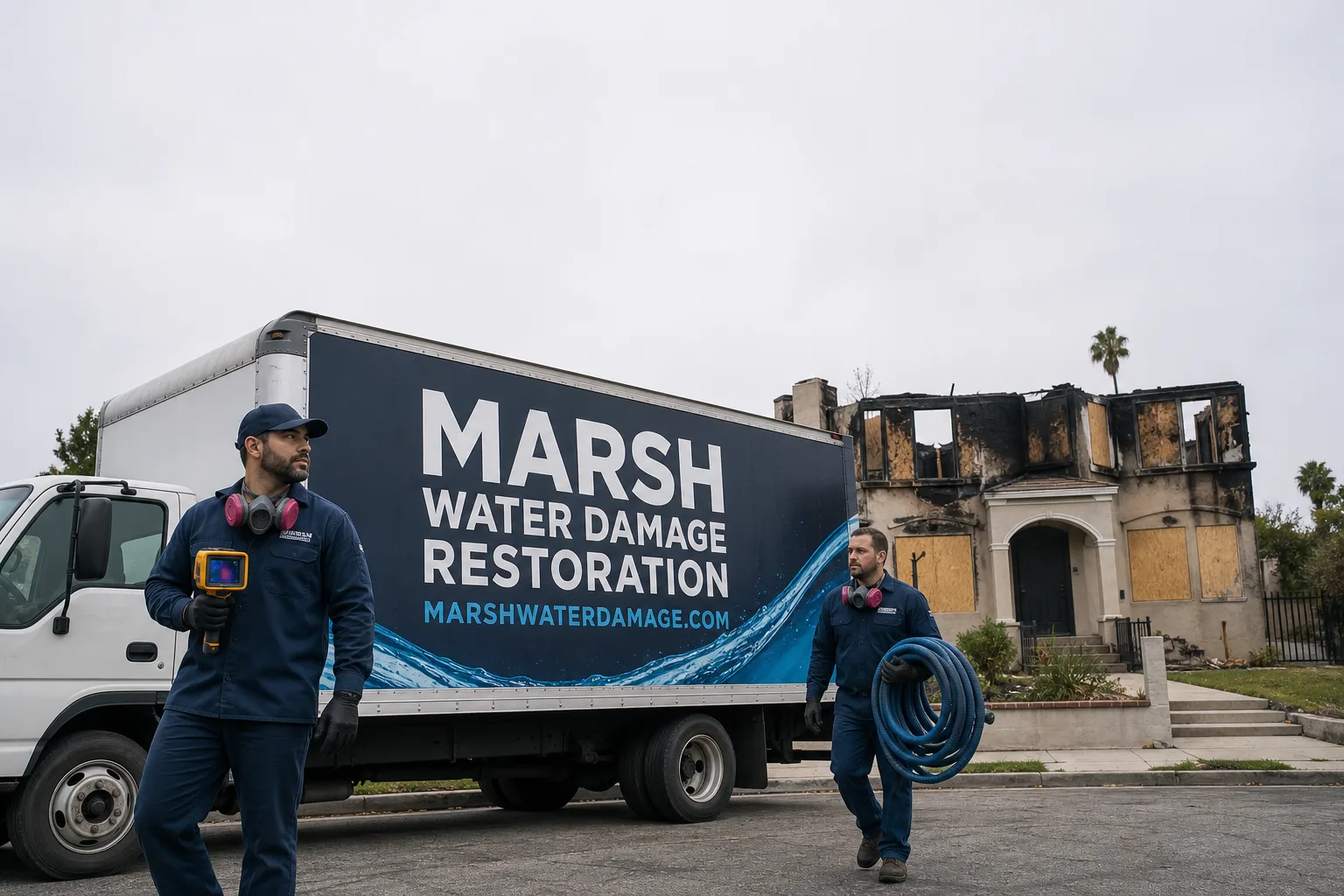
Free visual inspection and a written scope of work before any mitigation begins - photos, moisture readings, and drying logs go in your claim file
The scope we write is the scope we bill. Anything new gets shown to you, in writing, before we touch it.






 Before
 After
After Before
 After
After Before
 After
AfterFast, Reliable Water Damage Restoration Across East Flatbush
Water damage in East Flatbush doesn’t wait, and neither do we. A live person answers our phone 24 hours a day, every day, including holidays, at (910) 613-6568. When a flat roof membrane splits on a 1930s brick row house near Church Avenue, or a basement sewage backup hits a two-family on Snyder Avenue, our crews know the blocks, the parking constraints, the shared walls, and the building quirks that make East Flatbush different from anywhere else in Brooklyn. We’ve been handling water damage restoration since 2005 as part of the Threshold Group family, and every technician we send to your door is background-checked, identity-verified, and introduced to you by name and photo before the knock.
Why Marsh Water Damage Restoration Is East Flatbush’s Preferred Water Damage Restoration Company
East Flatbush homeowners call us because we understand what a water event here actually means. This neighborhood is overwhelmingly built from 1920s – 1950s attached and semi-detached brick row houses with flat built-up roofs – tar-and-gravel systems that fail from the inside out, silently, often weeks before you see a stain on your ceiling. By the time water shows up in a top-floor bedroom, it has usually migrated through ceiling joists, original plaster, and into the shared party wall between your home and the neighbor’s. We plan for that from the first phone call.
Our response time to East Flatbush is built around the reality of these blocks: narrow streets, double-parked cars, and alley-load access that disappears by late afternoon. We send crews with equipment that fits through tight row-house doors and down steep basement stairs. Tobias Reyner, who leads our restoration team, has made it a standing rule that every East Flatbush job includes moisture mapping of party walls as standard – not as an add-on. That’s the difference between drying one unit and actually drying the building.
Every job here gets a written price before any work starts, a written guarantee, and our 365-Day Done Right Promise printed on the work order. If the repair isn’t right within a full year, we make it right, including a free second visit. No arguments, no fine print.
Water Mitigation in East Flatbush
Water Mitigation in East Flatbush is the first and most urgent phase of any water loss: stopping the source, extracting standing water, removing wet materials that can’t be saved, and setting professional drying equipment. In this neighborhood, mitigation almost always means working fast in tight spaces – through a 30-inch row-house doorway, down a narrow stairwell, into a semi-finished basement that was never built for commercial drying gear. Most residential water extractions in East Flatbush run between $2,200 and $4,800 before drying equipment is set, depending on how far water has traveled through plaster, floor joists, and party walls.
When a homeowner calls us about water pushing through a ceiling on Lenox Road or a burst supply line on Clarendon Road, the first two hours matter more than the next two days. Category 1 water from a clean supply line degrades toward category 2 as it sits, especially in the warm, enclosed cavities of an old brick row house. We show up, extract, and get air moving.
Moisture Mapping on Shared Walls
We don’t just dry the unit that called. We run readings on the shared party wall, because East Flatbush row houses have no air gap between homes. A leak in one roofline routinely shows elevated moisture on both sides of the same wall. We document those readings in our drying logs, which matters enormously when two insurance carriers are involved in one event.
Written Scope Before Extraction
You’ll get a written scope of work and a dollar figure before we pull the first piece of baseboard. That’s non-negotiable on every Marsh job. What we say is what you pay, and anything that changes gets a new written approval from you first.
Flooded Basement in East Flatbush
A Flooded Basement in East Flatbush is rarely a simple pump-and-dry job. Many basements in this neighborhood were finished or semi-finished decades ago, often without permits, and now serve as rental units, storage, or living space. When a combined sewer backup hits during a heavy rain event – something East Flatbush’s aging infrastructure makes more common than it should be – that water is category 3: contaminated. It carries sewage, bacteria, and whatever the street washed into the system. Basement flood cleanup in East Flatbush typically runs between $3,500 and $7,200, with sewage-related losses on the higher end because of the disposal and antimicrobial requirements.
The density of East Flatbush matters here too. Your basement may share a foundation wall with the building next door. Water under your slab can wick into a neighbor’s basement floor assembly, which means our scope sometimes spans two properties before we’re finished.
Category 3 Water in Basement Apartments
If you have tenants, a finished basement apartment, or a family member living in a below-grade unit, the health stakes are higher. Contaminated water in a basement ADU changes what can be dried versus what must be removed. Porous materials like carpet, drywall, and insulation that absorbed category 3 water get cut out and disposed of, never dried in place. We’ll walk you through exactly what we’re removing and why before demolition starts.
Pack-Out and Alley-Load Access
On blocks like those off Utica Avenue, alley access is everything. Double-parked cars can block a crew’s equipment path for hours. Our team schedules extraction and pack-out early, and we know which blocks allow truck access from the rear versus front-load only. That local knowledge saves hours when every hour counts.
Trusted Brands We Service in East Flatbush
Our East Flatbush crews run Dri-Eaz and Phoenix drying equipment, the same gear used on large commercial losses, applied to your row house. We maintain a local stock of common parts for East Flatbush jobs – extraction hoses, antimicrobial treatments, air mover foam, moisture meter probes – so we’re not waiting on a warehouse when we need to swap equipment mid-job. Our technicians hold IICRC and IFA credentials, which means they’ve trained on the systems that actually dry a 1930s plaster-over-lath wall, not just a modern Sheetrock one. When we set a Phoenix air mover in a tight East Flatbush basement, we size it to the room’s cubic footage and humidity load, not a generic template.
Common Water Damage Restoration Problems We See in East Flatbush Homes
- Silent flat-roof membrane failures. The tar-and-gravel roofs on 1920s – 1950s row houses fail slowly, letting water travel through multiple floors before any visible stain appears. By the time a homeowner sees it, the joists and plaster above have been wet for days or weeks. We see this pattern constantly near Church Avenue and Utica Avenue.
- Party-wall moisture migration. East Flatbush row houses share continuous rooflines and party walls with no air gap. After a leak, moisture readings on one homeowner’s wall almost always show elevated levels on the neighbor’s side too. Treating both sides of the same event is the norm on these blocks, not the exception.
- Unpermitted basement buildouts. Many East Flatbush basements were finished decades ago without permits and now contain bedrooms, kitchens, or rental units. When water hits those spaces, our scoping changes: wiring may not be to code, walls may hide old cast-iron drains, and drying decisions have to consider tenant safety.
- Deteriorating original plumbing stacks. The original cast-iron drain stacks and early galvanized supply lines in pre-1955 row houses are reaching end of life. We regularly find pinhole leaks in walls and ceilings that homeowners mistake for roof problems, when the actual source is a failing pipe behind original plaster.
Pricing for Water Damage Restoration in East Flatbush, NY
In East Flatbush, you should expect to pay between $2,200 and $4,800 for most residential water extractions before drying equipment is set. A flooded basement with sewage involvement runs $3,500 to $7,200. Full structural drying – including dehumidification, air movement, and moisture monitoring on shared party walls – adds $1,800 to $3,400 depending on square footage and how many floors are involved. A flat-roof leak that saturates a ceiling and requires plaster removal, drying, antimicrobial treatment, and patching typically lands between $4,000 and $6,800.
What moves the number: how far water has traveled through the structure, whether a party wall needs drying on both sides, whether category 3 water is present, and how much original plaster or flooring has to come out. Call (910) 613-6568 for a free estimate. You’ll get a written price before any work starts – that’s not a promotional gimmick, it’s printed on every work order we write.
We Also Serve Cities Near East Flatbush
Our Water Damage Restoration team covers East Flatbush and the surrounding boroughs. If you’re in Brooklyn, Queens, Manhattan, or The Bronx and dealing with water damage, we’ll send the same Threshold Verified crew – background-checked, identity-verified, and at your door with a photo ID badge. Water Damage Restoration in East Flatbush is our home turf, but we’re built to move across the city fast.
Serving East Flatbush, NY - Our Local Coverage Area
We’re based in the East Flatbush area and know this community well. Use the map below to see our service coverage - if you’re nearby, we can almost certainly help.
FAQs About Water Damage Restoration in East Flatbush
Yes, and it usually does. East Flatbush’s attached brick row houses share continuous flat tar-and-gravel rooflines and party walls with no air gap, so a membrane failure on one section of roof routinely sends moisture into both homes below. We’ve run moisture mapping on a two-family near Church Avenue and Utica Avenue where one roof split showed elevated readings on both owners’ side of the same wall. That’s why our standard East Flatbush scope includes reading the party wall, documenting those numbers, and coordinating with both insurance carriers when needed. Call (910) 613-6568 for an exact assessment.
Within hours, not days. In an East Flatbush basement with plaster walls and tight clearances, clean water begins degrading toward category 2 within 48 hours, and mold can start in as little as 72. A live person answers our phone 24/7, and we dispatch crews to East Flatbush blocks the same day you call. The faster we get extraction and air movement going, the less material has to be cut out. Call (910) 613-6568 as soon as you see water – don’t wait for the damage to prove itself.
It usually involves three stages: extraction of standing water, removal of unsalvageable materials like carpet and drywall that absorbed contaminated water, and structural drying with professional-grade equipment. Because many East Flatbush basements are semi-finished or unpermitted living spaces, we also assess whether category 2 or 3 water is present, which changes what can be dried versus what must be removed. On tight blocks, alley-load access and double-parked cars can slow a crew down, so our team schedules around those constraints. We’ll walk you through the full scope in writing before any work begins. Call (910) 613-6568 for a free estimate.
Yes, this is one of the most common calls we get in East Flatbush. The flat built-up roofs on these pre-1955 row houses fail from the inside out as membranes age, and Brooklyn’s freeze-thaw cycles accelerate the cracking. We handle the water damage below the roofline: saturated plaster ceilings, wet joists, moisture in party walls, and the drying and remediation that follows. We also document the roof failure for your carrier and can recommend a licensed roofer for the membrane repair itself. Call (910) 613-6568 for a water damage assessment tied to a flat-roof failure.
Yes. We’re familiar with East Flatbush’s narrow row-house blocks and the realities of alley-load access, double-parked cars, and front-load-only buildings. Our crews plan equipment staging around block-specific access patterns, and we send gear that fits through standard row-house doorways and stairwells. When the evening parking crush hits, we’re already set up and running. Call (910) 613-6568 and tell us your cross streets – we’ll know the block when we get there.
What Makes Water Damage in East Flatbush Different
East Flatbush’s building stock creates water damage events that generic restoration companies don’t see coming. This is a neighborhood of attached and semi-detached brick row houses built between roughly 1920 and 1955, most of them converted to two- or three-family homes with finished or semi-finished basements used as additional dwelling units. The continuous flat tar-and-gravel rooflines stretch across property lines, sharing membranes and parapets and scuppers. When one section fails, the moisture doesn’t respect the legal boundary between your house and your neighbor’s. It travels down through top-floor ceilings, along joists, and into the shared party wall.
We’ve walked into a two-family brick row house near Church Avenue and Utica Avenue after a January freeze-thaw split a built-up roof membrane, and found saturated plaster-over-lath ceilings on the top floor plus high moisture readings punching through the shared party wall into the adjoining unit. That job required setting containment, placing Dri-Eaz and Phoenix air movers with dehumidification, pulling wet material, applying antimicrobial treatment, and documenting drying logs for both owners’ separate carriers – all before the block’s evening parking crush made alley-load access impossible. That’s a normal Wednesday in East Flatbush.
If you live in East Flatbush and you’re looking at a wet ceiling, a flooded basement, or a wall that feels damp days after a nor’easter passed through, call (910) 613-6568. You’ll get a live person, a written price, and a technician whose name and photo you’ll see before they ring your bell. Tobias Reyner and the rest of our team know exactly what these blocks throw at us, and we’re ready for it.
Written by Tobias Reyner, Owner at Marsh Water Damage Restoration, serving East Flatbush since 2005.