

Free visual inspection and a written scope of work before any mitigation begins - photos, moisture readings, and drying logs go in your claim file
The scope we write is the scope we bill. Anything new gets shown to you, in writing, before we touch it.






 Before
 After
After Before
 After
After Before
 After
AfterFast, Reliable Mold Remediation Across South Farmingdale
Mold remediation in South Farmingdale typically costs between $1,800 and $6,500 for a basement or crawl space job, depending on how far the moisture has traveled through the block walls and whether old flooring layers are involved. Most of the calls we take from South Farmingdale homeowners trace back to groundwater wicking through 60 to 75-year-old concrete-block foundations, which is why South Farmingdale Water Damage Restoration usually starts with drying those block walls before any mold work begins. That means the mold you see on drywall is usually the second chapter of a problem that started outside the foundation wall. If you’re smelling must in a basement off Merritts Road or near the Bethpage State Parkway, call (910) 613-6568 and we’ll walk you through what you’re actually dealing with before anyone shows up at your door.
We’ve been responding to South Farmingdale mold calls since 2005, and we know this housing stock. The Cape Cods and ranches built between 1948 and 1965 share a problem: minimal waterproofing, block foundations, and a water table that sits higher than almost anywhere else in Nassau County. Every visit starts with a live person on the phone, a written price before work starts, and a technician you know by name and photo before the knock.
Why Marsh Water Damage Restoration Is South Farmingdale’s Preferred Mold Remediation Company
The short answer is that we treat South Farmingdale mold as a groundwater problem first and a surface cleaning problem second. That distinction matters. A company that shows up, sprays the visible mold, and leaves will be back next spring, because the block wall behind that drywall is still wicking moisture from the water table. Our techs run moisture readings on a grid across the entire foundation wall, not just the damp spot you pointed to. In South Farmingdale’s Cape Cods, the moisture source is often four feet left or right of where the smell shows up.
Tobias Reyner leads our technical team, and the standard he set is simple: every homeowner gets a written scope before a single tool comes off the truck. That scope includes exactly what we’ll remove, what we’ll dry, what gets tested, and what it costs. No estimate that balloons once the demo starts. Our South Farmingdale customers consistently mention two things when they call back: the tech showed a photo ID badge at the door without being asked, and the final bill matched the written price. That’s the Threshold Verified standard, and it’s applied to every visit, not just the first one.
Response time to South Farmingdale is shaped by our New York City dispatch office, which coordinates local crews serving the area. When you call (910) 613-6568, a live person answers and starts the dispatch process immediately, not a voicemail queue. For an active mold bloom, speed matters. The sooner we get containment up and drying equipment running, the less demolition you’re looking at.
We also know the local compliance reality. A wet basement carpet in a 1950s Cape Cod often sits on top of original asbestos 9×9 vinyl tile. If a crew tears that carpet out without testing, they’ve just created an abatement project by accident. We plan for that before we cut anything. That’s the kind of local knowledge you only get from working this exact housing stock for years, not from reading a franchise playbook.
Mold Remediation Services in South Farmingdale
Mold Remediation Services in South Farmingdale involve more than killing surface mold. The job starts with identifying where the water is coming from, which in this part of Nassau County is usually the groundwater pressing against a 60-year-old block foundation. Then we contain the affected area so spores don’t spread through the house during removal, remove the compromised materials, dry the structure to a verifiable standard, and treat the remaining surfaces. A typical South Farmingdale basement remediation runs between $2,500 and $5,500 when it involves drywall removal, HEPA vacuuming, and antimicrobial treatment, plus drying equipment. If old flooring layers with asbestos or lead are present, the scope and price step up because abatement sequencing is mandatory.
Containment and Material Removal
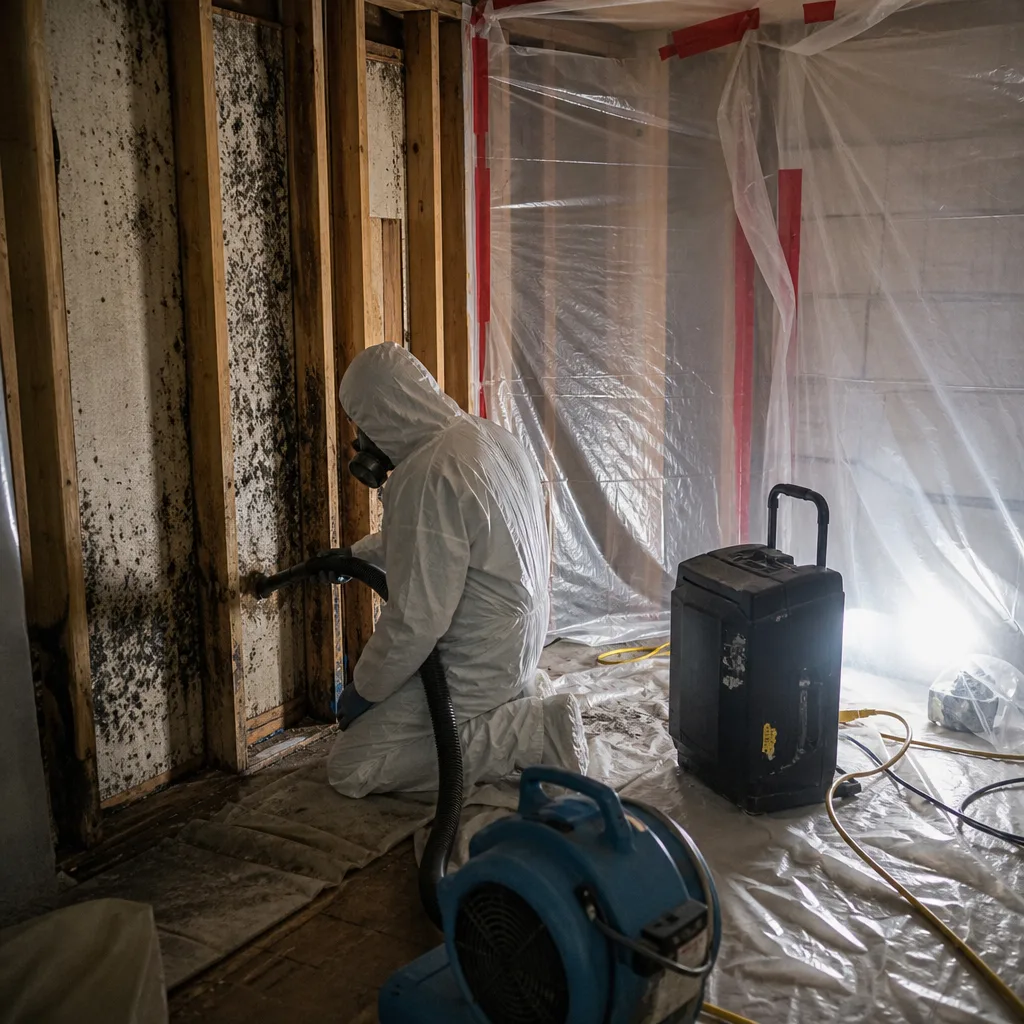
Before we cut anything, we seal the work area under negative air pressure so the spores we disturb don’t drift into your living room. South Farmingdale basements usually have open stairways, so proper containment here means sealing that entire stairwell path. Then we remove the mold-damaged drywall, insulation, and any soaked flooring back to clean substrate. On Cape Cods with multiple flooring layers, we test before we tear, not after.
Structural Drying and Verification
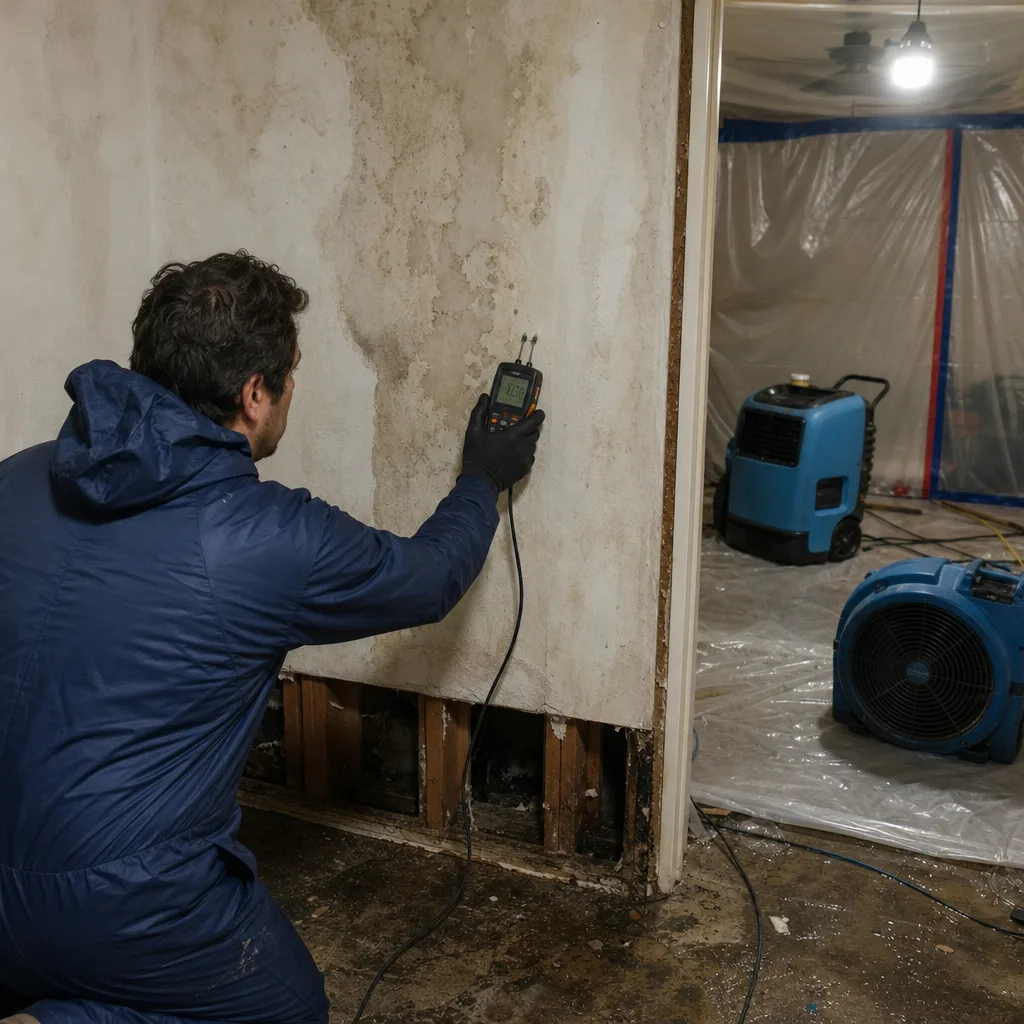
Once contaminated materials are out, the real work is drying the block walls and slab to a target moisture content. We use equipment from Phoenix and XPOWER, with air movers and dehumidifiers sized for the actual moisture load. Psychrometric readings (measuring the moisture in the air and surfaces) tell us when the structure is genuinely dry, not just dry to the touch. A wall that still reads 18% moisture will grow mold again within a season, no matter how much antimicrobial spray you put on it.
What happens when you call
- 1
A real person answersNo phone trees - you reach a local pro.
- 2
You get an upfront price rangeHonest numbers before anyone is dispatched.
- 3
A background-checked tech heads outLicensed & insured, dispatched right away.
- 4
You approve before work beginsNothing starts until you say go.
Professional Mold Removal in South Farmingdale
Professional Mold Removal in South Farmingdale means removing the mold you can see and the colony you can’t. Mold roots penetrate porous materials like drywall and carpet padding, so surface cleaning alone leaves the structure compromised. In South Farmingdale’s block-foundation homes, we routinely find mold behind baseboards and inside wall cavities that never showed on the visible wall surface. A professional removal job in a typical 20-by-20 South Farmingdale basement usually falls between $1,800 and $4,200, and it includes HEPA vacuuming of all surfaces in the affected area, not just the visible patches.
Black Mold and Air Quality
Black mold calls from South Farmingdale homeowners often start with a worry, not a visible problem: a cough that won’t quit, a musty smell that comes and goes, a dark stain behind the washer. We take those calls seriously and we don’t panic you. The first step is moisture mapping and air or surface testing to find out what’s actually there. Then we give you a written answer about what we found, what it means, and what removal involves. Air quality restoration follows removal, with HEPA air scrubbers running until spore counts in the contained area drop back to a normal indoor range.
Crawl Space Treatment
South Farmingdale’s older homes often have crawl spaces under the rear additions or enclosed porches that never got the attention the basement did. These spaces sit close to the ground, and with the area’s high water table, they stay damp year-round. Crawl space treatment here means installing vapor barriers, sealing entry points, and drying the floor joists above. Prices for crawl space mold treatment in South Farmingdale typically run $1,200 to $3,800 depending on square footage and access.
Trusted Brands We Service in South Farmingdale
We run restoration-grade equipment in South Farmingdale homes every day, and homeowners hear the brand names because the tools are in the truck when we arrive. Phoenix dehumidifiers and B-Air air movers are our primary drying platforms, and we stock parts locally for fast turnaround when a unit needs attention mid-job. For low-profile drying in tight Cape Cod basements, we use XPOWER fans that fit under ductwork and behind furnaces where standard equipment won’t go. That matters in South Farmingdale’s older homes, where floor joists are often only 7 feet off the slab. The same gear we run on commercial losses gets applied to your basement, and it’s operated by technicians credentialed through IICRC, RIA, and IFA.
Common Mold Remediation Problems We See in South Farmingdale Homes
- Block walls that never actually dried. After a flood or heavy rain event, homeowners dry the carpet and call it done. But the block walls behind the drywall hold moisture for weeks. We see mold return within a season because the wall was never dried to a target moisture content, just surface-dried.
- Asbestos tile hiding under wet flooring. The 1948-1965 housing stock in South Farmingdale routinely has original 9×9 asbestos vinyl tile under two or three later flooring layers. A water event soaks the top layers, and a tear-out that doesn’t test first creates an unlicensed abatement situation. We test before we cut, and we build abatement sequencing into the written scope.
- Oversized detached workshops with hidden pockets. Many South Farmingdale properties have detached garages or workshops added after the original build. These structures have bigger doors, different airflow, and often uninsulated walls. Standard drying equipment sizing doesn’t account for the moisture load behind workshop walls, and a quick moisture reading misses it. We size equipment for the actual structure, not the square footage on a chart.
- The smell migrates, the mold doesn’t. In block-foundation Cape Cods, the damp smell can show up in a hallway closet while the mold colony is on the opposite foundation wall. Homeowners sometimes have us test the wrong room because the smell travels. We map the whole foundation before we sample, not just the room that smells.
Pricing for Mold Remediation in South Farmingdale, NY
You deserve actual numbers before you make a call. For a South Farmingdale basement mold job involving drywall removal and drying, count on $2,500 to $5,500. That includes containment, demolition of affected materials, HEPA vacuuming, antimicrobial application, and drying equipment until the structure passes verification. Crawl space treatment runs $1,200 to $3,800. Black mold testing and air sampling typically runs $350 to $700 when it’s done as part of the initial assessment. If old asbestos tile or lead paint is discovered, abatement steps add $1,500 to $4,000 more depending on the area. These are the South Farmingdale market ranges we quote from, and every job gets a written price before work starts, not an estimate that moves after demo begins. Call (910) 613-6568 for a free estimate on your specific home.
We Also Serve Cities Near South Farmingdale
Our South Farmingdale crews also take mold remediation calls in the surrounding area. We handle basement and crawl space work in Brooklyn, Queens, Manhattan, and The Bronx, and our Mold Remediation team applies the same written-price, Threshold Verified standard on every job in every borough. If your home sits near the Nassau-Suffolk line or in a nearby city, call and we’ll send a crew that knows the water table and the housing stock.
Serving South Farmingdale, NY - Our Local Coverage Area
We’re based in the South Farmingdale area and know this community well. Use the map below to see our service coverage - if you’re nearby, we can almost certainly help.
FAQs About Mold Remediation in South Farmingdale
Mold returns because the block foundation wall is still wicking groundwater, and no surface drying fixes that. South Farmingdale sits on one of Long Island’s highest residential water tables, so the moisture is coming from outside the wall, not inside the room. The fix is drying the wall itself to a target moisture content and, in many cases, addressing exterior drainage or installing a vapor barrier. A surface-only cleanup will fail within a season, which is why our Mold Remediation process always starts with moisture mapping across the full foundation wall. For a wall reading on your basement, call (910) 613-6568.
Yes, and it’s the defining pattern here. South Farmingdale’s low elevation and proximity to the Massapequa and Wantagh flood zones mean the water table rises during any heavy rainfall, even when there’s no surface flooding. The groundwater pushes through aging block foundations and keeps basements damp all year. Nor’easter season makes it worse, but we take South Farmingdale groundwater mold calls in July and February at about the same rate. December through March, when the ground is saturated and the heat runs, is often the worst stretch.
Yes, if the old flooring is asbestos 9×9 vinyl tile or if lead paint is present and sanding or demolition disturbs it. In South Farmingdale’s 1948-1965 housing stock, original asbestos tile is common, typically under two or three later flooring layers. If a wet carpet sits on top of it, pulling the carpet disturbs the tile and releases fibers. That’s an abatement project by definition. On a recent Cape Cod off Merritts Road near the Bethpage State Parkway, our techs found exactly this situation. We set containment, ran dehumidification with XPOWER and Phoenix units on a four-day drying log, and folded licensed tile abatement into the written scope before any refinishing. The homeowner got one project plan instead of a surprise compliance problem mid-job. Call (910) 613-6568 for a scope that accounts for these layers before we cut anything.
Within 24 to 48 hours for a real chance to avoid mold colonization. In South Farmingdale’s climate, elevated indoor humidity plus wet drywall or carpet means colonization can start in 48 to 72 hours. But the bigger local issue is the groundwater. If water got in through the block walls rather than a pipe, the wall itself is saturated and it won’t dry on its own. Every day of delay means more drywall gets cut out and a larger remediation project. A live person answers our phone 24 hours a day at (910) 613-6568, including holidays.
Yes, because those structures change the airflow and moisture-load math. A detached workshop with an oversized door and no insulation doesn’t dry the same way a conditioned basement does. Standard equipment sizing based on square footage alone will leave hidden pockets behind workshop walls that never register on a quick reading. We size drying equipment for the actual structure, run moisture readings across the entire wall system, and account for the fact that outside air keeps pushing humidity back in. South Farmingdale’s larger lots mean these workshops are common, and we treat them as their own drying project, not an afterthought. Call (910) 613-6568 and tell us about the workshop; we’ll factor it into the written scope.
Written by Tobias Reyner, Owner at Marsh Water Damage Restoration, serving South Farmingdale and the surrounding area since 2005.