

Free visual inspection and a written scope of work before any mitigation begins - photos, moisture readings, and drying logs go in your claim file
The scope we write is the scope we bill. Anything new gets shown to you, in writing, before we touch it.






 Before
 After
After Before
 After
After Before
 After
AfterFast, Reliable Mold Remediation Across White Meadow Lake
Mold remediation in White Meadow Lake typically runs between $1,800 and $6,500 depending on how far the water has traveled through the structure, and in this community the answer is usually further than you’d think. Homes here don’t just get wet from rain. They get wet from the lake pushing up through the ground. That changes the whole scope of a mold job, and it’s why you want a crew that understands White Meadow Lake’s converted seasonal bungalows before they ever cut into a wall.
If you smell something damp and can’t find the source, don’t wait it out. Call (910) 613-6568 and a live person answers. Day or night. We’ll ask what you’re seeing, what you’re smelling, and whether you’re on a lakefront street or further up the hill. That one question tells us a lot about where to look first.
Why Marsh Water Damage Restoration Is White Meadow Lake’s Preferred Mold Remediation Company
White Meadow Lake is a private lake community where hundreds of homes sit at or near the water’s edge. That’s not a detail we learned from a map. It’s something we deal with on nearly every call here. The lake itself is a direct, recurring flood source. Spring snowmelt drains off the surrounding Morris County Highlands toward the lake, the water table rises under the homes, and moisture enters from below. A crew that treats every White Meadow Lake job as a standard storm call will dry the living room and miss the crawl space entirely. That’s how mold comes back.
The housing stock matters too. Most homes here were built between roughly 1950 and 1975 as seasonal lake cottages, then converted to year-round residences. They were never designed for full-time occupancy. Minimal insulation, no original vapor barriers, and DIY additions that bypassed modern building standards. We’ve worked on enough of them to know that water intrusion from below is just as common as intrusion from above. Restoring these homes means opening subfloor systems, rim joists, and uninsulated wall cavities that newer construction would rarely require.
Tobias Reyner leads our remediation team, and every technician we send to White Meadow Lake is background-checked, identity-verified, uniformed, and photo-badged. Before a tech arrives, you get their name and photo. At the door, they show a photo ID. That’s the Threshold Standard, applied to every single visit, not just the first one. We’ve been operating this way since 2005, and we don’t make exceptions for busy seasons.
Mold Removal Service in White Meadow Lake
Mold Removal Service in White Meadow Lake means removing visible mold growth and the moisture source feeding it. In the converted bungalows along Lake Shore Drive and up toward the private beach, that source is often the crawl space. A homeowner sees black staining on a baseboard and assumes the problem is in that room. Our technicians pull moisture readings from the stem wall, the rim joist, and the subfloor before deciding where to cut. Surface-level treatment fails here. The mold colony is almost always deeper.
Most mold removal jobs in White Meadow Lake run between $1,800 and $3,500 when the contamination is contained to one room or a crawl-space section. If framing members need antimicrobial treatment and the cavity needs to be dried before closing, expect the higher end of that range. We give you a written price before any work starts. Not an estimate that grows after demolition begins. A written price.
Containment and Controlled Demolition
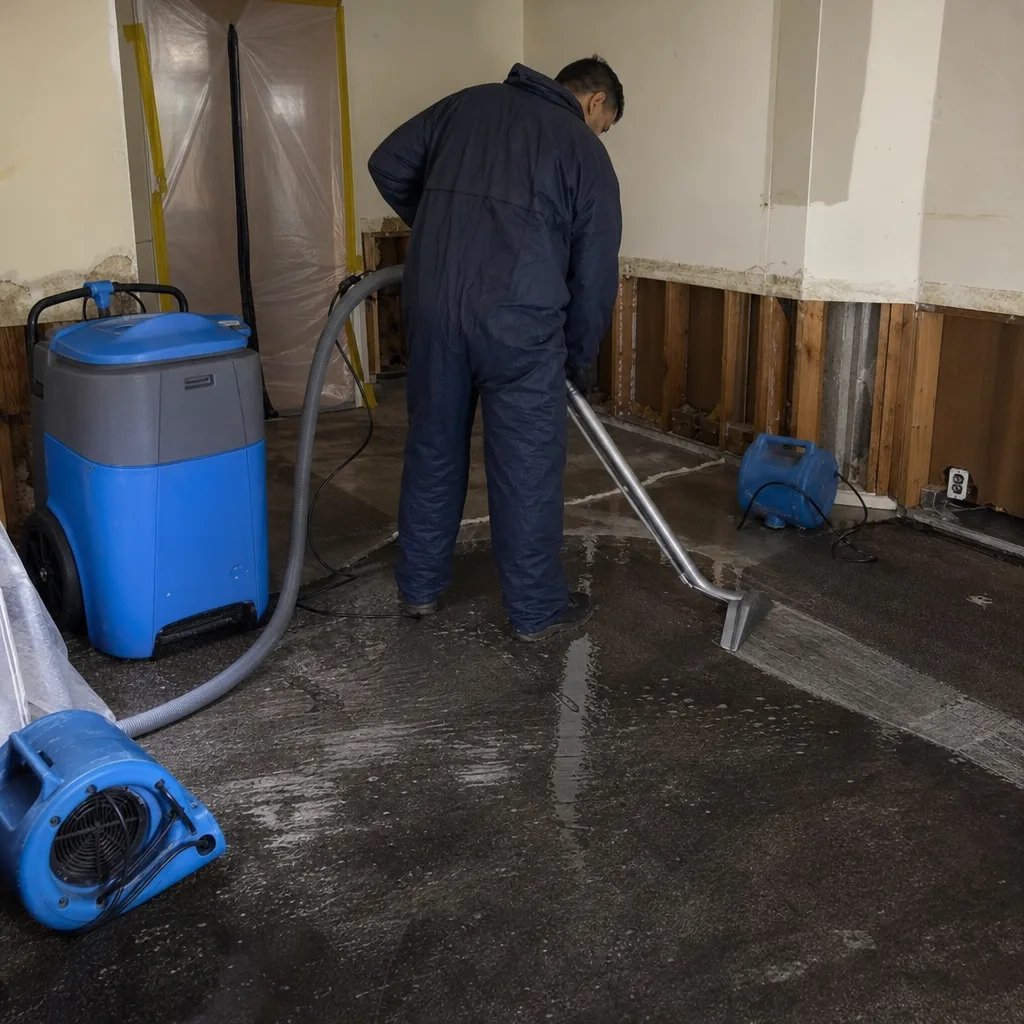
Before we pull any material, we set containment so spores don’t spread into living areas. In a small lake cottage, that means sealing doorways and running negative air pressure. Then we remove the wet drywall, insulation, and any finished flooring that reads high on a moisture meter.
Antimicrobial Treatment and Drying
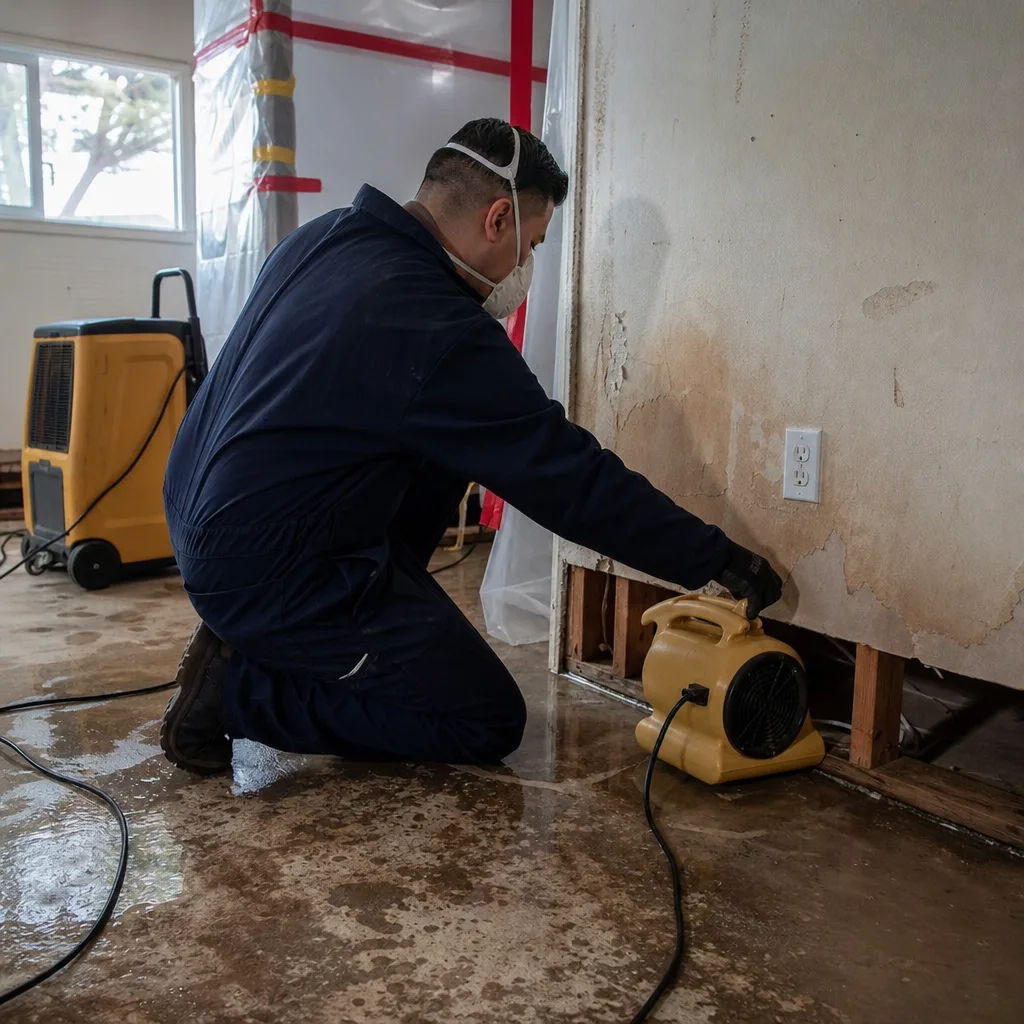
After the affected material is out, we treat the remaining framing with an antimicrobial agent and set drying equipment matched to the structure. Crawl spaces in these older homes need specific airflow patterns, not just a fan pointed at wet wood. We monitor moisture daily until drying logs show the structure is physically dry, not just dry to the touch.
Mold Remediation Services in White Meadow Lake
Mold Remediation Services in White Meadow Lake go beyond surface cleanup. This is the full protocol: identify the moisture source, contain the area, remove contaminated material, treat remaining surfaces, dry the structure, and verify the result. On a lakefront street, the moisture source is often the lake itself. Cold groundwater presses against foundation walls. Heavy freeze-thaw cycles in the Morris County Highlands crack mortar joints. Low-pitched 1960s roofs ice-dam and send meltwater down inside wall cavities. Every one of these failure points needs to be addressed, or the mold returns.
Remediation scopes in White Meadow Lake typically run between $3,000 and $6,500. The range reflects how much of the structure is involved. A single wall cavity with wet insulation is on the lower end. A crawl space with wet rim joists, subfloor damage, and uninsulated wall cavities that need to be opened is the higher end. We document everything. Photo documentation before, during, and after. Direct insurance billing when you need it. Your adjuster gets the same pictures we use to build the scope.
Crawl Space Treatment and Vapor Barriers
Many White Meadow Lake cottages sit over dirt crawl spaces with no vapor barrier at all. Ground moisture rises continuously, wetting floor joists even when no flood event has occurred. We treat the framing, then address the source. Installing or repairing a vapor barrier here isn’t an upsell. It’s the difference between a one-time remediation and a recurring mold problem.
Air Quality Restoration
After structural drying is complete, we run air scrubbers to pull airborne spores and particulates down before homeowners move back into the space. In these small cottages, the interior air volume is low and the turnover is quick. We verify with air sampling when the job requires it, and we provide the results in writing.
What happens when you call
- 1
A real person answersNo phone trees - you reach a local pro.
- 2
You get an upfront price rangeHonest numbers before anyone is dispatched.
- 3
A background-checked tech heads outLicensed & insured, dispatched right away.
- 4
You approve before work beginsNothing starts until you say go.
Trusted Brands We Service in White Meadow Lake
We run Dri-Eaz dehumidifiers, Phoenix desiccants, XPOWER air movers, and B-Air filtration units on our White Meadow Lake jobs. These are the same machines used on large commercial losses, sized down for residential work. The equipment matters in these older homes because the materials hold water differently than modern construction. A big-box rental fan won’t dry a rim joist. We bring what the structure actually needs, and we stock the consumables and replacement filters locally, so White Meadow Lake jobs don’t stall waiting on parts from out of state.
Common Mold Remediation Problems We See in White Meadow Lake Homes
- Ground-up flooding from the lake. On the lowest-elevation lakefront streets off Pawnee Avenue, water enters through foundation walls and stem walls before any rain comes through the roof. The crawl space floods first, and by the time a homeowner notices damp drywall upstairs, the rim joist and subfloor have been wet for days.
- Converted seasonal bungalow construction. Homes built between 1950 and 1975 as summer cottages have no vapor barrier, minimal insulation, and crawl spaces with exposed dirt floors. Mold colonization after a water event is faster and deeper than in a conventionally built home from the same era.
- Surface-level drying that leaves hidden cavities wet. In these low-insulation structures, the finished floor can read dry while the subfloor system underneath is saturated. Remediation crews that only check surface readings miss the core problem, and mold returns within weeks.
- Deferred calls on “musty smells.” Mold can begin growing on wet drywall within 24 to 48 hours in these warm, low-airflow cottages. By the time the smell is strong enough to notice, the colony is established in wall cavities that DIY additions have kept sealed and hidden.
Pricing for Mold Remediation in White Meadow Lake, NJ
Here’s what White Meadow Lake homeowners should expect. A contained, single-room mold removal with antimicrobial treatment runs $1,800 to $3,500. A full crawl space remediation with rim joist treatment, vapor barrier repair, and structural drying runs $3,500 to $5,500. When multiple rooms and wall cavities are involved, full remediation typically lands between $4,500 and $6,500. What pushes a job toward the top of the range: uninsulated exterior wall cavities that must be opened, subfloor replacement, and air quality verification with documented sampling. We deliver a written price before any work begins. No verbal estimate that balloons after demo. No surprise line items. If you’d like a free estimate for your White Meadow Lake home, call (910) 613-6568.
We Also Serve Cities Near White Meadow Lake
Our mold remediation crews serve White Meadow Lake and the surrounding northern New Jersey communities, including Newark, Jersey City, Paterson, and Elizabeth. If you’re in one of those areas and dealing with water damage or mold, our Mold Remediation team can help. For more detail on our local service area, see Mold Remediation in White Meadow Lake.
Serving White Meadow Lake, NJ - Our Local Coverage Area
We’re based in the White Meadow Lake area and know this community well. Use the map below to see our service coverage - if you’re nearby, we can almost certainly help.
FAQs About Mold Remediation in White Meadow Lake
White Meadow Lake sits in a natural drainage basin within the Morris County Highlands. Spring snowmelt and heavy rain drain toward the lake, raising the water table under lakeside homes. Groundwater presses against foundation walls and enters through stem wall cracks and the crawl space before any rain ever touches the roof. In converted 1950s and 1960s seasonal bungalows with no vapor barrier, that ground-up wetting reaches the rim joist and subfloor quickly. If you see water seeping in at the base of a foundation wall, call (910) 613-6568 immediately. This is a ground-up intrusion, and it needs full crawl-space extraction and drying, not a ceiling-down approach.
Mold can begin growing on wet drywall within 24 to 48 hours in these low-insulation cottages. The original seasonal construction means warm interior air hits cold, uninsulated wall cavities, creating condensation that keeps materials damp long after the visible water is gone. DIY additions that bypassed modern vapor barriers hold moisture even longer. If you see staining or smell something musty, don’t wait. The sooner containment and drying start, the less material has to be removed. Call (910) 613-6568 for an assessment.
Usually, yes. In a converted seasonal bungalow, the mold colony is rarely just on the surface. Wet insulation inside a wall cavity, a saturated subfloor under a dry-looking finished floor, and colonized rim joists in the crawl space all require controlled demolition to access. We don’t open more than necessary, but we also won’t treat only the visible surface and leave the hidden colony active. Our written scope shows exactly what we plan to open and why before any work begins.
We use Dri-Eaz dehumidifiers, Phoenix desiccants, XPOWER air movers, and B-Air filtration units on White Meadow Lake crawl space jobs. The technicians operating them are credentialed through IICRC, RIA, and IFA. We set airflow patterns specific to low-clearance crawl spaces, monitor moisture daily with pin-type and non-invasive meters, and keep drying logs until the structure is verified dry. That’s what the job requires here. Call (910) 613-6568 to schedule an assessment.
Yes. We categorize the water source as part of the initial assessment. Groundwater from the lake, snowmelt runoff, and any water that has traveled through soil or foundation cracks is Category 3, which means it carries contaminants. That affects the remediation scope: more containment, more material removal, and antimicrobial treatment on any framing the water touched. On a lakefront street, we assume ground-up intrusion is Category 3 until we confirm otherwise. Call (910) 613-6568 and we’ll walk you through what we’re checking.
If mold is spreading in your White Meadow Lake home, don’t wait until the smell gets worse. Our crews know these converted lake cottages, we know where the water comes from, and we know what has to come out before the drying can even start. Call (910) 613-6568 for a free estimate. A live person answers, day or night.
Written by Tobias Reyner, owner at Marsh Water Damage Restoration, serving White Meadow Lake since 2005.